يشهد السوق العالمي تحولًا عميقًا، مدفوعًا بالحاجة الملحة إلى الاستدامة. بالنسبة لمديري المشتريات، ومديري العمليات، ومسؤولي الاستدامة، والمديرين التنفيذيين لسلسلة التوريد، يمثل هذا التحول تحديًا كبيرًا وفرصة مقنعة، لا سيما في قطاع المنتجات ذات الاستخدام الواحد. من المتوقع أن يشهد سوق القش القابل للتحلل الحيوي، وهو نموذج مصغر لهذا الاتجاه الأكبر، نموًا هائلاً، حيث تتوقع بعض التحليلات ارتفاعًا من ما يقدر بـ 300 مليون دولار أمريكي في عام 2023 إلى أكثر من 890 مليون دولار أمريكي بحلول عام 2032، مما يعكس معدل نمو سنوي مركب قوي بنسبة 13.2٪ (CAGR). التوقعات الأخرى أكثر طموحًا، حيث تتوقع قفزة من 40.367 مليار دولار أمريكي في عام 2024 إلى 204.167 مليار دولار أمريكي بحلول عام 2031، بمعدل نمو سنوي مركب مذهل يبلغ 22.46٪.
This rapid expansion, however, is inseparable from a complex web of Customs Regulations و Import Compliance requirements. Businesses that fail to grasp and meticulously navigate these intricacies risk substantial operational disruptions, financial penalties, and irreversible damage to their brand reputation. Ensuring seamless market entry for القش القابلة للتحلل is not merely about sourcing eco-friendly alternatives; it’s about mastering the regulatory landscape to mitigate risks and secure a competitive edge.

The Global Imperative: Why Biodegradable Straws are Essential
إن ضرورة التحول عن المواد البلاستيكية التقليدية تنبع مباشرة من بصمتها البيئية المدمرة. على سبيل المثال، يمكن أن تستمر الشفاطات البلاستيكية التقليدية في النظم البيئية لمدة تصل إلى 500 عام، وتتفتت إلى جسيمات بلاستيكية دقيقة تتسلل إلى السلسلة الغذائية والمحيطات. وفي تناقض صارخ، يمكن أن تتحلل الشفاطات الورقية أو النباتية المصممة جيدًا في غضون أسابيع أو أشهر فقط، مما يقلل بشكل كبير من تأثيرها البيئي.
وقد حفزت هذه الإلحاح البيئي موجة من حظر استخدام البلاستيك مرة واحدة في جميع أنحاء العالم. يحظر توجيه الاتحاد الأوروبي للمواد البلاستيكية ذات الاستخدام الواحد (SUPD)، اعتبارًا من يوليو 2021، على نطاق واسع معظم الشفاطات البلاستيكية، بغض النظر عما إذا كانت تحمل علامة "مصدر حيوي" أو "قابلة للتحويل إلى سماد منزلي"، إذا كانت تحتوي على أي مكون بلاستيكي. وبالمثل، فإن لوائح حظر البلاستيك ذات الاستخدام الواحد في كندا (SUPPR)، والتي دخلت حيز التنفيذ في ديسمبر 2022، توسع هذا الحظر ليشمل الشفاطات المصنوعة من المواد البلاستيكية التقليدية أو القابلة للتحلل أو القابلة للتحلل الحيوي، مع استثناءات محدودة.
وتتفاقم هذه التحولات التنظيمية بسبب التغير العميق في تفضيلات المستهلكين والشركات. وتُظهِر الأجيال الشابة، على وجه الخصوص، تفضيلاً قوياً للخيارات المستدامة. لقد التزم عمالقة الصناعة مثل ستاربكس وماكدونالدز بالفعل بالتخلص التدريجي من الشفاطات البلاستيكية على مستوى العالم، وهي خطوة تستجيب لهذا السوق المتطور وتدفعه. ونتيجة لذلك، العالمية القش القابلة للتحلل يشهد السوق طلبًا غير مسبوق، مما يؤكد صحة توقعات النمو الكبيرة ويؤكد الضرورة التجارية للشركات لتأمين مصادر متوافقة ومستدامة.

فك رموز لوائح الاستيراد الرئيسية للقش القابل للتحلل
Successful importation of biodegradable straws hinges on a granular understanding of destination market regulations. Ignorance of these rules can lead to seized shipments, significant fines, and logistical nightmares.
United States Import Compliance
All products entering the U.S. must adhere to a layered set of regulations enforced by agencies such as U.S. Customs and Border Protection (CBP), the Food and Drug Administration (FDA), and the Department of Agriculture (USDA).
- HTS Classification for Biodegradable Straws: Accurate Harmonized Tariff Schedule of the United States (HTSUS) classification is fundamental. Polylactic acid (PLA) straws, derived from corn starch, are typically classified under HTSUS 3917.32.0050. This classification applies to “tubes, pipes and hoses and fittings therefor… of plastics, other, not reinforced or otherwise combined with other materials, without fittings, other.” The standard general duty rate for these is 3.1% ad valorem.
- FDA Compliance for Food Contact Materials: As food contact substances, biodegradable straws must meet stringent FDA safety standards. This ensures that the materials do not leach harmful chemicals into beverages.
- Additional Duties and Trade Remedies: Importers must also be aware of potential additional duties. For instance, products from China may incur an additional 25% ad valorem duty under HTSUS 9903.88.02, as seen with similar starch-based plastic items. Staying updated on Section 301 tariffs and other trade remedies is critical for cost predictability.
Canadian Single-Use Plastic Bans and Exceptions
Canada’s SUPPR represents one of the most comprehensive bans globally. Effective December 20, 2022, it prohibits the manufacture and import for sale in Canada of most plastic straws, critically including those marketed as “biodegradable” plastic.
- Flexible Straw Exceptions: To ensure accessibility for individuals with disabilities, the SUPPR does allow for the manufacture and import of flexible single-use plastic straws under strict conditions. These can only be sold in packages of 20 or more, must not be publicly displayed, and can only be provided upon request.
- CBSA Enforcement: The Canada Border Services Agency (CBSA) plays a crucial role in enforcing these regulations at the border, working in collaboration with Environment and Climate Change Canada (ECCC). Shipments found to be non-compliant will be referred to ECCC’s Enforcement Branch, leading to potential penalties.
China’s National Standards for Biodegradable Straws
China, a significant producer and consumer, has also established robust national standards. GB/T 41008-2021, effective June 1, 2022, outlines technical and biodegradability requirements for drinking straws.
- Mandatory Food-Contact Materials: These standards mandate the use of approved food-contact biodegradable plastics such as PLA, PBS, PBAT, and PHAs, or natural polymeric materials.
- Labeling and Certification Requirements: Packaging must include detailed product information and a specific biodegradability mark, as defined by GB/T 41010-2021. Furthermore, as of January 1, China has banned the import and transshipment of non-degradable disposable plastic straws and stirrers.
Navigating HTS Classification and Duty Rates for Biodegradable Straws
Accurate HTS Classification is not a mere administrative step; it is paramount for determining applicable duty rates, ensuring smooth customs clearance, and avoiding costly penalties. Misclassification can result in delays, fines, and even seizure of goods.
For businesses importing into the U.S., understanding specific duty rates is crucial. As noted, PLA straws (HSUS 3917.32.0050) face a 3.1% ad valorem duty rate. However, the complexity can increase with origin-specific tariffs, such as the Section 301 Trade Remedy Duties. For example, starch-based plastic plates originating from China have been subjected to an additional 7.5% duty under HTSUS 9903.88.15. These duties directly impact landed costs and profit margins.
Given the potential for complex classifications and the significant financial implications, importers can obtain a binding ruling from U.S. CBP (19 CFR Part 177). This legally binding decision provides certainty on how specific products will be classified and assessed duties, offering a proactive strategy to prevent future disputes. For further details on classification and compliance, the U.S. Customs and Border Protection website offers extensive resources on import guidelines and tariff schedules.
Essential Certifications and Standards for Compostable Straws
The terms “biodegradable” and “compostable” are often used interchangeably, yet they carry distinct meanings with profound implications for compliance and environmental integrity. While all compostable products are biodegradable, not all biodegradable products are compostable. قابل للتسميد is generally considered the “gold standard” in the industry, signifying a product’s ability to break down into nutrient-rich compost, water, and CO2 within a specific timeframe and under controlled conditions, without leaving harmful residues. This distinction is critical for businesses making sustainability claims. For a deeper understanding of these differences, explore our comprehensive guide on Compostable vs. Biodegradable Straws: A B2B Guide.
Key Certifications for Industrial Compostability:
To ensure products meet these rigorous standards, several reputable certification bodies provide verification:
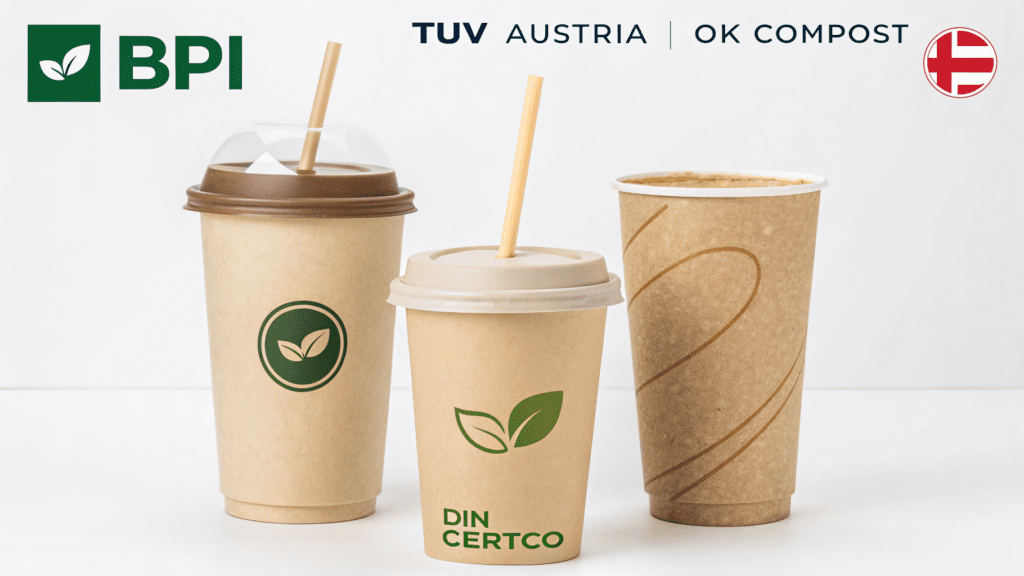
- BPI Certification (North America): The Biodegradable Products Institute (BPI) is a leading authority in North America, verifying compliance with ASTM D6400 (“Standard Specification for Labeling of Plastics Designed to be Aerobically Composted in Municipal or Industrial Facilities”) and ASTM D6868 for industrial composting. A product bearing the BPI logo offers verifiable proof of its compostability. For more on this, refer to our BPI Compostable vs. Biodegradable Sustainability Guide.
- TÜV AUSTRIA (Europe): This international certification body offers “OK compost INDUSTRIAL” and “OK compost HOME” certifications, aligning with the European standard EN 13432. TÜV AUSTRIA also provides certifications for marine and soil biodegradability, catering to diverse end-of-life scenarios.
- DIN CERTCO: A German certification body that awards the “DIN-Geprüft Compostable” mark, also signifying compliance with EN 13432.
The Rigors of Industrial Compostable Straws:
For a product to be certified as industrial compostable under ASTM D6400 and EN 13432, it must:
- Biodegrade at least 90% within six months.
- Disintegrate to less than 10% of its original dry weight in a 2mm screen after 12 weeks.
- Be non-toxic and free from heavy metals or fluorine compounds (including PFAS).
Home Compostable Straws Defined:
While more accessible for consumers, home compostable straws adhere to different criteria:
- Must biodegrade at least 90% within one year (ISO 14855).
- Disintegrate at least 90% to less than 2mm after 26 weeks (ISO 20200).
- Must also be non-toxic and free of heavy metals or fluorine.
Beyond certification, businesses must also be mindful of consumer protection regulations. In the U.S., the Federal Trade Commission (FTC) regulates environmental marketing claims, aiming to prevent misleading information about product biodegradability. In Europe, Extended Producer Responsibility (EPR) schemes in many countries require exporters and brands to register and report on packaging materials, including their end-of-life management, adding another layer of compliance.
Understanding the Environmental Impact and Decomposition of Biodegradable Straws
The term “biodegradable” itself masks a critical nuance: the true environmental impact of a straw depends heavily on its material composition and the specific environment in which it is disposed. Without the right conditions, even “biodegradable” plastics like PLA may not decompose effectively in natural environments and can still contribute to microplastic pollution.
Decomposition studies highlight these complexities. Research comparing paper, hay, bamboo, PLA, and sugarcane husk straws across various simulated environments (water, ocean water, hydrochloric acid, compost) found that hay straws demonstrated the most efficient decomposition, with a significant 61% mass decrease in compost within 30 days. Conversely, PLA straws consistently showed the least decomposition across all tested conditions. This underscores that lighter organic materials, due to their inherent fragility and ease of microbial breakdown, often decompose more efficiently.
While paper straws are widely adopted as an alternative, they face challenges such as becoming soggy and collapsing in beverages. This has spurred innovation, with ongoing research into water-stable, strong, and truly biodegradable lignocellulose straws (LCSs) that could fully biodegrade within 30 days of soil burial, comparable to pine-based paper straws. Further breakthroughs are emerging, such as a novel microbial consortium that achieved mature compost from rice straw within just 25 days, significantly faster than traditional composting methods, as published in the World Journal of Microbiology and Biotechnology in 2022. This kind of research informs the future of truly effective biodegradable solutions, particularly for materials like rice and rice bran. For businesses targeting marine environments, understanding these material nuances is vital; our guide on Marine Biodegradable Straws for Hospitality and Foodservice provides relevant insights.
Operational Impacts and ROI: The Business Case for Biodegradable Straws
Investing in compliant القش القابلة للتحلل is not merely a cost of doing business in a regulated world; it’s a strategic move that delivers tangible operational benefits and significant return on investment (ROI). Non-compliance can lead to severe penalties, supply chain disruptions, and reputational damage. Conversely, proactive adherence positions a business for market leadership and enhanced brand value.
This table highlights the strategic implications for businesses investing in compliant القش القابلة للتحلل:
| ميزة | التأثير التشغيلي B2B | ملاحظة الامتثال | إمكانات العائد على الاستثمار |
|---|---|---|---|
| Material Composition | Dictates sourcing, production costs, and product performance (e.g., sogginess for paper). | Must align with FDA food-contact rules, and national/regional bans (e.g., EU SUPD). | Reduced environmental fees, enhanced brand reputation, access to green markets. |
| Certification (BPI, TÜV) | Streamlines market access; validates sustainability claims; boosts consumer trust. | Mandatory for “compostable” claims in many U.S. states and EU countries. | Higher sales to eco-conscious buyers; premium pricing; avoiding misleading claims penalties. |
| HTS & Duty Compliance | Affects landed costs, supply chain predictability, and financial planning. | Incorrect classification leads to penalties (e.g., 3.1% duty for PLA straws, plus potential 25% for China origin). | Cost savings from avoiding fines; efficient customs clearance; predictable logistics. |
| Regulatory Tracking | Requires dedicated resources for continuous monitoring of evolving bans and standards. | Canada’s SUPPR prohibits “biodegradable plastic” straws; US federal agencies shifting away from paper straws (Feb 2025). | Proactive adaptation reduces disruption; competitive advantage in compliant markets; fosters long-term viability. |
Beyond the direct financial implications, businesses that demonstrably commit to sustainable, compliant sourcing through certified biodegradable straws can benefit from enhanced brand perception, attracting environmentally conscious consumers and bolstering their corporate social responsibility profile. This strategic alignment with global sustainability goals translates into significant market share opportunity in a rapidly evolving landscape.
Case Studies: Leading the Shift to Sustainable Straws
Global brands have been at the forefront of the shift away from plastic straws, demonstrating both the challenges and opportunities inherent in this transition. Their experiences offer valuable lessons for any B2B decision-maker.
- Starbucks’ Global Phase-Out: As early as 2018, Starbucks, with its vast network of over 30,000 stores globally, committed to phasing out single-use plastic straws by 2020. This was a bold Strategic Sustainability Move aimed at significantly reducing plastic waste and enhancing its global brand perception. The initiative spurred a massive Impact on Supply Chain, shifting demand towards paper and other القش القابلة للتحلل alternatives. While the transition required significant investment in new product development and supplier relationships, it solidified Starbucks’ reputation as a leader in corporate environmental responsibility.
- McDonald’s Transition: McDonald’s also embarked on a similar journey, phasing out plastic straws in the UK and Ireland by 2018, with a broader global target of 2025. This move was a direct response to escalating Compliance and Consumer Pressure regarding single-use plastics. The transition, particularly in the UK, faced initial Sourcing Challenges related to paper straw durability. Early customer feedback highlighted issues with paper straws dissolving or becoming soggy too quickly. This prompted McDonald’s to continuously innovate and collaborate with suppliers to improve paper straw technology, showcasing the need for ongoing R&D and flexible supply chain partnerships in the sustainable packaging sector.
These case studies underscore that transitioning to biodegradable straws is not without its hurdles, particularly around product performance and supply chain stability. However, they also unequivocally demonstrate that proactive engagement with sustainability—driven by both regulatory foresight and consumer demand—is a powerful differentiator and a necessity for long-term market relevance.

Strategic Best Practices for Importing Biodegradable Straws
Navigating the complexities of Customs Regulations و Import Compliance for القش القابلة للتحلل requires a robust, proactive strategy. For procurement, operations, and sustainability leaders, adopting these best practices will streamline processes, minimize risks, and ensure uninterrupted market access:
- Due Diligence on Material Claims: Do not take “biodegradable” at face value. Demand scientific evidence and third-party certifications (like BPI, TÜV AUSTRIA, or DIN CERTCO) to verify true biodegradability and compostability claims. This protects your brand from greenwashing accusations and ensures genuine environmental impact reduction.
- Proactive Regulatory Monitoring: The landscape of حظر استخدام البلاستيك مرة واحدة و Customs Regulations is constantly evolving. Establish dedicated resources for continuous monitoring of new legislation, especially in target markets like the EU, Canada, China, and key U.S. states. Utilize official government websites and trade publications for the latest updates.
- Partnering with Customs Experts: For complex Import Compliance issues, engaging licensed customs brokers, trade attorneys, or specialized consultants is invaluable. Their expertise can help with accurate HTS classification, duty minimization strategies, and navigating specific agency requirements (CBP, FDA, USDA). They can also assist in obtaining binding rulings from U.S. CBP for specific products.
- Robust Record-Keeping: Maintain meticulous and detailed import transaction records for a minimum of five years, as required by CBP and other regulatory bodies. This includes purchase orders, invoices, shipping documents, certificates of origin, and any relevant compliance certifications. Adequate record-keeping is crucial for audits and resolving potential discrepancies.
- Supplier Vetting: Implement a stringent supplier vetting process that goes beyond price and volume. Ensure your suppliers can provide all necessary certifications (e.g., BPI, TÜV, FSC for paper products) and demonstrate compliance with labeling requirements for all target markets. Verify their quality control processes and environmental management systems.
By embedding these strategic practices into your supply chain and procurement operations, businesses can transform regulatory compliance from a reactive burden into a proactive component of their competitive advantage, ensuring efficient, ethical, and profitable sourcing of biodegradable straws.
Conclusion: Your Gateway to Compliant Biodegradable Straw Sourcing
The global shift towards sustainability mandates a strategic approach to sourcing القش القابلة للتحلل. Navigating the intricate web of Customs Regulations, Import Compliance, and evolving environmental standards is paramount for market access and operational success. By understanding HTS Classification, securing appropriate certifications, and staying abreast of حظر استخدام البلاستيك مرة واحدة, businesses can transform compliance from a hurdle into a competitive advantage. This foresight not only mitigates risks but also unlocks new market opportunities in a world increasingly prioritizing ecological responsibility.
Future-proof your supply chain and unlock new market opportunities. Partner with regulatory experts today to ensure seamless, compliant importation of biodegradable straws.