Das Navigieren in der Landschaft der nachhaltigen Verpackungs- und Abfallwirtschaft erfordert ein genaues Verständnis, insbesondere für Beschaffungs- und Betriebsleiter in der Hotel- und Gastronomiebranche. Die Begriffe „biologisch abbaubar“ und „kompostierbar“ werden oft synonym verwendet, was zu weitverbreiteter Verwirrung und möglichen Fehltritten im Betrieb führt. Diese semantische Mehrdeutigkeit stellt ein erhebliches Risiko für Unternehmen dar, die eine echte Compliance in den Bereichen Umwelt, Soziales und Governance (ESG) anstreben, und kann möglicherweise zu kostspieligen „Greenwashing“-Vorwürfen und ineffizienten Abfallströmen führen.
For B2B decision-makers, distinguishing between these terms is not merely an academic exercise; it’s a strategic imperative. The global compostable packaging market, valued at approximately USD 55.53 billion in 2024 (Grand View Research, 2024), is projected to reach USD 89.85 billion by 2032, exhibiting a Compound Annual Growth Rate (CAGR) of 6.20% from 2025 to 2032 (Precedence Research, 2023). This growth underscores a critical opportunity for businesses to align with evolving consumer expectations and regulatory landscapes. However, without a clear understanding of certified compostability, companies risk investing in solutions that fail to deliver promised environmental benefits or meet increasingly stringent compliance standards, impacting everything from supply chain efficiency to brand reputation. Ignoring this distinction can lead to increased waste disposal costs, regulatory fines, and significant brand damage in a market increasingly valuing genuine sustainability (Ellen MacArthur Foundation, 2022).
Das Verständnis dieser Unterscheidung ist für einen nachhaltigen B2B-Betrieb und die Vermeidung kostspieliger Greenwashing von entscheidender Bedeutung.
„Biologisch abbaubar“ verstehen: Eine weit gefasste und oft irreführende Behauptung
Der Begriff „biologisch abbaubar“ deutet darauf hin, dass ein Material auf natürliche Weise abgebaut wird, ist jedoch weitgehend unreguliert und nicht spezifisch für B2B-Anwendungen. Ohne klare Standards kann diese weit gefasste Definition effektive Abfallmanagement- und Nachhaltigkeitsinitiativen behindern und ein Minenfeld für ahnungslose Unternehmen schaffen.
Die unregulierte Natur der biologischen Abbaubarkeit: Risiken für Lieferketten
Das Hauptproblem bei „biologisch abbaubar“ liegt darin, dass es keinen definierten Zeitrahmen oder bestimmte Umweltbedingungen für die Zersetzung gibt. Während der Begriff den Abbau durch Mikroorganismen impliziert, könnte die Zersetzung eines als „biologisch abbaubar“ gekennzeichneten Produkts in Wirklichkeit „Hunderte von Jahren“ dauern. Entscheidend ist, dass es immer noch schädliche Rückstände hinterlassen oder sogar in Mikroplastik zerfallen kann, was genau die Umweltziele untergräbt, die es angeblich unterstützt.
The Federal Trade Commission (FTC) in the U.S. has explicitly warned businesses against making unqualified “biodegradable” claims, highlighting the significant risks of greenwashing. Such vague claims can mislead consumers and result in regulatory scrutiny. For instance, some “biodegradable” plastics, like oxo-degradable products, are essentially conventional plastics mixed with additives that cause them to disintegrate faster, yet they break down into countless microplastics that can severely contaminate the environment, rather than truly disappearing. This poses a significant reputational and compliance risk for supply chains that inadvertently incorporate such materials, especially for hospitality businesses managing high volumes of single-use items.
Why “Biodegradable” Falls Short for B2B Sustainability Goals
The inherent lack of specificity in “biodegradable” claims makes them inadequate for robust B2B sustainability strategies.
- No Defined Timeframe: Without a guaranteed timeframe, businesses cannot reliably predict or manage the end-of-life cycle for their products, leading to unpredictable waste accumulation and inefficient operational settings, particularly in fast-paced foodservice environments.
- Absence of Toxicity Testing: There is no required testing for toxic byproducts in generally “biodegradable” materials. This introduces environmental and reputational risks, as products could release harmful substances into soil or water.
- Consumer and Waste Facility Confusion: The ambiguity surrounding “biodegradable” confuses both consumers and waste management facilities, complicating proper disposal and increasing contamination rates in recycling or composting streams, a common issue in hotel waste management.
- Legal and Regulatory Vulnerability: The use of “biodegradable” in sales and marketing for single-use products is considered problematic and is even “potentially illegal” in some U.S. states, such as California (AB 1201), which bans such claims without third-party certification. This creates a clear compliance risk for businesses operating in regulated markets.
“Biodegradable” lacks clear standards, posing significant greenwashing and operational risks for businesses.
Defining “BPI Compostable”: The Gold Standard for Sustainable Operations
“BPI Compostable” signifies a rigorously tested and certified product designed to break down effectively in specific industrial environments, offering clear advantages for compliant and impactful B2B sustainability efforts. This certification provides a transparent, verifiable pathway to genuine circular economy contributions.
The Role of the Biodegradable Products Institute (BPI) in Certification
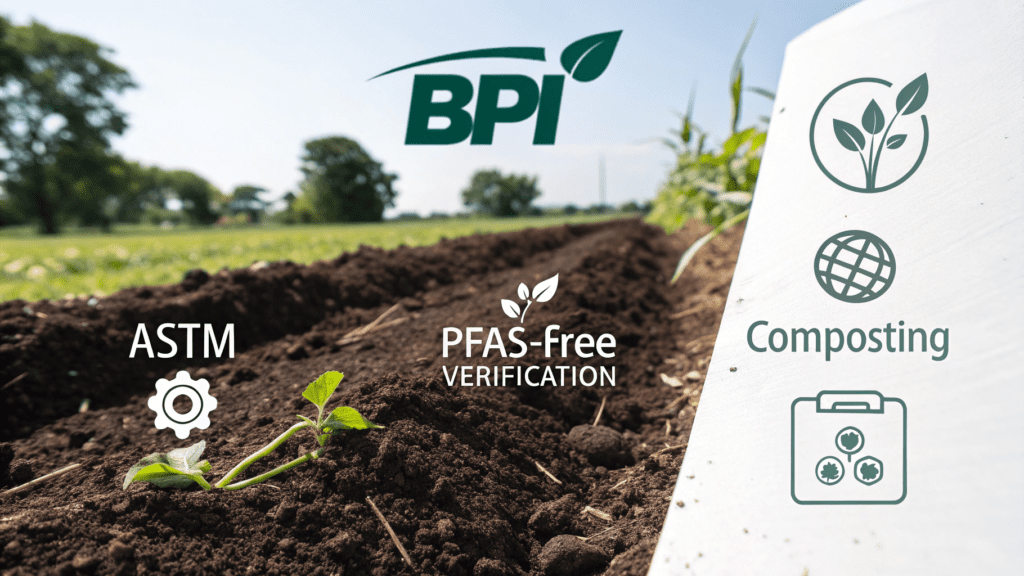
The Biodegradable Products Institute (BPI) is North America’s leading non-profit authority, established in 1999, dedicated to promoting and certifying compostable products and packaging. BPI certification is not just a label; it’s an independent, third-party verification that products meet stringent ASTM (American Society for Testing and Materials) standards for compostability.
Das BPI-Zertifizierungszeichen – ein eindeutiges Wirbeldesign – kennzeichnet Produkte, die speziell für die ordnungsgemäße Zersetzung in kommerziellen Systemen entwickelt wurden. Dieses Zeichen ist für Beschaffungsmanager und Betriebsleiter von unschätzbarem Wert, da es Kompostern hilft, echte kompostierbare Stoffe von ähnlichen zu unterscheiden und so kostspielige Kontaminationen in ihren Anlagen zu verhindern. Es ist ein klares Signal der Integrität und der Einhaltung wissenschaftlich fundierter Standards, was für den Vertrauensaufbau bei Abfallmanagementpartnern und Endnutzern von entscheidender Bedeutung ist, insbesondere in Gastronomiebetrieben mit hohem Durchsatz.
Erfüllung strenger ASTM-Standards für BPI-zertifizierte kompostierbare Materialien
Um die BPI-Zertifizierung zu erhalten, müssen Produkte umfassende und strenge Tests durchlaufen, um den spezifischen ASTM-Standards zu entsprechen.
- ASTM D6400 (für Kunststoffe/Verpackungen) oder ASTM D6868 (für Beschichtungen/Folien): Dies sind die wichtigsten Standards, die BPI-zertifizierte Produkte erfüllen müssen. Sie bestimmen, wie gut ein Produkt in industriellen Kompostieranlagen zersetzt wird.
- Definierter Zerfallszeitplan: In kommerziellen Kompostierungsumgebungen müssen die Produkte innerhalb von 12 Wochen (84 Tagen) zu 90 % physisch zerfallen und innerhalb von 90 bis 180 Tagen biologisch zu Kohlendioxid, Wasser und Biomasse abgebaut werden. Dies gewährleistet eine zeitnahe Verarbeitung und einen effizienten Durchsatz in Industrieanlagen, was für die Abfallentsorgung in der Gastronomie von entscheidender Bedeutung ist.
- Ungiftige Bestandteile: Critically, the breakdown process must yield non-toxic components, leaving no harmful residues, unacceptable levels of heavy metals, or fluorinated chemicals (PFAS). The resulting compost must also be proven safe for plant growth, ensuring environmental benefit and resource recovery that genuinely enriches soil and supports regenerative agriculture.
- Exclusive to Industrial Composting: It’s important to note that BPI certification applies exclusively to products proven to break down in commercial composting environments, which maintain the necessary high heat, moisture, and microbial activity levels. These products are generally not intended for home composting or traditional landfills, where conditions for decomposition are insufficient.
BPI Compostable means certified breakdown in industrial facilities, ensuring genuine environmental benefits.
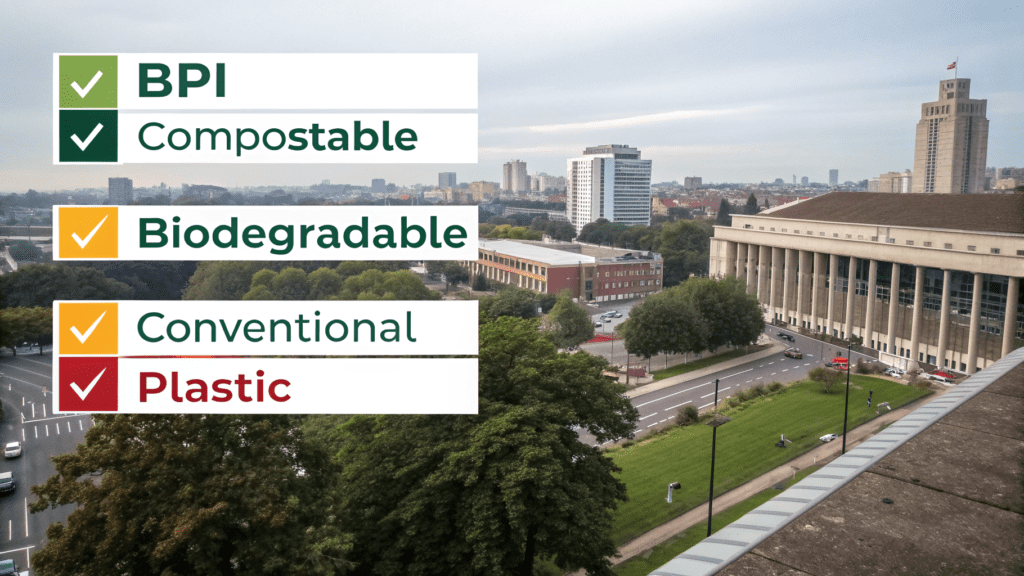
BPI Compostable vs. Biodegradable: A Critical Comparison for B2B Decision-Makers
Das Verständnis der betrieblichen, Compliance- und finanziellen Auswirkungen von „BPI kompostierbar“ im Vergleich zu „biologisch abbaubar“ ist für strategische Beschaffungs- und Nachhaltigkeitsinitiativen von größter Bedeutung. Die Unterschiede haben tiefgreifende Auswirkungen auf die Abfallwirtschaft, die Einhaltung gesetzlicher Vorschriften und den Ruf der Marke.
Procurement managers face the complex task of selecting materials that not only meet operational needs but also align with growing corporate ESG goals and regulatory demands. Choosing mistakenly labeled “biodegradable” products can lead to waste stream contamination, increased disposal costs, and significant brand damage from greenwashing accusations. Conversely, investing in BPI-certified compostable solutions offers a verifiable path to environmental responsibility and operational efficiency, particularly for hospitality and foodservice businesses managing high volumes of organic waste.
Comparison Table: Feature | B2B Operational Impact | Compliance Note | ROI Potential
| Besonderheit | B2B Betriebswirkung | Compliance Note | ROI -Potenzial |
|---|---|---|---|
| “Biodegradable” (General) | Unvorhersehbarer Ausfall in unterschiedlichen Umgebungen; hohes Risiko der Bildung von Mikroplastik und der Ansammlung auf Mülldeponien. Möglicherweise sind separate, nicht optimierte Abfallströme erforderlich, was die logistische Komplexität und die Kosten für Hotels und Restaurants erhöht. | Mangel an klaren regulatorischen Definitionen weltweit; hohes Risiko von „Greenwashing“-Behauptungen, die zu einer Überprüfung durch die FTC/Regulierungsbehörden führen. Aufgrund irreführender Angaben ist die Vermarktung von Einwegprodukten in einigen US-Bundesstaaten (z. B. California AB 1201) möglicherweise illegal. | Begrenzter oder negativer ROI aufgrund möglicher Deponieentsorgung, erhöhter Abfalltransportkosten aufgrund von Kontamination und schwerwiegender Rufschädigung durch irreführende Behauptungen. Trägt nicht zuverlässig zu Kreislaufwirtschaftsinitiativen oder überprüfbaren ESG-Kennzahlen bei. |
| „BPI kompostierbar“ | Guaranteed breakdown within 90-180 days in commercial composting facilities; enables efficient organic waste diversion and reduces landfill volume and methane emissions. Streamlines waste segregation and improves operational flow for foodservice operations. | Certified to ASTM D6400/D6868 standards by an independent third party; avoids “greenwashing” liabilities; aligns with and often required by increasing state/local regulations (e.g., CA AB 1201, Canada SOR/2022-138 for single-use plastics). | Positive ROI through significantly reduced waste disposal costs, enhanced brand reputation and market differentiation (supports ESG reporting), and contribution to circular economy goals (valuable compost production). Reduces future compliance risk. |
Choosing BPI compostable products offers clear operational, compliance, and financial advantages over vague “biodegradable” claims.

Navigating the Challenges: Infrastructure, Misinformation, and BPI Compostable Solutions
Despite the clear benefits of BPI-certified compostable products, B2B leaders face hurdles related to infrastructure, consumer perception, and regulatory complexities. Addressing these challenges is key to maximizing their environmental and operational advantages, especially within the hospitality and foodservice sectors.
The Industrial Composting Infrastructure Gap: A Key Hurdle
Eine große Herausforderung für die weit verbreitete Einführung BPI-zertifizierter kompostierbarer Stoffe ist die Verfügbarkeit geeigneter industrieller Kompostieranlagen. In vielen Regionen mangelt es an ausreichender Infrastruktur, die für den ordnungsgemäßen Abbau dieser Stoffe unter kontrollierten Bedingungen unerlässlich ist. Diese Infrastrukturlücke bedeutet, dass selbst wirklich kompostierbare Produkte möglicherweise auf Mülldeponien oder in Verbrennungsanlagen landen, wenn keine ordnungsgemäße Sammlung und Verarbeitung möglich ist, was sich negativ auf die Nachhaltigkeitsbemühungen von Hotels und Restaurants auswirkt.
Contamination remains a significant issue; approximately 17% of composters’ operating expenses are for removing non-compostable items. Inconsistent curbside collection programs further exacerbate disposal challenges for compostable packaging. If BPI-certified products, or any organic material, end up in landfills, they may produce methane—a potent greenhouse gas—if conditions become anaerobic. This underscores the critical need for improved sorting and collection systems tailored for compostable materials, particularly for large-scale foodservice operations.
Battling “Greenwashing” and Consumer Confusion with “BPI Compostable”
Misleading “biodegradable” labels cause widespread confusion, often implying breakdown in any environment. The term “biodegradable” is widely criticized for “greenwashing,” diverting attention from true sustainability. For procurement and sustainability officers in hospitality, this presents a constant battle against misinformation, which impacts both internal operations and external perceptions.
BPI certification directly combats this by providing clear, verifiable proof of compostability, thereby building consumer and stakeholder trust. It assures that products will perform as intended in an industrial composting setting. Educating staff, supply chain partners, and end-users on proper disposal of BPI-certified materials is crucial for effective waste diversion and maximizing the environmental benefits. This education extends to differentiating BPI-certified items from non-certified “look-alikes” to prevent contamination in hotel and restaurant waste streams.
Evolving Regulatory Landscape: Compliance and Opportunity
The regulatory landscape around sustainable packaging is rapidly evolving, moving towards greater clarity and enforcement. U.S. states like California (AB 1201) and Washington have already banned misleading “biodegradable” claims without robust third-party certification. In Canada, the SOR/2022-138 Regulation on single-use plastics often mandates ASTM D6400/BPI compliance for viable alternatives, reflecting a broader trend towards certified solutions across North America.
Organizations like the U.S. Composting Council and BPI actively collaborate to guide legislation, anticipating more laws on compostable products in the coming years. Proactive businesses that align with BPI standards can preempt future regulations, avoid potential penalties, and position themselves as leaders in responsible environmental stewardship. This forward-looking compliance not only mitigates risk but also unlocks opportunities for market differentiation in the competitive hospitality and foodservice industries. For full regulatory details,read our comprehensive guide on sustainable packaging regulations.
Addressing infrastructure gaps and misinformation is key to leveraging BPI compostable solutions effectively.

The Strategic Advantage of BPI-Certified Compostable Solutions for Procurement and Operations
Embracing BPI-certified compostable packaging offers more than environmental benefits; it provides tangible operational efficiencies, strengthens brand reputation, and contributes to long-term financial health. For procurement managers and operations directors in hospitality and foodservice, this translates into measurable business value.
Bolstering Corporate ESG Goals and Brand Reputation
Adopting BPI-certified products directly helps companies meet ambitious Environmental, Social, and Governance (ESG) targets. By verifiably diverting waste from landfills and contributing to a circular economy, businesses can credibly report on their waste reduction efforts, enhancing stakeholder trust and attracting socially conscious investors. The Ellen MacArthur Foundation’s 2025 targets, for example, include ensuring 100% of plastic packaging is reusable, recyclable, or compostable, setting a clear industry benchmark for the hospitality sector.
A strong commitment to certified compostables differentiates brands in a competitive, sustainability-conscious market. It demonstrates genuine leadership, resonating with environmentally aware consumers and partners, and can translate into improved brand loyalty and market share. This proactive stance on sustainability can become a significant competitive differentiator for hotels, cafes, and restaurants.
Operational Efficiency and Waste Stream Optimization
Properly implemented BPI-certified products streamline organic waste collection, directly reducing landfill volume and associated disposal costs. This is particularly valuable for businesses with significant food-related waste, such as hospitality providers or food service companies. Leveraging compostable packaging for food-contact applications (e.g., takeout containers, coffee cups) facilitates cleaner organic waste streams, as food contamination often makes conventional plastic recycling impractical.
This transition also reduces reliance on conventional plastics, which are increasingly subject to regulatory scrutiny and consumer backlash. By minimizing contamination in composting streams, businesses support local composting infrastructure, reduce disposal fees, and contribute to the production of valuable compost. For businesses seeking comprehensive sustainability strategies in the hospitality sector, exploring how BPI certification aligns with broader sustainability goals can yield significant benefits. Further insights on optimizing waste streams with certified compostable solutions can be found by reading more aboutBPI compostable certification and hospitality sustainability.
Case Study: Eco-Friendly Food Service Provider’s Waste Reduction Success
A major university food service provider implemented BPI-certified compostable foodservice ware (e.g., PLA cold cups, compostable paperboard containers) across its campuses starting in late 2023. This strategic shift was driven by a commitment to reduce landfill waste and enhance campus sustainability initiatives.
Within just 12 months, the provider reported a significant 35% reduction in landfill-bound waste originating from their dining halls. This impressive achievement was made possible by clearly labeling all BPI-certified items with the distinct swirl mark and by actively collaborating with local commercial composting facilities that accepted ASTM D6400 compliant materials. The streamlined organic waste collection, enabled by the identifiable compostable products, led to an estimated 15% reduction in waste hauling costs for their organic stream. This case demonstrates that with proper product selection, labeling, and waste stream partnerships, BPI-certified compostables offer a viable and economically beneficial solution for large-scale operations like university dining services.
BPI-certified solutions enhance ESG, streamline operations, and offer measurable financial and reputational gains.
The Future Landscape: Growth and Innovation in Compostable Materials
The trajectory for compostable materials is one of significant expansion and ongoing innovation, driven by a collective global commitment to reduce plastic pollution and foster a more circular economy. Procurement and operations leaders must recognize this evolving landscape to make informed, future-proof decisions.
Projected Market Growth and Driving Factors
The global compostable packaging market is projected to reach USD 89.85 billion by 2032, growing at a robust 6.20% CAGR from 2025. This growth is a direct response to escalating consumer demand for sustainable solutions, combined with increasingly stringent government regulations aimed at mitigating plastic pollution and promoting eco-friendly practices. The food and beverages segment is expected to continue its dominance, holding the largest revenue share in the compostable packaging market, as businesses in this sector prioritize packaging that can be co-composted with food waste. Paper and paperboard, alongside Polylactic Acid (PLA), are leading material segments due to their renewability and certified compostable properties.
Advancements in Biopolymer Innovation and Material Science
Continuous innovation is focused on developing new biopolymers that rival traditional plastics in performance while remaining compostable. Researchers are exploring novel materials like PHA (polyhydroxyalkanoates), derived from renewable resources like algae and bacteria. These advancements aim to create materials with enhanced durability, flexibility, and barrier properties, addressing previous limitations of compostable alternatives. New formulations are specifically designed to decompose into harmless compounds, enriching soil and contributing to natural nutrient cycling without leaving behind microplastics or toxins. Ongoing research is also addressing economic challenges, striving to reduce the cost and optimize the density of compostable materials, making them increasingly competitive with conventional packaging for hospitality and foodservice applications.
The Role of Compostable Materials in a Circular Economy
Compostable materials are crucial for diverting organic waste from landfills, thereby significantly reducing methane emissions—a potent greenhouse gas. By transforming into nutrient-rich compost, they contribute to soil health and fertility, potentially reducing reliance on synthetic fertilizers and supporting regenerative agricultural practices. Integrating compostables supports the broader circular economy goal of keeping resources in use for as long as possible. While not a “silver bullet” for all waste challenges, they are a vital component, particularly for food-contaminated items where recycling is challenging. For businesses interested in the long-term ROI of adopting these solutions, exploring the benefits ofKompostierbare Trinkhalme von BPI für Compliance im Gastgewerbe und ROIcan provide valuable insights into future market advantages.
Innovation and market growth in compostable materials are driving a more circular, sustainable future.
Abschluss
Understanding the precise difference between “BPI compostable” and “biodegradable” is not merely semantic; it is fundamental for B2B decision-makers committed to genuine sustainability, operational efficiency, and regulatory compliance. While “biodegradable” offers a vague promise with potential hidden pitfalls like greenwashing and microplastic pollution, “BPI compostable” provides a certified, verifiable pathway to responsible waste management and a healthier planet. This distinction empowers procurement managers, operations directors, and sustainability officers in the hospitality and foodservice industries to make informed choices that mitigate risk, enhance brand reputation, and contribute positively to both the environment and the bottom line. Embrace BPI-certified solutions to ensure your environmental claims are robust, your operations are streamlined, and your brand’s commitment to a circular economy is impactful and credible.
Evaluate Your Waste Streams Today!
Leverage this clarity for measurable environmental and business benefits, reducing landfill waste by up to 35% and cutting hauling costs by 15%.
Embrace BPI-certified solutions for verifiable sustainability and operational excellence.
Häufig gestellte Fragen (FAQ)
Q: Why is “biodegradable” often misleading for hospitality businesses?
A: The term “biodegradable” lacks specific standards for breakdown time or conditions, meaning products can take hundreds of years to decompose or leave harmful microplastics. For hospitality, this can lead to greenwashing accusations, regulatory fines, and contamination of waste streams, undermining genuine sustainability efforts.
Q: How does BPI certification benefit foodservice operations specifically?
A: BPI certification ensures products like takeout containers and cutlery break down efficiently in industrial composting facilities. This streamlines organic waste collection, reduces landfill volume, and minimizes contamination, leading to lower waste hauling costs and improved operational efficiency for high-volume foodservice providers.
Q: What are the key ASTM standards for BPI compostable products?
A: BPI-certified products must meet ASTM D6400 (for plastics/packaging) or ASTM D6868 (for coatings/films). These standards require 90% disintegration within 12 weeks and biodegradation into non-toxic components within 90-180 days in commercial composting environments.
Q: Can BPI-certified products be composted at home or in landfills?
A: BPI certification applies exclusively to products designed for industrial composting facilities, which maintain specific heat, moisture, and microbial conditions. They are generally not intended for home composting or traditional landfills, where conditions are insufficient for proper breakdown.
Q: How can hotels ensure proper disposal of BPI-certified items to avoid contamination?
A: Hotels should clearly label BPI-certified items with the distinct swirl mark, provide dedicated organic waste bins, and educate staff and guests on proper segregation. Partnering with local commercial composting facilities that accept ASTM D6400 compliant materials is also crucial to ensure effective waste diversion.