Naviguer dans le paysage de l'emballage durable et de la gestion des déchets exige une compréhension précise, en particulier pour les responsables des achats et des opérations dans les secteurs de l'hôtellerie et de la restauration. Les termes « biodégradable » et « compostable » sont souvent utilisés de manière interchangeable, ce qui entraîne une confusion généralisée et de potentiels faux pas opérationnels. Cette ambiguïté sémantique représente un risque important pour les entreprises qui s’efforcent d’atteindre une véritable conformité environnementale, sociale et de gouvernance (ESG), conduisant potentiellement à des accusations coûteuses de « greenwashing » et à des flux de déchets inefficaces.
Pour les décideurs B2B, faire la distinction entre ces termes n’est pas simplement un exercice académique ; c’est un impératif stratégique. Le marché mondial des emballages compostables, évalué à environ 55,53 milliards USD en 2024 (Grand View Research, 2024), devrait atteindre 89,85 milliards USD d’ici 2032, affichant un taux de croissance annuel composé (TCAC) de 6,20 % de 2025 à 2032 (Precedence Research, 2023). Cette croissance souligne une opportunité cruciale pour les entreprises de s’aligner sur l’évolution des attentes des consommateurs et des paysages réglementaires. Cependant, sans une compréhension claire de la compostabilité certifiée, les entreprises risquent d'investir dans des solutions qui ne parviennent pas à offrir les avantages environnementaux promis ou à répondre à des normes de conformité de plus en plus strictes, ce qui a un impact sur tout, de l'efficacité de la chaîne d'approvisionnement à la réputation de la marque. Ignorer cette distinction peut entraîner une augmentation des coûts d’élimination des déchets, des amendes réglementaires et des dommages importants à la marque sur un marché valorisant de plus en plus la véritable durabilité (Fondation Ellen MacArthur, 2022).
Comprendre cette distinction est crucial pour des opérations B2B durables et pour éviter un greenwashing coûteux.
Comprendre le terme « biodégradable » : une affirmation large et souvent trompeuse
Le terme « biodégradable » suggère qu’un matériau se décompose naturellement, mais il est largement non réglementé et manque de spécificité pour les applications B2B. Sans normes claires, cette définition large peut entraver une gestion efficace des déchets et des initiatives de développement durable, créant ainsi un champ de mines pour les entreprises sans méfiance.
La nature non réglementée de la biodégradabilité : risques pour les chaînes d'approvisionnement
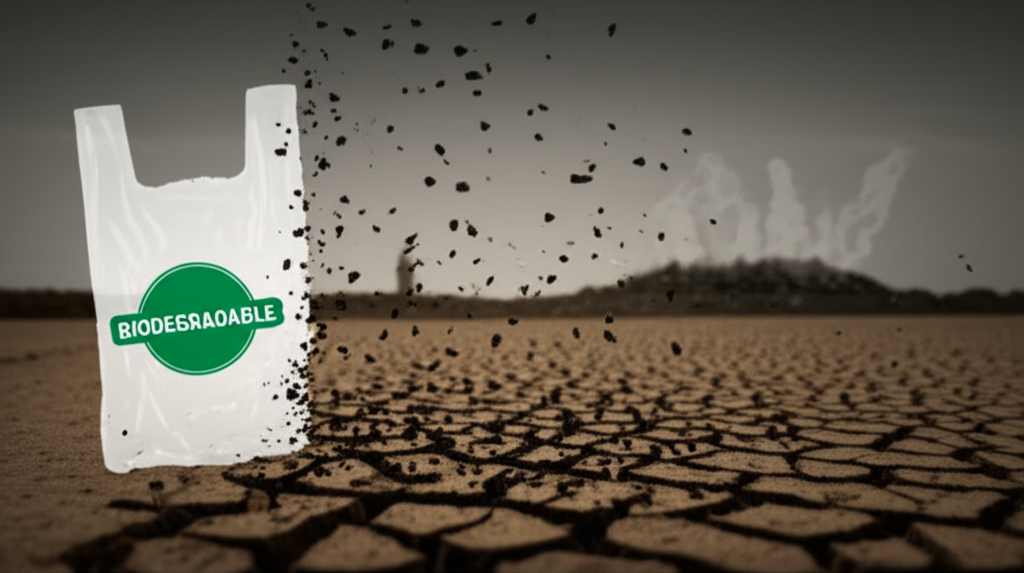
The core issue with “biodegradable” lies in its lack of a defined timeframe or specific environmental conditions for decomposition. While the term implies breakdown by microorganisms, a product labeled “biodegradable” could, in reality, take “hundreds of years” to decompose. Crucially, it may still leave behind harmful residues or even fragment into microplastics, undermining the very environmental goals it purports to support.
La Federal Trade Commission (FTC) des États-Unis a explicitement mis en garde les entreprises contre toute déclaration « biodégradable » sans réserve, soulignant les risques importants de greenwashing. De telles allégations vagues peuvent induire les consommateurs en erreur et donner lieu à un examen réglementaire. Par exemple, certains plastiques « biodégradables », comme les produits oxo-dégradables, sont essentiellement des plastiques conventionnels mélangés à des additifs qui les font se désintégrer plus rapidement, mais ils se décomposent en d’innombrables microplastiques qui peuvent gravement contaminer l’environnement, au lieu de véritablement disparaître. Cela pose un risque important en termes de réputation et de conformité pour les chaînes d'approvisionnement qui intègrent par inadvertance de tels matériaux, en particulier pour les entreprises hôtelières qui gèrent de gros volumes d'articles à usage unique.
Why “Biodegradable” Falls Short for B2B Sustainability Goals
The inherent lack of specificity in “biodegradable” claims makes them inadequate for robust B2B sustainability strategies.
- No Defined Timeframe: Without a guaranteed timeframe, businesses cannot reliably predict or manage the end-of-life cycle for their products, leading to unpredictable waste accumulation and inefficient operational settings, particularly in fast-paced foodservice environments.
- Absence of Toxicity Testing: There is no required testing for toxic byproducts in generally “biodegradable” materials. This introduces environmental and reputational risks, as products could release harmful substances into soil or water.
- Consumer and Waste Facility Confusion: The ambiguity surrounding “biodegradable” confuses both consumers and waste management facilities, complicating proper disposal and increasing contamination rates in recycling or composting streams, a common issue in hotel waste management.
- Legal and Regulatory Vulnerability: The use of “biodegradable” in sales and marketing for single-use products is considered problematic and is even “potentially illegal” in some U.S. states, such as California (AB 1201), which bans such claims without third-party certification. This creates a clear compliance risk for businesses operating in regulated markets.
“Biodegradable” lacks clear standards, posing significant greenwashing and operational risks for businesses.
Defining “BPI Compostable”: The Gold Standard for Sustainable Operations
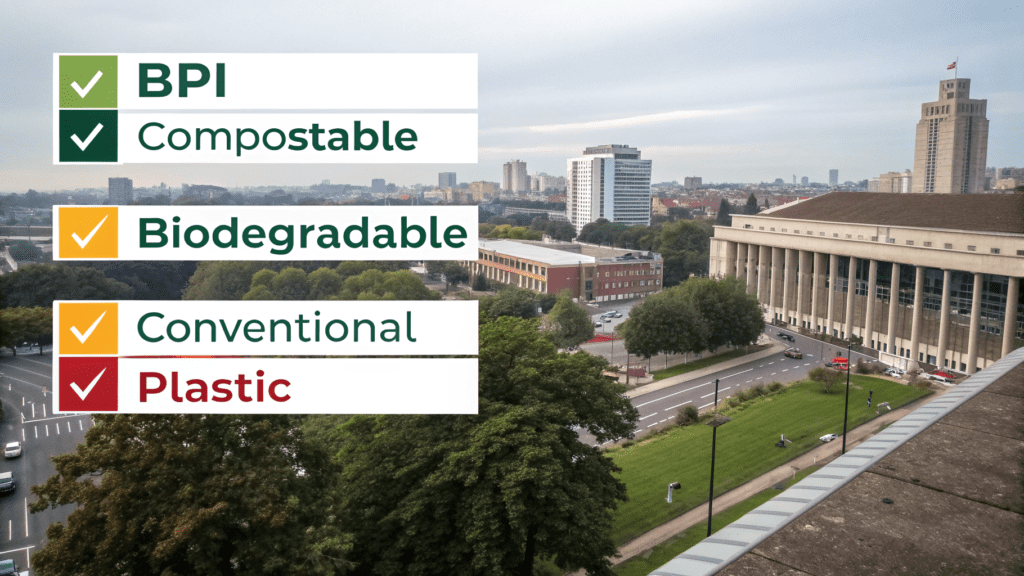
“BPI Compostable” signifies a rigorously tested and certified product designed to break down effectively in specific industrial environments, offering clear advantages for compliant and impactful B2B sustainability efforts. This certification provides a transparent, verifiable pathway to genuine circular economy contributions.
The Role of the Biodegradable Products Institute (BPI) in Certification
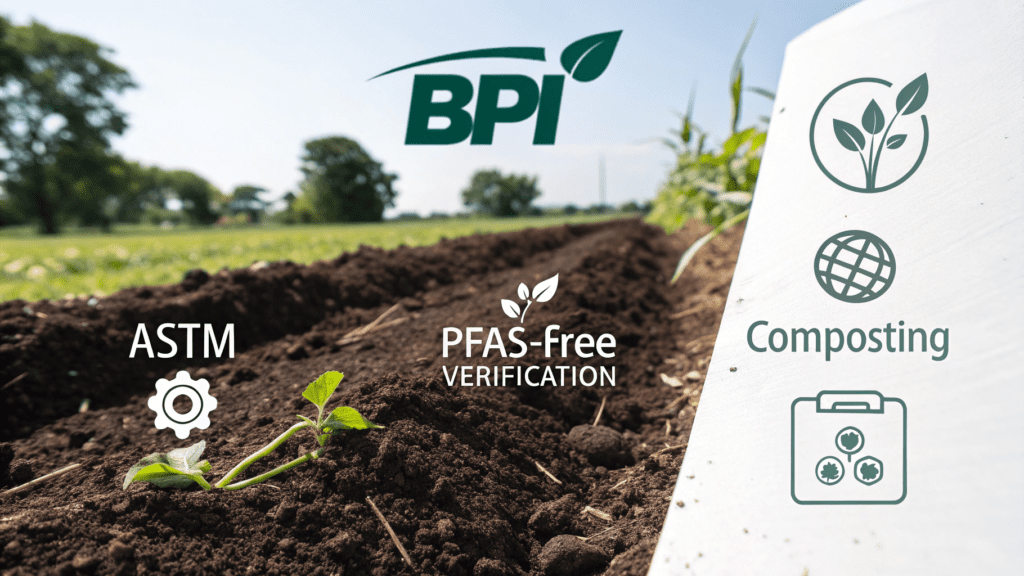
Le Biodegradable Products Institute (BPI) est la principale autorité à but non lucratif d’Amérique du Nord, créée en 1999, dédiée à la promotion et à la certification des produits et emballages compostables. La certification BPI n’est pas qu’un label ; il s'agit d'une vérification indépendante par un tiers que les produits répondent aux normes strictes de l'ASTM (American Society for Testing and Materials) en matière de compostabilité.
La marque de certification BPI – un motif tourbillonnant distinct – identifie les produits spécifiquement conçus pour une décomposition appropriée dans les systèmes commerciaux. Cette marque est inestimable pour les responsables des achats et les directeurs des opérations, car elle aide les composteurs à différencier les véritables compostables des sosies, évitant ainsi une contamination coûteuse dans leurs installations. Il fournit un signal clair d’intégrité et d’adhésion à des normes scientifiquement étayées, ce qui est crucial pour instaurer la confiance avec les partenaires de gestion des déchets et les utilisateurs finaux, en particulier dans les établissements hôteliers à volume élevé.
Répondre aux normes ASTM strictes pour les compostables certifiés BPI
Pour obtenir la certification BPI, les produits doivent subir des tests complets et rigoureux pour se conformer aux normes ASTM spécifiques.
- ASTM D6400 (for plastics/packaging) or ASTM D6868 (for coatings/films): These are the primary standards that BPI-certified products must meet. They dictate how well a product breaks down in industrial composting facilities.
- Defined Disintegration Timeline: Les produits doivent se désintégrer physiquement à 90 % en 12 semaines (84 jours) et se biodégrader en dioxyde de carbone, en eau et en biomasse en 90 à 180 jours dans des environnements de compostage commercial. Cela garantit un traitement rapide et un débit efficace dans les installations industrielles, essentiels à la gestion des déchets des services alimentaires.
- Composants non toxiques : Il est essentiel que le processus de décomposition fournisse des composants non toxiques, ne laissant aucun résidu nocif, aucun niveau inacceptable de métaux lourds ou de produits chimiques fluorés (PFAS). Le compost obtenu doit également s’avérer sans danger pour la croissance des plantes, garantissant ainsi des avantages environnementaux et une récupération des ressources qui enrichissent véritablement les sols et soutiennent l’agriculture régénérative.
- Exclusif au compostage industriel : Il est important de noter que la certification BPI s’applique exclusivement aux produits dont il est prouvé qu’ils se décomposent dans les environnements de compostage commercial, qui maintiennent les niveaux élevés de chaleur, d’humidité et d’activité microbienne nécessaires. Ces produits ne sont généralement pas destinés au compostage domestique ou aux décharges traditionnelles, où les conditions de décomposition sont insuffisantes.
BPI Compostable, c'est une décomposition certifiée en usine, garantissant de réels bénéfices environnementaux.
BPI compostable vs biodégradable : une comparaison critique pour les décideurs B2B
Comprendre les implications opérationnelles, de conformité et financières de « BPI compostable » par rapport à « biodégradable » est primordial pour les initiatives stratégiques d’approvisionnement et de développement durable. Ces distinctions ont un impact profond sur la gestion des déchets, le respect des réglementations et la réputation de la marque.
Procurement managers face the complex task of selecting materials that not only meet operational needs but also align with growing corporate ESG goals and regulatory demands. Choosing mistakenly labeled “biodegradable” products can lead to waste stream contamination, increased disposal costs, and significant brand damage from greenwashing accusations. Conversely, investing in BPI-certified compostable solutions offers a verifiable path to environmental responsibility and operational efficiency, particularly for hospitality and foodservice businesses managing high volumes of organic waste.
Comparison Table: Feature | B2B Operational Impact | Compliance Note | ROI Potential
| Fonctionnalité | Impact opérationnel B2B | Note de conformité | Potentiel de retour sur investissement |
|---|---|---|---|
| “Biodegradable” (General) | Unpredictable breakdown in varied environments; high risk of microplastic formation and landfill accumulation. May necessitate separate, unoptimized waste streams, increasing logistical complexity and costs for hotels and restaurants. | Lack of clear regulatory definitions globally; high risk of “greenwashing” claims leading to FTC/regulatory scrutiny. Potentially illegal for single-use product marketing in some U.S. states (e.g., California AB 1201) due to misleading claims. | Limited or negative ROI due to potential for landfill disposal, increased waste hauling costs from contamination, and severe reputational damage from misleading claims. Does not reliably contribute to circular economy initiatives or verifiable ESG metrics. |
| “BPI Compostable” | Guaranteed breakdown within 90-180 days in commercial composting facilities; enables efficient organic waste diversion and reduces landfill volume and methane emissions. Streamlines waste segregation and improves operational flow for foodservice operations. | Certified to ASTM D6400/D6868 standards by an independent third party; avoids “greenwashing” liabilities; aligns with and often required by increasing state/local regulations (e.g., CA AB 1201, Canada SOR/2022-138 for single-use plastics). | Positive ROI through significantly reduced waste disposal costs, enhanced brand reputation and market differentiation (supports ESG reporting), and contribution to circular economy goals (valuable compost production). Reduces future compliance risk. |
Choosing BPI compostable products offers clear operational, compliance, and financial advantages over vague “biodegradable” claims.
Navigating the Challenges: Infrastructure, Misinformation, and BPI Compostable Solutions
Despite the clear benefits of BPI-certified compostable products, B2B leaders face hurdles related to infrastructure, consumer perception, and regulatory complexities. Addressing these challenges is key to maximizing their environmental and operational advantages, especially within the hospitality and foodservice sectors.
The Industrial Composting Infrastructure Gap: A Key Hurdle
A major challenge for widespread adoption of BPI-certified compostables is the availability of adequate industrial composting facilities. Many regions lack sufficient infrastructure, which is essential for these items to break down properly under controlled conditions. This infrastructure gap means that even genuinely compostable products might end up in landfills or incinerators if proper collection and processing are unavailable, impacting the sustainability efforts of hotels and restaurants.
Contamination remains a significant issue; approximately 17% of composters’ operating expenses are for removing non-compostable items. Inconsistent curbside collection programs further exacerbate disposal challenges for compostable packaging. If BPI-certified products, or any organic material, end up in landfills, they may produce methane—a potent greenhouse gas—if conditions become anaerobic. This underscores the critical need for improved sorting and collection systems tailored for compostable materials, particularly for large-scale foodservice operations.
Battling “Greenwashing” and Consumer Confusion with “BPI Compostable”
Misleading “biodegradable” labels cause widespread confusion, often implying breakdown in any environment. The term “biodegradable” is widely criticized for “greenwashing,” diverting attention from true sustainability. For procurement and sustainability officers in hospitality, this presents a constant battle against misinformation, which impacts both internal operations and external perceptions.
La certification BPI combat directement ce phénomène en fournissant une preuve claire et vérifiable de compostabilité, renforçant ainsi la confiance des consommateurs et des parties prenantes. Il garantit que les produits fonctionneront comme prévu dans un environnement de compostage industriel. La formation du personnel, des partenaires de la chaîne d'approvisionnement et des utilisateurs finaux sur l'élimination appropriée des matériaux certifiés BPI est cruciale pour un réacheminement efficace des déchets et maximiser les avantages environnementaux. Cette formation s'étend à la différenciation des articles certifiés BPI des « sosies » non certifiés afin de prévenir la contamination dans les flux de déchets des hôtels et des restaurants.
Paysage réglementaire en évolution : conformité et opportunités
Le paysage réglementaire autour des emballages durables évolue rapidement, évoluant vers plus de clarté et d’application. Des États américains comme la Californie (AB 1201) et Washington ont déjà interdit les allégations trompeuses de « biodégradabilité » sans certification solide par un tiers. Au Canada, le règlement DORS/2022-138 sur les plastiques à usage unique exige souvent la conformité ASTM D6400/BPI pour les alternatives viables, reflétant une tendance plus large vers des solutions certifiées à travers l'Amérique du Nord.
Organizations like the U.S. Composting Council and BPI actively collaborate to guide legislation, anticipating more laws on compostable products in the coming years. Proactive businesses that align with BPI standards can preempt future regulations, avoid potential penalties, and position themselves as leaders in responsible environmental stewardship. This forward-looking compliance not only mitigates risk but also unlocks opportunities for market differentiation in the competitive hospitality and foodservice industries. For full regulatory details,read our comprehensive guide on sustainable packaging regulations.
Addressing infrastructure gaps and misinformation is key to leveraging BPI compostable solutions effectively.
The Strategic Advantage of BPI-Certified Compostable Solutions for Procurement and Operations
Embracing BPI-certified compostable packaging offers more than environmental benefits; it provides tangible operational efficiencies, strengthens brand reputation, and contributes to long-term financial health. For procurement managers and operations directors in hospitality and foodservice, this translates into measurable business value.
Bolstering Corporate ESG Goals and Brand Reputation
Adopting BPI-certified products directly helps companies meet ambitious Environmental, Social, and Governance (ESG) targets. By verifiably diverting waste from landfills and contributing to a circular economy, businesses can credibly report on their waste reduction efforts, enhancing stakeholder trust and attracting socially conscious investors. The Ellen MacArthur Foundation’s 2025 targets, for example, include ensuring 100% of plastic packaging is reusable, recyclable, or compostable, setting a clear industry benchmark for the hospitality sector.
A strong commitment to certified compostables differentiates brands in a competitive, sustainability-conscious market. It demonstrates genuine leadership, resonating with environmentally aware consumers and partners, and can translate into improved brand loyalty and market share. This proactive stance on sustainability can become a significant competitive differentiator for hotels, cafes, and restaurants.
Operational Efficiency and Waste Stream Optimization
Properly implemented BPI-certified products streamline organic waste collection, directly reducing landfill volume and associated disposal costs. This is particularly valuable for businesses with significant food-related waste, such as hospitality providers or food service companies. Leveraging compostable packaging for food-contact applications (e.g., takeout containers, coffee cups) facilitates cleaner organic waste streams, as food contamination often makes conventional plastic recycling impractical.
This transition also reduces reliance on conventional plastics, which are increasingly subject to regulatory scrutiny and consumer backlash. By minimizing contamination in composting streams, businesses support local composting infrastructure, reduce disposal fees, and contribute to the production of valuable compost. For businesses seeking comprehensive sustainability strategies in the hospitality sector, exploring how BPI certification aligns with broader sustainability goals can yield significant benefits. Further insights on optimizing waste streams with certified compostable solutions can be found by reading more aboutBPI compostable certification and hospitality sustainability.
Case Study: Eco-Friendly Food Service Provider’s Waste Reduction Success
A major university food service provider implemented BPI-certified compostable foodservice ware (e.g., PLA cold cups, compostable paperboard containers) across its campuses starting in late 2023. This strategic shift was driven by a commitment to reduce landfill waste and enhance campus sustainability initiatives.
Within just 12 months, the provider reported a significant 35% reduction in landfill-bound waste originating from their dining halls. This impressive achievement was made possible by clearly labeling all BPI-certified items with the distinct swirl mark and by actively collaborating with local commercial composting facilities that accepted ASTM D6400 compliant materials. The streamlined organic waste collection, enabled by the identifiable compostable products, led to an estimated 15% reduction in waste hauling costs for their organic stream. This case demonstrates that with proper product selection, labeling, and waste stream partnerships, BPI-certified compostables offer a viable and economically beneficial solution for large-scale operations like university dining services.
BPI-certified solutions enhance ESG, streamline operations, and offer measurable financial and reputational gains.
The Future Landscape: Growth and Innovation in Compostable Materials
The trajectory for compostable materials is one of significant expansion and ongoing innovation, driven by a collective global commitment to reduce plastic pollution and foster a more circular economy. Procurement and operations leaders must recognize this evolving landscape to make informed, future-proof decisions.
Projected Market Growth and Driving Factors
The global compostable packaging market is projected to reach USD 89.85 billion by 2032, growing at a robust 6.20% CAGR from 2025. This growth is a direct response to escalating consumer demand for sustainable solutions, combined with increasingly stringent government regulations aimed at mitigating plastic pollution and promoting eco-friendly practices. The food and beverages segment is expected to continue its dominance, holding the largest revenue share in the compostable packaging market, as businesses in this sector prioritize packaging that can be co-composted with food waste. Paper and paperboard, alongside Polylactic Acid (PLA), are leading material segments due to their renewability and certified compostable properties.
Advancements in Biopolymer Innovation and Material Science
Continuous innovation is focused on developing new biopolymers that rival traditional plastics in performance while remaining compostable. Researchers are exploring novel materials like PHA (polyhydroxyalkanoates), derived from renewable resources like algae and bacteria. These advancements aim to create materials with enhanced durability, flexibility, and barrier properties, addressing previous limitations of compostable alternatives. New formulations are specifically designed to decompose into harmless compounds, enriching soil and contributing to natural nutrient cycling without leaving behind microplastics or toxins. Ongoing research is also addressing economic challenges, striving to reduce the cost and optimize the density of compostable materials, making them increasingly competitive with conventional packaging for hospitality and foodservice applications.
The Role of Compostable Materials in a Circular Economy
Compostable materials are crucial for diverting organic waste from landfills, thereby significantly reducing methane emissions—a potent greenhouse gas. By transforming into nutrient-rich compost, they contribute to soil health and fertility, potentially reducing reliance on synthetic fertilizers and supporting regenerative agricultural practices. Integrating compostables supports the broader circular economy goal of keeping resources in use for as long as possible. While not a “silver bullet” for all waste challenges, they are a vital component, particularly for food-contaminated items where recycling is challenging. For businesses interested in the long-term ROI of adopting these solutions, exploring the benefits ofPailles compostables BPI pour la conformité de l'hôtellerie et le retour sur investissementcan provide valuable insights into future market advantages.
Innovation and market growth in compostable materials are driving a more circular, sustainable future.
Conclusion
Understanding the precise difference between “BPI compostable” and “biodegradable” is not merely semantic; it is fundamental for B2B decision-makers committed to genuine sustainability, operational efficiency, and regulatory compliance. While “biodegradable” offers a vague promise with potential hidden pitfalls like greenwashing and microplastic pollution, “BPI compostable” provides a certified, verifiable pathway to responsible waste management and a healthier planet. This distinction empowers procurement managers, operations directors, and sustainability officers in the hospitality and foodservice industries to make informed choices that mitigate risk, enhance brand reputation, and contribute positively to both the environment and the bottom line. Embrace BPI-certified solutions to ensure your environmental claims are robust, your operations are streamlined, and your brand’s commitment to a circular economy is impactful and credible.
Evaluate Your Waste Streams Today!
Leverage this clarity for measurable environmental and business benefits, reducing landfill waste by up to 35% and cutting hauling costs by 15%.
Embrace BPI-certified solutions for verifiable sustainability and operational excellence.
Foire aux questions (FAQ)
Q: Why is “biodegradable” often misleading for hospitality businesses?
A: The term “biodegradable” lacks specific standards for breakdown time or conditions, meaning products can take hundreds of years to decompose or leave harmful microplastics. For hospitality, this can lead to greenwashing accusations, regulatory fines, and contamination of waste streams, undermining genuine sustainability efforts.
Q: How does BPI certification benefit foodservice operations specifically?
A: BPI certification ensures products like takeout containers and cutlery break down efficiently in industrial composting facilities. This streamlines organic waste collection, reduces landfill volume, and minimizes contamination, leading to lower waste hauling costs and improved operational efficiency for high-volume foodservice providers.
Q: What are the key ASTM standards for BPI compostable products?
A: BPI-certified products must meet ASTM D6400 (for plastics/packaging) or ASTM D6868 (for coatings/films). These standards require 90% disintegration within 12 weeks and biodegradation into non-toxic components within 90-180 days in commercial composting environments.
Q: Can BPI-certified products be composted at home or in landfills?
A: BPI certification applies exclusively to products designed for industrial composting facilities, which maintain specific heat, moisture, and microbial conditions. They are generally not intended for home composting or traditional landfills, where conditions are insufficient for proper breakdown.
Q: How can hotels ensure proper disposal of BPI-certified items to avoid contamination?
A: Hotels should clearly label BPI-certified items with the distinct swirl mark, provide dedicated organic waste bins, and educate staff and guests on proper segregation. Partnering with local commercial composting facilities that accept ASTM D6400 compliant materials is also crucial to ensure effective waste diversion.