Muoversi nel panorama degli imballaggi sostenibili e della gestione dei rifiuti richiede una comprensione precisa, soprattutto per i leader degli approvvigionamenti e delle operazioni nei settori dell’ospitalità e della ristorazione. I termini “biodegradabile” e “compostabile” sono spesso usati in modo intercambiabile, generando una diffusa confusione e potenziali passi falsi operativi. Questa ambiguità semantica rappresenta un rischio significativo per le aziende che lottano per un’autentica conformità ambientale, sociale e di governance (ESG), portando potenzialmente a costose accuse di “greenwashing” e a flussi di rifiuti inefficienti.
Per i decisori B2B, distinguere tra questi termini non è semplicemente un esercizio accademico; è un imperativo strategico. Si prevede che il mercato globale degli imballaggi compostabili, valutato a circa 55,53 miliardi di dollari nel 2024 (Grand View Research, 2024), raggiungerà gli 89,85 miliardi di dollari entro il 2032, mostrando un tasso di crescita annuale composto (CAGR) del 6,20% dal 2025 al 2032 (Precedence Research, 2023). Questa crescita sottolinea un’opportunità fondamentale per le aziende di allinearsi alle aspettative in evoluzione dei consumatori e ai panorami normativi. Tuttavia, senza una chiara comprensione della compostabilità certificata, le aziende rischiano di investire in soluzioni che non riescono a fornire i benefici ambientali promessi o a soddisfare standard di conformità sempre più rigorosi, incidendo su tutto, dall’efficienza della catena di fornitura alla reputazione del marchio. Ignorare questa distinzione può portare a un aumento dei costi di smaltimento dei rifiuti, a sanzioni normative e a un danno significativo al marchio in un mercato che valorizza sempre più la vera sostenibilità (Ellen MacArthur Foundation, 2022).
Comprendere questa distinzione è fondamentale per operazioni B2B sostenibili ed evitare costosi greenwashing.
Capire “biodegradabile”: un’affermazione ampia e spesso fuorviante
Il termine “biodegradabile” suggerisce che un materiale si decompone naturalmente, ma è in gran parte non regolamentato e privo di specificità per le applicazioni B2B. Senza standard chiari, questa ampia definizione può ostacolare un’efficace gestione dei rifiuti e iniziative di sostenibilità, creando un campo minato per le aziende ignare.
La natura non regolamentata della biodegradabilità: rischi per le catene di approvvigionamento
Il problema principale del “biodegradabile” risiede nella mancanza di un periodo di tempo definito o di condizioni ambientali specifiche per la decomposizione. Sebbene il termine implichi la decomposizione da parte dei microrganismi, un prodotto etichettato come “biodegradabile” potrebbe, in realtà, impiegare “centinaia di anni” per decomporsi. Fondamentalmente, potrebbe ancora lasciare residui nocivi o addirittura frammentarsi in microplastiche, minando gli stessi obiettivi ambientali che pretende di sostenere.
The Federal Trade Commission (FTC) in the U.S. has explicitly warned businesses against making unqualified “biodegradable” claims, highlighting the significant risks of greenwashing. Such vague claims can mislead consumers and result in regulatory scrutiny. For instance, some “biodegradable” plastics, like oxo-degradable products, are essentially conventional plastics mixed with additives that cause them to disintegrate faster, yet they break down into countless microplastics that can severely contaminate the environment, rather than truly disappearing. This poses a significant reputational and compliance risk for supply chains that inadvertently incorporate such materials, especially for hospitality businesses managing high volumes of single-use items.
Why “Biodegradable” Falls Short for B2B Sustainability Goals
The inherent lack of specificity in “biodegradable” claims makes them inadequate for robust B2B sustainability strategies.
- No Defined Timeframe: Without a guaranteed timeframe, businesses cannot reliably predict or manage the end-of-life cycle for their products, leading to unpredictable waste accumulation and inefficient operational settings, particularly in fast-paced foodservice environments.
- Absence of Toxicity Testing: There is no required testing for toxic byproducts in generally “biodegradable” materials. This introduces environmental and reputational risks, as products could release harmful substances into soil or water.
- Consumer and Waste Facility Confusion: The ambiguity surrounding “biodegradable” confuses both consumers and waste management facilities, complicating proper disposal and increasing contamination rates in recycling or composting streams, a common issue in hotel waste management.
- Legal and Regulatory Vulnerability: The use of “biodegradable” in sales and marketing for single-use products is considered problematic and is even “potentially illegal” in some U.S. states, such as California (AB 1201), which bans such claims without third-party certification. This creates a clear compliance risk for businesses operating in regulated markets.
“Biodegradable” lacks clear standards, posing significant greenwashing and operational risks for businesses.
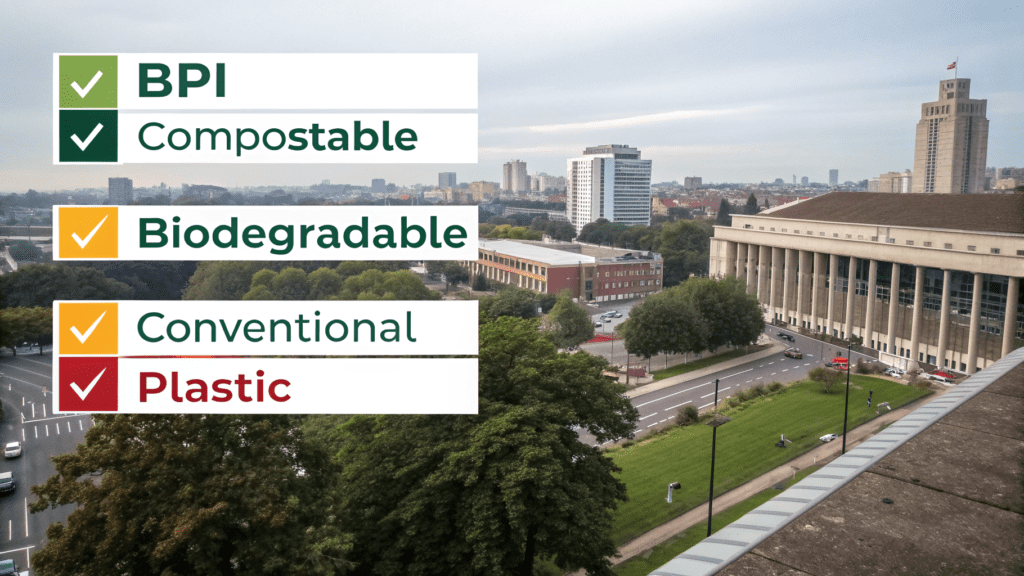
Defining “BPI Compostable”: The Gold Standard for Sustainable Operations
“BPI Compostable” signifies a rigorously tested and certified product designed to break down effectively in specific industrial environments, offering clear advantages for compliant and impactful B2B sustainability efforts. This certification provides a transparent, verifiable pathway to genuine circular economy contributions.
The Role of the Biodegradable Products Institute (BPI) in Certification
Il Biodegradable Products Institute (BPI) è la principale autorità no-profit del Nord America, fondata nel 1999, dedicata alla promozione e alla certificazione di prodotti e imballaggi compostabili. La certificazione BPI non è solo un'etichetta; si tratta di una verifica indipendente di terze parti che attesta che i prodotti soddisfano i rigorosi standard ASTM (American Society for Testing and Materials) per la compostabilità.
The BPI certification mark—a distinct swirl design—identifies products specifically designed for proper decomposition in commercial systems. This mark is invaluable for procurement managers and operations directors as it helps composters differentiate true compostables from look-alikes, thereby preventing costly contamination in their facilities. It provides a clear signal of integrity and adherence to scientifically backed standards, which is crucial for building trust with waste management partners and end-users, especially in high-volume hospitality settings.
Meeting Stringent ASTM Standards for BPI-Certified Compostables
To earn the BPI certification, products must undergo comprehensive and stringent testing to comply with specific ASTM standards.
- ASTM D6400 (for plastics/packaging) or ASTM D6868 (for coatings/films): These are the primary standards that BPI-certified products must meet. They dictate how well a product breaks down in industrial composting facilities.
- Defined Disintegration Timeline: Products are required to physically disintegrate by 90% within 12 weeks (84 days) and biodegrade into carbon dioxide, water, and biomass within 90 to 180 days in commercial composting environments. This ensures timely processing and efficient throughput in industrial facilities, critical for foodservice waste management.
- Non-Toxic Components: Critically, the breakdown process must yield non-toxic components, leaving no harmful residues, unacceptable levels of heavy metals, or fluorinated chemicals (PFAS). The resulting compost must also be proven safe for plant growth, ensuring environmental benefit and resource recovery that genuinely enriches soil and supports regenerative agriculture.
- Exclusive to Industrial Composting: It’s important to note that BPI certification applies exclusively to products proven to break down in commercial composting environments, which maintain the necessary high heat, moisture, and microbial activity levels. These products are generally not intended for home composting or traditional landfills, where conditions for decomposition are insufficient.
BPI Compostable means certified breakdown in industrial facilities, ensuring genuine environmental benefits.
BPI Compostable vs. Biodegradable: A Critical Comparison for B2B Decision-Makers
Understanding the operational, compliance, and financial implications of “BPI compostable” versus “biodegradable” is paramount for strategic procurement and sustainability initiatives. The distinctions profoundly impact waste management, regulatory adherence, and brand reputation.
Procurement managers face the complex task of selecting materials that not only meet operational needs but also align with growing corporate ESG goals and regulatory demands. Choosing mistakenly labeled “biodegradable” products can lead to waste stream contamination, increased disposal costs, and significant brand damage from greenwashing accusations. Conversely, investing in BPI-certified compostable solutions offers a verifiable path to environmental responsibility and operational efficiency, particularly for hospitality and foodservice businesses managing high volumes of organic waste.
Comparison Table: Feature | B2B Operational Impact | Compliance Note | ROI Potential
| Caratteristica | Impatto operativo B2B | Nota di conformità | Potenziale ROI |
|---|---|---|---|
| “Biodegradable” (General) | Unpredictable breakdown in varied environments; high risk of microplastic formation and landfill accumulation. May necessitate separate, unoptimized waste streams, increasing logistical complexity and costs for hotels and restaurants. | Lack of clear regulatory definitions globally; high risk of “greenwashing” claims leading to FTC/regulatory scrutiny. Potentially illegal for single-use product marketing in some U.S. states (e.g., California AB 1201) due to misleading claims. | Limited or negative ROI due to potential for landfill disposal, increased waste hauling costs from contamination, and severe reputational damage from misleading claims. Does not reliably contribute to circular economy initiatives or verifiable ESG metrics. |
| “BPI Compostable” | Guaranteed breakdown within 90-180 days in commercial composting facilities; enables efficient organic waste diversion and reduces landfill volume and methane emissions. Streamlines waste segregation and improves operational flow for foodservice operations. | Certified to ASTM D6400/D6868 standards by an independent third party; avoids “greenwashing” liabilities; aligns with and often required by increasing state/local regulations (e.g., CA AB 1201, Canada SOR/2022-138 for single-use plastics). | Positive ROI through significantly reduced waste disposal costs, enhanced brand reputation and market differentiation (supports ESG reporting), and contribution to circular economy goals (valuable compost production). Reduces future compliance risk. |
La scelta dei prodotti compostabili BPI offre chiari vantaggi operativi, di conformità e finanziari rispetto alle vaghe dichiarazioni di “biodegradabilità”.

Affrontare le sfide: infrastrutture, disinformazione e soluzioni compostabili BPI
Nonostante gli evidenti vantaggi dei prodotti compostabili certificati BPI, i leader B2B devono affrontare ostacoli legati alle infrastrutture, alla percezione dei consumatori e alle complessità normative. Affrontare queste sfide è fondamentale per massimizzarne i vantaggi ambientali e operativi, soprattutto nei settori dell’ospitalità e della ristorazione.
Il divario infrastrutturale del compostaggio industriale: un ostacolo chiave
Una sfida importante per l’adozione diffusa dei materiali compostabili certificati BPI è la disponibilità di adeguati impianti di compostaggio industriale. Molte regioni non dispongono di infrastrutture sufficienti, il che è essenziale affinché questi elementi si decompongano correttamente in condizioni controllate. Questo divario infrastrutturale significa che anche i prodotti autenticamente compostabili potrebbero finire in discariche o inceneritori se non sono disponibili una raccolta e un trattamento adeguati, incidendo sugli sforzi di sostenibilità di hotel e ristoranti.
La contaminazione rimane un problema significativo; circa il 17% delle spese operative dei composter riguarda la rimozione di oggetti non compostabili. Programmi di raccolta porta a porta incoerenti aggravano ulteriormente le sfide relative allo smaltimento degli imballaggi compostabili. Se i prodotti certificati BPI, o qualsiasi materiale organico, finiscono nelle discariche, potrebbero produrre metano, un potente gas serra, se le condizioni diventano anaerobiche. Ciò sottolinea la necessità fondamentale di sistemi di smistamento e raccolta migliorati su misura per i materiali compostabili, in particolare per le operazioni di ristorazione su larga scala.
Combattere il “greenwashing” e la confusione dei consumatori con “BPI compostabile”
Le etichette fuorvianti “biodegradabili” causano una diffusa confusione, spesso implicando il guasto in qualsiasi ambiente. Il termine “biodegradabile” è ampiamente criticato come “greenwashing”, distogliendo l’attenzione dalla vera sostenibilità. Per i responsabili degli approvvigionamenti e della sostenibilità nel settore dell’ospitalità, ciò rappresenta una battaglia costante contro la disinformazione, che ha un impatto sia sulle operazioni interne che sulle percezioni esterne.
La certificazione BPI combatte direttamente questo problema fornendo una prova chiara e verificabile della compostabilità, rafforzando così la fiducia dei consumatori e delle parti interessate. Garantisce che i prodotti funzioneranno come previsto in un ambiente di compostaggio industriale. Educare il personale, i partner della catena di fornitura e gli utenti finali sul corretto smaltimento dei materiali certificati BPI è fondamentale per un’efficace diversione dei rifiuti e per massimizzare i benefici ambientali. Questa formazione si estende alla differenziazione degli articoli certificati BPI dai "sosia" non certificati per prevenire la contaminazione nei flussi di rifiuti di hotel e ristoranti.
Panorama normativo in evoluzione: conformità e opportunità
The regulatory landscape around sustainable packaging is rapidly evolving, moving towards greater clarity and enforcement. U.S. states like California (AB 1201) and Washington have already banned misleading “biodegradable” claims without robust third-party certification. In Canada, the SOR/2022-138 Regulation on single-use plastics often mandates ASTM D6400/BPI compliance for viable alternatives, reflecting a broader trend towards certified solutions across North America.
Organizzazioni come il Composting Council degli Stati Uniti e BPI collaborano attivamente per guidare la legislazione, anticipando ulteriori leggi sui prodotti compostabili nei prossimi anni. Le aziende proattive che si allineano agli standard BPI possono anticipare le normative future, evitare potenziali sanzioni e posizionarsi come leader nella gestione responsabile dell’ambiente. Questa conformità lungimirante non solo mitiga i rischi, ma sblocca anche opportunità di differenziazione del mercato nei settori competitivi dell’ospitalità e della ristorazione. Per tutti i dettagli normativi,leggi la nostra guida completa sulle normative sugli imballaggi sostenibili.
Affrontare le lacune infrastrutturali e la disinformazione è fondamentale per sfruttare in modo efficace le soluzioni compostabili BPI.
The Strategic Advantage of BPI-Certified Compostable Solutions for Procurement and Operations
Embracing BPI-certified compostable packaging offers more than environmental benefits; it provides tangible operational efficiencies, strengthens brand reputation, and contributes to long-term financial health. For procurement managers and operations directors in hospitality and foodservice, this translates into measurable business value.
Bolstering Corporate ESG Goals and Brand Reputation
Adopting BPI-certified products directly helps companies meet ambitious Environmental, Social, and Governance (ESG) targets. By verifiably diverting waste from landfills and contributing to a circular economy, businesses can credibly report on their waste reduction efforts, enhancing stakeholder trust and attracting socially conscious investors. The Ellen MacArthur Foundation’s 2025 targets, for example, include ensuring 100% of plastic packaging is reusable, recyclable, or compostable, setting a clear industry benchmark for the hospitality sector.
A strong commitment to certified compostables differentiates brands in a competitive, sustainability-conscious market. It demonstrates genuine leadership, resonating with environmentally aware consumers and partners, and can translate into improved brand loyalty and market share. This proactive stance on sustainability can become a significant competitive differentiator for hotels, cafes, and restaurants.
Operational Efficiency and Waste Stream Optimization
Properly implemented BPI-certified products streamline organic waste collection, directly reducing landfill volume and associated disposal costs. This is particularly valuable for businesses with significant food-related waste, such as hospitality providers or food service companies. Leveraging compostable packaging for food-contact applications (e.g., takeout containers, coffee cups) facilitates cleaner organic waste streams, as food contamination often makes conventional plastic recycling impractical.
This transition also reduces reliance on conventional plastics, which are increasingly subject to regulatory scrutiny and consumer backlash. By minimizing contamination in composting streams, businesses support local composting infrastructure, reduce disposal fees, and contribute to the production of valuable compost. For businesses seeking comprehensive sustainability strategies in the hospitality sector, exploring how BPI certification aligns with broader sustainability goals can yield significant benefits. Further insights on optimizing waste streams with certified compostable solutions can be found by reading more aboutBPI compostable certification and hospitality sustainability.
Case Study: Eco-Friendly Food Service Provider’s Waste Reduction Success
A major university food service provider implemented BPI-certified compostable foodservice ware (e.g., PLA cold cups, compostable paperboard containers) across its campuses starting in late 2023. This strategic shift was driven by a commitment to reduce landfill waste and enhance campus sustainability initiatives.
Within just 12 months, the provider reported a significant 35% reduction in landfill-bound waste originating from their dining halls. This impressive achievement was made possible by clearly labeling all BPI-certified items with the distinct swirl mark and by actively collaborating with local commercial composting facilities that accepted ASTM D6400 compliant materials. The streamlined organic waste collection, enabled by the identifiable compostable products, led to an estimated 15% reduction in waste hauling costs for their organic stream. This case demonstrates that with proper product selection, labeling, and waste stream partnerships, BPI-certified compostables offer a viable and economically beneficial solution for large-scale operations like university dining services.
BPI-certified solutions enhance ESG, streamline operations, and offer measurable financial and reputational gains.
The Future Landscape: Growth and Innovation in Compostable Materials
The trajectory for compostable materials is one of significant expansion and ongoing innovation, driven by a collective global commitment to reduce plastic pollution and foster a more circular economy. Procurement and operations leaders must recognize this evolving landscape to make informed, future-proof decisions.
Projected Market Growth and Driving Factors
The global compostable packaging market is projected to reach USD 89.85 billion by 2032, growing at a robust 6.20% CAGR from 2025. This growth is a direct response to escalating consumer demand for sustainable solutions, combined with increasingly stringent government regulations aimed at mitigating plastic pollution and promoting eco-friendly practices. The food and beverages segment is expected to continue its dominance, holding the largest revenue share in the compostable packaging market, as businesses in this sector prioritize packaging that can be co-composted with food waste. Paper and paperboard, alongside Polylactic Acid (PLA), are leading material segments due to their renewability and certified compostable properties.
Advancements in Biopolymer Innovation and Material Science
Continuous innovation is focused on developing new biopolymers that rival traditional plastics in performance while remaining compostable. Researchers are exploring novel materials like PHA (polyhydroxyalkanoates), derived from renewable resources like algae and bacteria. These advancements aim to create materials with enhanced durability, flexibility, and barrier properties, addressing previous limitations of compostable alternatives. New formulations are specifically designed to decompose into harmless compounds, enriching soil and contributing to natural nutrient cycling without leaving behind microplastics or toxins. Ongoing research is also addressing economic challenges, striving to reduce the cost and optimize the density of compostable materials, making them increasingly competitive with conventional packaging for hospitality and foodservice applications.
The Role of Compostable Materials in a Circular Economy
Compostable materials are crucial for diverting organic waste from landfills, thereby significantly reducing methane emissions—a potent greenhouse gas. By transforming into nutrient-rich compost, they contribute to soil health and fertility, potentially reducing reliance on synthetic fertilizers and supporting regenerative agricultural practices. Integrating compostables supports the broader circular economy goal of keeping resources in use for as long as possible. While not a “silver bullet” for all waste challenges, they are a vital component, particularly for food-contaminated items where recycling is challenging. For businesses interested in the long-term ROI of adopting these solutions, exploring the benefits ofCannucce compostabili BPI per la conformità all'ospitalità e il ROIcan provide valuable insights into future market advantages.
Innovation and market growth in compostable materials are driving a more circular, sustainable future.
Conclusione
Understanding the precise difference between “BPI compostable” and “biodegradable” is not merely semantic; it is fundamental for B2B decision-makers committed to genuine sustainability, operational efficiency, and regulatory compliance. While “biodegradable” offers a vague promise with potential hidden pitfalls like greenwashing and microplastic pollution, “BPI compostable” provides a certified, verifiable pathway to responsible waste management and a healthier planet. This distinction empowers procurement managers, operations directors, and sustainability officers in the hospitality and foodservice industries to make informed choices that mitigate risk, enhance brand reputation, and contribute positively to both the environment and the bottom line. Embrace BPI-certified solutions to ensure your environmental claims are robust, your operations are streamlined, and your brand’s commitment to a circular economy is impactful and credible.
Evaluate Your Waste Streams Today!
Leverage this clarity for measurable environmental and business benefits, reducing landfill waste by up to 35% and cutting hauling costs by 15%.
Embrace BPI-certified solutions for verifiable sustainability and operational excellence.
Domande frequenti (FAQ)
Q: Why is “biodegradable” often misleading for hospitality businesses?
A: The term “biodegradable” lacks specific standards for breakdown time or conditions, meaning products can take hundreds of years to decompose or leave harmful microplastics. For hospitality, this can lead to greenwashing accusations, regulatory fines, and contamination of waste streams, undermining genuine sustainability efforts.
Q: How does BPI certification benefit foodservice operations specifically?
A: BPI certification ensures products like takeout containers and cutlery break down efficiently in industrial composting facilities. This streamlines organic waste collection, reduces landfill volume, and minimizes contamination, leading to lower waste hauling costs and improved operational efficiency for high-volume foodservice providers.
Q: What are the key ASTM standards for BPI compostable products?
A: BPI-certified products must meet ASTM D6400 (for plastics/packaging) or ASTM D6868 (for coatings/films). These standards require 90% disintegration within 12 weeks and biodegradation into non-toxic components within 90-180 days in commercial composting environments.
Q: Can BPI-certified products be composted at home or in landfills?
A: BPI certification applies exclusively to products designed for industrial composting facilities, which maintain specific heat, moisture, and microbial conditions. They are generally not intended for home composting or traditional landfills, where conditions are insufficient for proper breakdown.
Q: How can hotels ensure proper disposal of BPI-certified items to avoid contamination?
A: Hotels should clearly label BPI-certified items with the distinct swirl mark, provide dedicated organic waste bins, and educate staff and guests on proper segregation. Partnering with local commercial composting facilities that accept ASTM D6400 compliant materials is also crucial to ensure effective waste diversion.