

Is a BPI Compostable Microwave Safe? Navigating Sustainable Solutions for B2B Foodservice
By Your Sustainability Content Strategist

Compelling Industry Problem Introduction
The landscape of foodservice packaging is undergoing a profound transformation, driven by escalating environmental mandates and shifting consumer preferences. For procurement managers, operations directors, sustainability officers, and supply chain executives, adapting to this new reality is not merely a compliance exercise but a strategic imperative. The global compostable packaging market, valued at USD 55.53 billion in 2024, is projected to surge to USD 89.85 billion by 2032, demonstrating a robust 6.20% Compound Annual Growth Rate (CAGR) (Grand View Research, 2024). This exponential growth signals a clear market demand for eco-friendly alternatives.
Consumers are actively scrutinizing the sustainability credentials of the brands they support; a multi-country survey revealed that 86% of respondents acknowledge climate change and are willing to pay an average of 9.7% more for sustainable products (NielsenIQ, 2023). Ignoring this trend carries significant operational and commercial risks, from eroding brand loyalty to incurring penalties under tightening environmental regulations. This comprehensive guide clarifies whether BPI-certified compostable solutions meet the demanding criteria of microwave safety, operational efficiency, and environmental responsibility, empowering B2B decision-makers to make informed choices.
Embracing BPI-certified microwave-safe packaging is crucial for foodservice to meet evolving demands and mitigate risks.
Understanding BPI Certification: The Gold Standard for Compostability
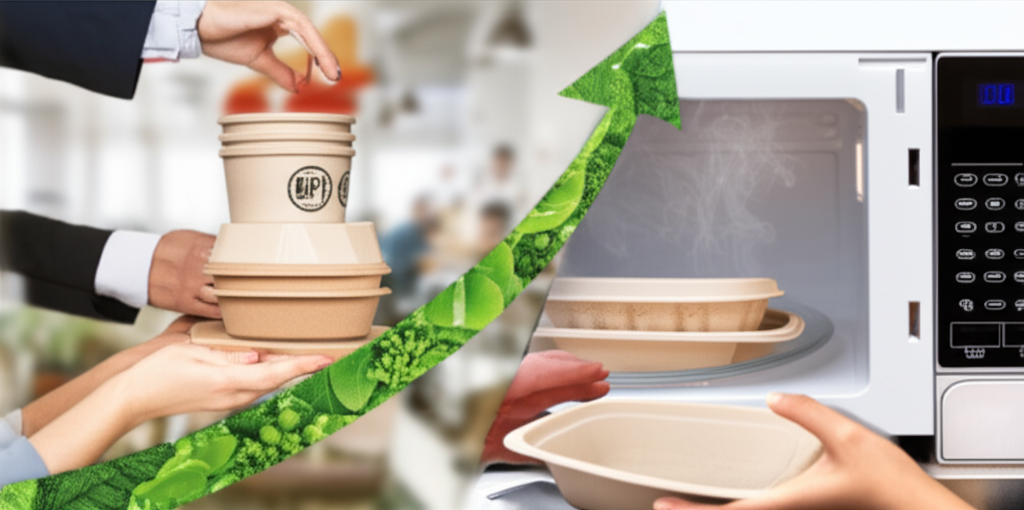
At the heart of reliable compostable packaging lies rigorous certification. The Biodegradable Products Institute (BPI) offers North America’s leading third-party verification program for compostable products. BPI certification ensures that products rigorously meet ASTM D6400 or D6868 standards, which dictate that items will achieve 90% disintegration within 12 weeks and 90% biodegradation within 180 days in industrial composting facilities. This meticulous testing guarantees that BPI-certified products break down into non-toxic biomass, water, and carbon dioxide, without leaving harmful residues or microplastics.
Crucially, addressing significant chemical concerns, BPI has proactively evolved its standards. As of January 1, 2020, BPI prohibits intentionally added PFAS (per- and polyfluoroalkyl substances) in certified products, with a strict limit of less than 100ppm total fluorine. This commitment to eliminating “forever chemicals” from the supply chain sets a vital benchmark for environmental and human health safety in compostable packaging.
BPI certification guarantees rigorous compostability standards, including the absence of intentionally added PFAS.
Unpacking “Microwave Safe” for BPI Certified Compostable Packaging
While BPI certification is the benchmark for compostability, a product’s “microwave-safe” status depends primarily on its material composition and specific design. It’s imperative for B2B buyers to understand these distinctions to ensure both operational suitability and safety.
Material Matters for Microwave Safety:
- Sugarcane Bagasse & Plant Fibers: Materials like sugarcane bagasse (a byproduct of sugarcane processing) and other plant fibers (such as bamboo, miscanthus, or sorghum) are generally highly regarded for their heat resistance. Products made from these natural fibers are typically microwave-safe, capable of withstanding temperatures up to 200°F (93°C) for approximately 20 minutes for reheating. Some advanced plant fiber items are engineered to handle even higher temperatures, up to 450°F, making them microwave-safe for 2-3/4 minutes (unlined) and 5-3/4 minutes (lined) of heating.
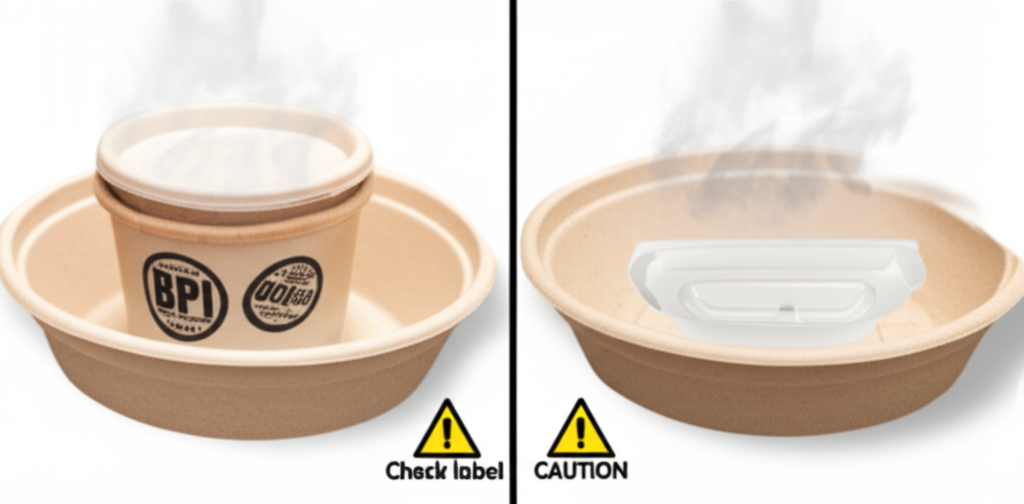
- PLA (Polylactic Acid) Considerations: Polylactic Acid, a bioplastic derived from renewable resources like corn starch, is widely used in compostable packaging. However, standard PLA can be sensitive to high heat and may warp or melt when exposed to microwave temperatures. While some specialized “white PLA” containers are explicitly designed and certified as microwave-safe, it is crucial to always check for explicit “microwave-safe” labels or symbols on PLA products. CPLA (crystallized polylactic acid), while designed for hot foods, is generally not microwave-safe.
General Microwave Usage Guidelines:
Even with microwave-safe compostable packaging, best practices are essential. Advise your operations teams to:
- Always check for the “microwave-safe” label on the product itself. If it’s not explicitly stated, avoid microwaving.
- Use lower power settings and shorter heating intervals (e.g., 30-second to 1-minute bursts) to prevent overheating and potential deformation.
- Remove or vent lids before microwaving to prevent steam buildup and breakage.
- Avoid using for high-fat or sugary foods, as these can reach extremely high temperatures that might compromise the container’s integrity.
- Recognize that most compostable containers are designed for single use and may not withstand repeated microwave exposure or washing.
Microwave safety for compostable packaging depends on material and explicit labeling; always follow usage guidelines.
Regulatory Landscape and Compliance for Microwave Safe Compostable Packaging
Navigating the complex web of regulations is a core responsibility for supply chain and procurement leaders. BPI-certified compostable packaging, particularly those designed for microwave use, must comply with stringent food contact material regulations across key markets.
In the U.S., FDA governs food contact materials, with compliance under GMP regulation (21 CFR 174.5) and FCN program assessing microwave suitability. The EU Framework Regulation (EC) No 1935/2004 and EN 13432 mandate safety for intended use, including microwaving, and the SUPD bans many conventional single-use plastics. Internationally, Australia’s AS4736:2006 aligns with EN 13432, Canada promotes certified compostable ware, and Japan transitions to a “Positive List” system by June 2025. These global movements underscore the growing imperative for certified and safe compostable solutions. For full details on global regulatory frameworks, refer to our comprehensive guide on sustainable packaging regulations. Learn more about global sustainable packaging regulations.
Global regulations increasingly mandate certified compostable packaging, requiring B2B compliance for microwave-safe solutions.
B2B Operational Impact & ROI of BPI Compostable Microwave Safe Solutions
Adopting BPI-certified microwave-safe compostable packaging offers a multi-faceted return on investment for B2B operations, extending far beyond mere compliance.
- Waste Diversion & Cost Savings: Redirecting organic waste (food scraps and certified compostable packaging) from landfills to composting facilities can significantly reduce disposal fees. For composters, the removal of non-compostable contaminants often accounts for approximately 17% of operating expenses. By enabling cleaner waste streams, businesses can contribute to cost efficiencies in the composting infrastructure, potentially reducing their own waste hauling costs in the long run. Embracing a comprehensive sustainable waste management strategy can further unlock these savings. For more insights, refer to our B2B playbook on sustainable waste management. Read our B2B playbook on sustainable waste management.
- Enhanced Brand Reputation & ESG Commitment: In an era of heightened corporate social responsibility, adopting BPI-certified compostable packaging signals a strong commitment to environmental, social, and governance (ESG) principles. This proactive stance enhances brand reputation, builds trust with consumers and stakeholders, and can lead to higher brand valuation growth for companies with strong sustainability positioning.
- Meeting Mandates & Regulatory Compliance: Forward-thinking businesses are not waiting for mandates; they are preparing for them. California’s groundbreaking SB 54, for instance, requires all packaging to be recyclable or compostable by 2032. Proactive adoption of certified solutions ensures compliance with current and impending regulations, mitigating future risks and potential penalties.
- Capturing Consumer Preference: Consumer demand is a powerful market force. Over 60% of diners actively check for compostable or recyclable takeout materials, and 7 in 10 diners are more likely to purchase from establishments that use sustainable packaging. Providing convenient, microwave-safe, and genuinely compostable options directly addresses this growing preference, boosting customer satisfaction and loyalty. Understanding the nuances of “compostable” versus “biodegradable” is critical for clear communication with your customers and internal teams. Learn more about this distinction in our sustainability guide: Explore the compostable vs. biodegradable distinction.
| Feature | B2B Operational Impact | Compliance Note | ROI Potential |
|---|---|---|---|
| BPI Certification | Streamlines waste sorting for foodservice operations. | Meets ASTM D6400/D6868; PFAS-free since 2020. | Reduces landfill costs, boosts brand loyalty. |
| Microwave Safety | Supports convenient reheating of grab-and-go meals. | Requires “microwave-safe” labeling on product. | Enhances customer satisfaction and service offerings. |
| Plant-Based Materials | Reduces reliance on fossil fuels in supply chain. | USDA Biobased certification for renewable content. | Appeals to eco-conscious consumers, lowers carbon footprint. |
| Durability (e.g., Bagasse) | Minimizes leaks and breakage during transport and use. | Ensures food safety and product integrity under heat. | Prevents product loss, reduces customer complaints. |
BPI-certified microwave-safe packaging offers significant ROI through waste reduction, brand enhancement, and compliance.
Case Studies: Leading the Charge in Sustainable Microwaveable Packaging

Real-world applications underscore the viability and impact of BPI-certified microwave-safe solutions. Forward-thinking companies are not just adopting these materials but innovating to push their boundaries.
- Good Natured Products Inc.: This North American leader has successfully launched BPI-certified microwavable to-go containers. Made from an impressive 97% plant-based materials, these containers are engineered for durability and leak resistance, performing comparably to traditional plastic counterparts. Their success demonstrates that high-performance, commercially viable, and affordable plant-based microwaveable packaging is achievable through dedicated development and a commitment to sustainability. As Paul Antoniadis, CEO of good natured Products Inc., emphasized in a BNN Bloomberg interview, these products ensure “your customers can heat up their grub in peace knowing there’s nothing nasty leaching into it!”
- W-Cycle’s SupraPulp™: A remarkable innovation in the field, SupraPulp™ is a patented material derived primarily from sugarcane bagasse, with potential for other feedstocks like reed, wood, and banana leaves. Developed in part to address an Israeli government challenge for hot and greasy food trays in schools, SupraPulp™ is fully compostable and boasts an extraordinary temperature resistance, withstanding conditions from -40°C to 270°C (-40°F to 518°F). This material’s ability to be both liquid and oil-proof, preventing wetting by oily and moist foods, showcases the advanced engineering now possible in sustainable, microwave-safe packaging.
These examples highlight that the industry is moving beyond basic compostability to deliver solutions that meet the rigorous demands of modern foodservice operations, from freezer to microwave.
Case studies demonstrate the viability and high performance of BPI-certified microwave-safe packaging in foodservice.
Future Outlook and Trends in BPI Compostable Microwave Packaging
The trajectory for BPI-certified compostable microwave packaging is one of accelerating innovation and market expansion over the next 5-10 years.
- Market Projections: The broader compostable packaging market is projected to reach USD 232.47 billion by 2034, growing at a robust CAGR of 8.4%. This indicates a clear long-term growth opportunity for businesses positioned in this space.
- Advanced Materials & Design: Innovations will continue to focus on enhancing performance. Expect the widespread adoption of PHA bioplastics (Polyhydroxyalkanoates), which are fully biodegradable even in marine environments, offering superior moisture resistance and durability. Furthermore, integrated self-venting mechanisms, already emerging in microwave packaging, will become standard for compostable options. These built-in valves or pre-engineered weak spots will automatically release steam, preventing bursting and ensuring more evenly cooked food without manual intervention. New materials like nano-cellulose and edible coatings are also on the horizon, promising lighter, stronger, and even more environmentally benign packaging.
- Stricter Regulatory Landscape: The regulatory environment will become increasingly stringent. More U.S. states and international jurisdictions are expected to mandate certified compostable packaging and implement clear labeling requirements to combat “greenwashing” and consumer confusion. California’s SB 54 is just one example, with BPI certification likely becoming mandatory for foodservice packaging in seven additional states by 2026. This regulatory push will accelerate adoption as businesses strive for compliance.
- Infrastructure Expansion: The success of compostable packaging relies heavily on robust composting infrastructure. Future trends include greater collaborative efforts between packaging manufacturers, composters, and municipalities to expand industrial composting facilities. Programs like the Composting Consortium are actively working to build a roadmap for investment in technologies and infrastructure, bridging the gap between product availability and proper end-of-life processing.
- Beyond PFAS: Towards Truly Chemical-Free Solutions: While BPI has already taken a significant step by prohibiting intentionally added PFAS, the future will see an even greater emphasis on “free from” claims across a wider spectrum of chemicals of concern. This commitment to safer materials will become a standard expectation, driven by consumer demand and a growing body of peer-reviewed research on chemical migration from packaging into food.
The future of BPI compostable microwave packaging promises innovation, stricter regulations, and infrastructure growth.
Challenges to Broader B2B Adoption
Despite the promising outlook, several significant challenges must be addressed for broader B2B adoption of BPI-certified compostable microwave packaging:
- Infrastructure Gaps: A critical barrier remains the limited commercial composting infrastructure. Currently, only about 10% of U.S. composting facilities accept food scraps, which are essential for processing most compostable packaging. This means that even certified products often end up in landfills if regional composting options are unavailable, negating their intended environmental benefit.
- Consumer Confusion: Widespread consumer confusion is a major hurdle. Misleading labels, a lack of clear differentiation between “compostable,” “biodegradable,” and conventional plastics, and insufficient education cause significant contamination in both composting and recycling streams. This forces composters to dedicate substantial resources (up to 17% of operating expenses) to remove contaminants, sometimes leading to entire loads being diverted to landfills.
- Cost & Scalability: The initial higher cost of compostable materials and manufacturing processes compared to traditional plastics can deter businesses, particularly smaller enterprises. While innovations are reducing costs, achieving cost parity and scaling production to meet mass market demand remains a challenge.
- Chemical Migration Concerns (General Packaging Context): While BPI specifically addresses PFAS, some peer-reviewed research indicates broader chemical migration risks from plastics when subjected to microwave conditions. Studies have shown that microwave heating can lead to the migration of various intentionally and non-intentionally added substances (IAS/NIAS) and even microplastics from general plastic food containers into food. While BPI’s rigorous certification for compostables aims to mitigate chemical concerns, the industry must continuously innovate and provide transparency on all material components to build full confidence among B2B buyers regarding overall food safety under microwave conditions.
Infrastructure, consumer confusion, cost, and chemical migration are key challenges for broader B2B adoption.

Competitive Advantage & Business Case
For B2B decision-makers, the transition to BPI-certified microwave-safe compostable packaging represents a clear competitive advantage and a robust business case.
- Quantifiable Cost Savings & Risk Mitigation: While initial material costs might be higher, the long-term operational savings from waste diversion can be significant. By facilitating the composting of food-soiled packaging, businesses can reduce landfill disposal fees, potentially saving up to 17% on waste management expenses for operations partnered with industrial composters. Furthermore, proactive adoption mitigates the increasing compliance risks associated with single-use plastic bans and evolving PFAS regulations, protecting your brand from future penalties and public scrutiny.
- Enhanced Brand Value & Market Share Opportunity: Aligning with increasing consumer demand for sustainability is a powerful differentiator. Companies with strong ESG commitments achieve higher brand valuation growth. By visibly demonstrating your dedication to eco-friendly practices through certified compostable packaging, you attract environmentally conscious consumers and strengthen loyalty. Over 70% of diners are more likely to choose establishments using sustainable packaging, providing a direct market share opportunity in a competitive landscape. This commitment transcends simple marketing; it speaks to the core values of modern consumers and partners. Our detailed guide on BPI compostable certification in hospitality highlights how these efforts translate into tangible business benefits: Discover BPI certification benefits in hospitality.
- Operational Streamlining: For foodservice operations, BPI-certified packaging simplifies waste sorting. Food-soiled compostable items can be collected together, streamlining back-of-house operations and reducing staff training complexities associated with separating different waste streams. This operational efficiency further reinforces the business case.
Adopting BPI-certified microwave-safe packaging offers competitive advantages, cost savings, and enhanced brand value.
Frequently Asked Questions (FAQ)
❓ Are all BPI-certified compostable products microwave safe?
No. Microwave safety depends on the material:
- Sugarcane bagasse & plant fibers → Generally microwave-safe; can handle moderate reheating.
- PLA (Polylactic Acid) → Sensitive to heat; may warp or melt. Only specialized versions (e.g., “white PLA”) may be microwave-safe.
✅ Always look for explicit “microwave-safe” labels before use.
❓ What are the key benefits of using BPI-certified microwave-safe packaging in foodservice?
- Waste Diversion & Cost Savings → Reduces landfill fees by enabling organic waste + packaging composting.
- Compliance & Risk Mitigation → Meets ASTM standards and avoids penalties under regulations like California SB 54.
- ESG & Brand Reputation → Demonstrates sustainability leadership, builds consumer trust, and improves ESG ratings.
- Operational Efficiency → Simplifies sorting—food-soiled packaging can go directly into compost bins.
❓ How do BPI-certified products address PFAS concerns?
Since January 2020, BPI prohibits intentionally added PFAS in all certified products.
- Limit: <100 ppm total fluorine.
- Outcome: Safe for food contact, eliminates harmful “forever chemicals,” and reduces regulatory risk.
❓ What are the main challenges for B2B adoption of compostable microwave packaging?
- Limited Composting Infrastructure → Only a fraction of facilities accept compostable packaging.
- Consumer Confusion → Many mistakenly place compostables in recycling bins, leading to contamination.
- Higher Upfront Costs → Compostable materials often cost more than plastics, though ROI improves over time.
- Chemical Migration Concerns → Ongoing research needed to ensure food safety under all microwave conditions.
FAQs clarify BPI certification, microwave safety, benefits, PFAS, and adoption challenges for B2B buyers.
Conclusion: Embracing BPI Compostable Microwave Safety for a Sustainable Future
BPI-certified compostable microwave-safe packaging offers a compelling, scientifically backed solution for businesses committed to both environmental stewardship and operational excellence. While challenges in infrastructure and consumer education persist, these are actively being addressed through industry collaboration, stricter regulations, and continuous material innovation.
By strategically leveraging advanced plant-based materials and adhering to recognized certifications like BPI, businesses can confidently meet increasing consumer demand for eco-friendly products. This proactive approach not only helps achieve critical ESG objectives but also differentiates your brand, mitigates regulatory risks, and contributes to a more circular economy. The decision to invest in BPI-certified microwave-safe solutions is an investment in your brand’s future, aligning profitability with planetary responsibility.Strategize your procurement today
Integrate BPI compostable microwave-safe packaging to enhance sustainability, ensure operational excellence, and differentiate your brand.