¿Cuánto tiempo tarda el material compostable BPI en descomponerse? Una guía estratégica para líderes B2B
Por un estratega sénior de contenidos de sostenibilidad B2B
El impulso global por la sostenibilidad ha transformado el panorama operativo de las empresas B2B. Con una mayor conciencia ambiental y una red de regulaciones cada vez más compleja, las empresas se encuentran bajo una inmensa presión para adoptar prácticas más ecológicas. A la vanguardia de este cambio está la creciente demanda de materiales compostables, particularmente aquellos certificados por laInstituto de Productos Biodegradables (BPI). La certificación BPI sirve como garantía vital para las declaraciones medioambientales, pero para los gerentes de adquisiciones, directores de operaciones, responsables de sostenibilidad y ejecutivos de la cadena de suministro en las industrias hotelera y de servicios de alimentos, es fundamental comprender los plazos y las condiciones precisas de avería de los materiales certificados por BPI. Ignorar este detalle crucial puede generar riesgos de cumplimiento, ineficiencias operativas y oportunidades perdidas en un mercado en rápida evolución.
Considere las implicaciones comerciales: se prevé que el mercado mundial de envases compostables, valorado en 55 530 millones de dólares en 2024, alcance los 89 850 millones de dólares en 2032, lo que demuestra una sólida tasa de crecimiento anual compuesto (CAGR) del 6,20 % entre 2025 y 2032 (Fuente:Investigación de Grand View, 2024). Este aumento refleja no solo una tendencia sino una recalibración fundamental de las cadenas de suministro hacia la circularidad. Las empresas que comprenden claramente los mecanismos de la compostabilidad BPI están mejor posicionadas para satisfacer esta demanda, mitigar los costos de eliminación de residuos y mejorar la reputación de su marca. Esta guía proporciona información esencial, respaldada por datos, para los tomadores de decisiones B2B sobre el rendimiento del compostaje de materiales certificados por BPI, ayudándole a navegar este imperativo estratégico con confianza.
Comprender el desglose del material compostable de BPI es crucial para que las empresas de hostelería y servicios de alimentación garanticen el cumplimiento y aprovechen las oportunidades del mercado.
Decodificación de los tiempos de descomposición del material compostable BPI para operaciones B2B
Los materiales compostables con certificación BPI no son simplemente “biodegradables” en un sentido vago; están meticulosamente diseñados para descomponerse en condiciones específicas y controladas que se encuentran en las instalaciones de compostaje industrial. Esta distinción es fundamental para las operaciones B2B, ya que tiene un impacto directo en las estrategias de gestión de residuos y las reclamaciones medioambientales. El proceso de certificación exige el cumplimiento de rigurosos estándares de la Sociedad Estadounidense de Pruebas y Materiales (ASTM), principalmente ASTM D6400 y ASTM D6868.
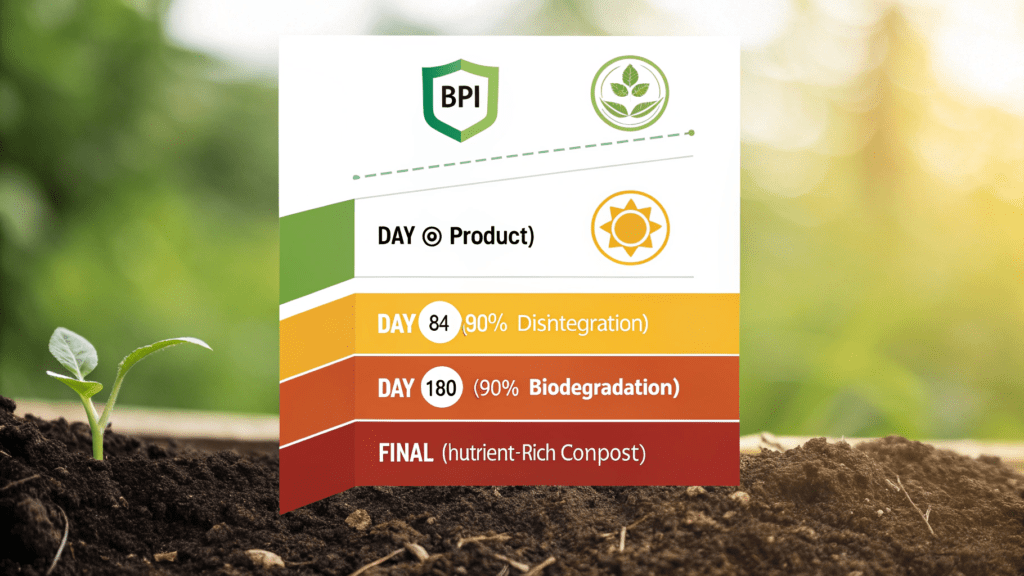
Estos estándares estipulan puntos de referencia de desempeño claros. Para la desintegración física, los productos certificados por BPI deben descomponerse en pequeños fragmentos (menos de 2 mm) dentro de84 días (12 semanas)cuando se somete a condiciones de compostaje industrial. Esto asegura que el material se vuelva indistinguible del compost. Más allá de la desintegración física, la biodegradación total (la conversión de carbono orgánico en dióxido de carbono, agua, compuestos inorgánicos y biomasa) debe ocurrir en al menos el 90% dentro de180 días (6 meses). Lo más importante es que este proceso no debe dejar residuos tóxicos ni metales pesados, lo que garantiza que el abono resultante sea seguro y beneficioso para el suelo.
Cumplimiento de las normas ASTM: requisitos D6400 y D6868
La norma ASTM D6400 aborda específicamente los plásticos compostables, mientras que la ASTM D6868 se aplica a materiales compuestos, como los que combinan bioplásticos con papel o fibra. Ambos estándares son fundamentales para la certificación BPI y dictan cómo deben funcionar los productos en un entorno de compostaje industrial. Exigen una biodegradación mínima del 90 % del carbono orgánico en CO2 en un plazo de 180 días, lo que demuestra que el material es realmente consumido por microorganismos. Además, el requisito de desintegración física del 90 % en 84 días garantiza que el material no permanezca como fragmentos problemáticos en el compost terminado. Un aspecto clave de estas normas es la prohibición de que queden residuos tóxicos o metales pesados después del compostaje, garantizando la integridad y seguridad del producto final del compost. Este riguroso proceso de prueba y certificación ayuda a las empresas a evitar afirmaciones engañosas de "lavado verde" y garantiza un impacto ambiental genuino.
El papel fundamental de las instalaciones de compostaje industrial
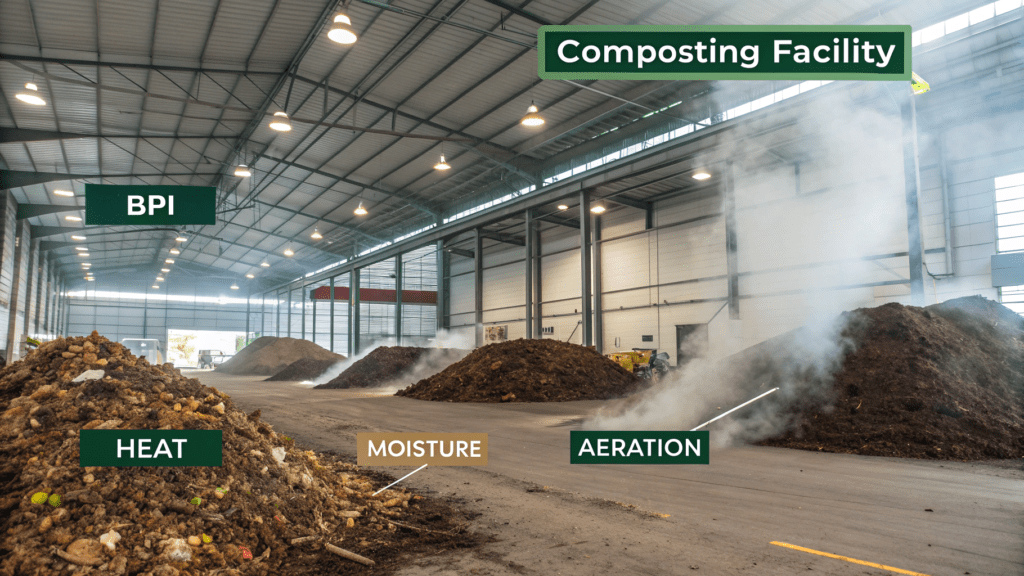
Es vital que las partes interesadas B2B comprendan que los productos certificados por BPI están diseñados explícitamente para instalaciones de compostaje industrial, no para pilas de compost en el patio trasero o vertederos en general. Las instalaciones industriales proporcionan las condiciones óptimas (calor elevado (normalmente entre 150 y 160 °F), niveles de humedad controlados y aireación constante) que son esenciales para acelerar la actividad microbiana y la descomposición eficiente. Estos entornos controlados garantizan que los materiales certificados por BPI se descompongan según los plazos previstos.
Sin acceso a tales instalaciones, incluso los productos certificados por BPI pueden no descomponerse según lo previsto y terminar potencialmente en vertederos donde pueden descomponerse anaeróbicamente y producir metano, un potente gas de efecto invernadero. El tiempo real necesario para que los productos se descompongan también puede variar en la práctica, oscilando entre 30 y 190 días, dependiendo de factores específicos de la instalación, como las prácticas de gestión y la composición y el espesor específicos del material. Esta variabilidad subraya la importancia de una infraestructura de compostaje sólida, un desafío importante en muchas regiones de América del Norte y Europa.
Los materiales certificados por BPI se descomponen en un plazo de 84 a 180 días en condiciones de compostaje industrial, lo que es crucial para una gestión eficaz de los residuos B2B.
El imperativo estratégico: materiales compostables certificados por BPI y cumplimiento
Adoptar materiales certificados BPI es más que un gesto medioambiental; es un imperativo empresarial estratégico que garantiza la alineación con los mandatos de sostenibilidad emergentes y salvaguarda la reputación de la marca. La marca de certificación BPI valida las afirmaciones medioambientales y proporciona verificación por parte de terceros de que los productos cumplen con estrictos estándares científicos. Esto es particularmente crucial a medida que los organismos reguladores y los consumidores examinan cada vez más las iniciativas de sostenibilidad corporativa, especialmente dentro de los sectores de hotelería y servicios de alimentos, donde prevalecen los artículos de un solo uso.
Más allá del rendimiento ante averías, la certificación BPI también incluye salvaguardias críticas contra productos químicos nocivos. Desde el 1 de enero de 2020, BPI ha exigido que todos los artículos certificados tengan menos de 100 partes por millón (ppm) de flúor total, lo que garantiza de manera efectiva que no haya PFAS (sustancias perfluoroalquiladas) agregadas intencionalmente. Esta medida proactiva mitiga los riesgos legales y de reputación asociados con las sustancias químicas persistentes. También es importante reiterar que "compostable" (con su tiempo y condiciones de descomposición definidos) difiere significativamente del término general y a menudo indefinido "biodegradable", lo que proporciona un estándar mucho más alto de responsabilidad ambiental. Para profundizar en estas distinciones, explore nuestra guía sobreBPI Compostable vs. Biodegradable: Guía de Sostenibilidad.
Navegando por los panoramas regulatorios y la certificación
El panorama regulatorio en torno a los materiales compostables está evolucionando rápidamente, lo que plantea desafíos y oportunidades para las empresas. En Estados Unidos, el Programa Orgánico Nacional (NOP) del Departamento de Agricultura (USDA) está debatiendo actualmente si se deben incluir bioplásticos en el abono orgánico certificado, una decisión que tendrá un profundo impacto en la industria del compostaje. De manera similar, las leyes de Responsabilidad Extendida del Productor (EPR) están ganando terreno en América del Norte, y varias provincias canadienses y cuatro estados de EE. UU. han aprobado dichas leyes. BPI aboga activamente por que estos fondos EPR apoyen específicamente la expansión de la infraestructura de compostaje y la educación pública, en lugar de desviarlos a otras corrientes de gestión de residuos.
Además, la confusión de los consumidores respecto a la eliminación adecuada sigue siendo un obstáculo importante. Los estudios muestran que casi un tercio de los consumidores encuestados colocan por error envases compostables en contenedores de reciclaje (Fuente:Reciclaje de recursos, 2023). Para combatir esto, BPI, en colaboración con el Consejo de Compostaje de EE. UU. (USCC), está trabajando para desarrollar principios para un etiquetado claro y estandarizado, incluida la exhibición destacada de la marca BPI. Un etiquetado claro es crucial para minimizar la contaminación y garantizar que los artículos compostables lleguen al final de su vida útil previsto, especialmente en entornos de gran volumen como hoteles y cafeterías.
La certificación BPI garantiza el cumplimiento y mitiga los riesgos, algo crucial para que la hostelería y el servicio de alimentación naveguen por las cambiantes regulaciones de sostenibilidad.
Cuantificación del valor: impacto operativo de las soluciones compostables de BPI
La integración de materiales compostables con certificación BPI en su cadena de suministro ofrece beneficios operativos tangibles que se extienden más allá del cumplimiento ambiental. Una ventaja principal es la reducción de los residuos de los vertederos, lo que se traduce directamente en menores costes de eliminación para las empresas. A medida que las tarifas de vertido de vertederos siguen aumentando y aumentan las presiones regulatorias, desviar los residuos de los vertederos se convierte en una propuesta económica cada vez más atractiva para hoteles, restaurantes y servicios de catering.
Sin embargo, el camino no está exento de desafíos. La contaminación por materiales no compostables sigue siendo un obstáculo importante para las instalaciones de compostaje, y a algunas les cuesta hasta el 17% de sus gastos operativos totales en eliminación de contaminantes (Fuente:Consejo de Compostaje de EE. UU., 2023). Este número destaca la necesidad crítica de sistemas de recolección efectivos y educación del consumidor en entornos de hotelería y servicios de alimentos. Además, la insuficiente infraestructura de compostaje industrial en muchas regiones presenta obstáculos logísticos, lo que obliga a las empresas a evaluar cuidadosamente las capacidades locales al implementar soluciones compostables. A pesar de estos desafíos, la adopción de soluciones certificadas por BPI mejora significativamente el perfil de responsabilidad social corporativa (RSC) de una empresa, fortalece la imagen de marca y mejora el posicionamiento en el mercado en una economía cada vez más consciente del medio ambiente.
| Característica | Impacto operativo B2B | Nota de cumplimiento | Potencial de retorno de la inversión |
|---|---|---|---|
| Certificación BPI | Garantiza la eliminación adecuada al final de su vida útil en entornos industriales; simplifica la gestión del flujo de residuos en la hostelería. | Cumple con ASTM D6400/D6868; evita residuos nocivos, apoyando los estándares de compost orgánico. | Imagen de marca mejorada; apoya los objetivos de sostenibilidad, atrayendo clientes con conciencia ecológica. |
| Elección de material (por ejemplo, PLA) | Versátil para diversas aplicaciones de embalaje y servicios de alimentos (por ejemplo, contenedores rígidos, películas). | Debe alcanzar un 90% de desintegración (84 días) y un 90% de biodegradación (180 días). | Accesses growing market segments (Food & Beverage: 48.7% of global market by 2025); broad applicability. |
| Compostaje Industrial | Requiere logística específica de recolección y procesamiento; Optimiza el proceso de descomposición. | Los productos certificados por BPI dependen de estas condiciones controladas para una descomposición efectiva. | La desviación del vertedero ahorra costos de eliminación; reduce las emisiones de metano, contribuyendo a los objetivos de reducción de carbono. |
| Compromiso libre de PFAS | Garantiza la seguridad y pureza del producto; evita un posible escrutinio regulatorio y responsabilidad. | BPI requiere menos de 100 ppm de flúor total desde enero de 2020. | Mitiga los riesgos legales y reputacionales; genera confianza en el consumidor y diferencia las ofertas. |
Rendimiento en el mundo real: conocimientos del estudio del Consorcio de Compostaje
La eficacia de los materiales certificados por BPI en entornos de compostaje industrial del mundo real ha sido rigurosamente validada. Un innovador estudio de campo a gran escala, realizado en abril de 2024 por el Composting Consortium (una iniciativa de Closed Loop Partners) en América del Norte, proporciona pruebas convincentes. Este estudio probó rigurosamente más de 23,000 unidades de envases compostables certificados para contacto con alimentos en 10 instalaciones de compostaje diversas de EE. UU., que representan varios parámetros operativos.
Los resultados fueron muy alentadores: los envases de plástico compostables lograron una impresionante desintegración del 98% en promedio, superando significativamente el umbral de la industria del 90%. De manera similar, los envases de fibra compostables demostraron una desintegración promedio del 83%, cumpliendo con los puntos de referencia establecidos de la industria. Este estudio confirma que cuando los envases con certificación BPI se procesan en instalaciones que cumplen con parámetros operativos razonables, se descomponen con éxito, lo que subraya la confiabilidad del estándar BPI en aplicaciones prácticas. Esta validación del mundo real debería infundir confianza a los tomadores de decisiones B2B en hotelería y servicios de alimentos que están considerando una transición a soluciones compostables. Para comprender más sobre cómo gestionar esta transición de forma eficaz, considere revisar nuestraGuía B2B para la gestión sostenible de residuos.
Las soluciones certificadas por BPI ofrecen beneficios operativos tangibles, incluidos costos reducidos de vertederos y un perfil de RSC mejorado.
Impulsando hacia adelante: las perspectivas del mercado para los materiales compostables de BPI
La trayectoria de los materiales compostables de BPI es de expansión significativa, impulsada por la creciente demanda de los consumidores, los impulsores regulatorios y la innovación continua. Se prevé que el mercado mundial de envases compostables alcance los 89.850 millones de dólares estadounidenses para 2032, exhibiendo una sólida tasa de crecimiento anual compuesto (CAGR) del 6,20% entre 2025 y 2032. Este crecimiento es un indicador claro de que las empresas que priorizan las soluciones compostables se están alineando con una tendencia dominante del mercado.
El ácido poliláctico (PLA), derivado de fuentes agrícolas renovables como el almidón de maíz y la caña de azúcar, está preparado para seguir siendo un material líder y se prevé que tendrá una cuota de mercado sustancial del 36,4% para 2025 en el segmento de envases de plástico compostables. Su versatilidad en aplicaciones, desde contenedores rígidos hasta películas flexibles, lo posiciona como un material de referencia para diversas industrias, especialmente el sector de alimentos y bebidas, que se espera que lidere la demanda de uso final con una participación del 48,7 % para 2025. Líderes clave de la industria como Amcor, Mondi Group, NatureWorks y Eco-Products están invirtiendo activamente y ampliando sus ofertas de compostables, lo que indica un compromiso más amplio de la industria.
Impulsando la adopción: innovación e inversión en infraestructura
La creciente demanda de productos sostenibles por parte de los consumidores está impulsando activamente el cambio hacia un modelo de bioeconomía circular, en el que los materiales están diseñados para ser reutilizados, reciclados o convertidos en abono. Los avances en la ciencia de los materiales están generando continuamente soluciones compostables más robustas y versátiles. Más allá de los materiales establecidos como el PLA, están surgiendo nuevas opciones innovadoras, incluidos los polihidroxialcanoatos (PHA), polímeros producidos por fermentación microbiana, e incluso envases a base de micelio derivados de las estructuras de las raíces de los hongos, que ofrecen alternativas ecológicas a las espumas plásticas tradicionales. Estas innovaciones están ampliando las capacidades funcionales de los materiales compostables, igualando las de los plásticos convencionales en muchas aplicaciones relevantes para la hostelería y el servicio de alimentos.
La integración tecnológica, como la aplicación de la Inteligencia Artificial (IA) y el Aprendizaje Automático (ML) en los procesos de certificación, mejorará la transparencia y la eficiencia en la verificación de la biodegradabilidad. Fundamentalmente, satisfacer la creciente demanda y los objetivos políticos depende de una inversión significativa en infraestructura de compostaje. Iniciativas como la Coalición de Infraestructura de Compostaje de EE. UU. (USCIC) están trabajando para establecer capacidades generalizadas de compostaje, promoviendo legislación y subvenciones para financiar la expansión necesaria. Este compromiso con el desarrollo de infraestructura es primordial para que las empresas B2B obtengan plenamente los beneficios ambientales y económicos de los materiales certificados por BPI. Para las empresas hoteleras que buscan aprovechar la certificación BPI para sus objetivos de sostenibilidad, nuestra guía sobreBPI Compostable Certification & Hospitality Sustainabilityofrece información valiosa.
El mercado de materiales compostables se está expandiendo, impulsado por la innovación y las inversiones cruciales en infraestructura para la adopción B2B.
Competitive Advantage & Business Case
Para los tomadores de decisiones B2B en hotelería y servicios de alimentos, adoptar materiales compostables con certificación BPI se traduce en una ventaja competitiva convincente y un sólido argumento comercial. Más allá de los beneficios ambientales directos, existen ganancias cuantificables. Al reducir los desechos de los vertederos, las empresas pueden lograr ahorros significativos en los costos de eliminación, que pueden representar una parte sustancial de los gastos operativos. Además, el cumplimiento de las normativas en evolución, como la Directiva sobre plásticos de un solo uso de la UE y las leyes EPR emergentes de EE. UU., mitiga el riesgo de multas y desafíos legales, preservando el valor de la marca.
La oportunidad de participación de mercado es sustancial: con el mercado mundial de envases compostables preparado para un crecimiento significativo, los primeros usuarios obtienen la ventaja de ser los primeros en actuar. Las empresas que se comprometan de manera demostrable con las soluciones certificadas por BPI pueden atraer al creciente segmento de consumidores y socios B2B conscientes del medio ambiente, mejorando el valor de la marca y fomentando una mayor lealtad de los clientes. Este giro estratégico también puede conducir a mejores relaciones con proveedores de materiales innovadores y al potencial de nuevas fuentes de ingresos a través de líneas de productos sostenibles. El cambio hacia envases compostables no se trata sólo de reducir la huella ambiental; se trata de posicionar su empresa para el liderazgo del mercado futuro y la resiliencia en una economía impulsada por la sostenibilidad.
La adopción de materiales certificados por BPI ofrece una ventaja competitiva, reduciendo costos, garantizando el cumplimiento y mejorando el valor de la marca.
Conclusión
Los materiales compostables con certificación BPI ofrecen un camino vital, respaldado científicamente, para lograr operaciones sostenibles. Comprender los plazos precisos de su descomposición (desintegración física en 84 días y biodegradación total en 180 días en condiciones de compostaje industrial) es fundamental para una gestión eficaz de los residuos B2B y estrategias de sostenibilidad. Las empresas que priorizan la certificación BPI obtienen no sólo garantía de cumplimiento y riesgos ambientales mitigados, sino también una clara ventaja competitiva en un mercado con conciencia ecológica en rápida expansión.
Transforme su cadena de suministro para un futuro sostenible. Asóciese con proveedores de materiales compostables certificados por BPI para lograr sus objetivos ambientales y mejorar la eficiencia operativa hoy.
Adopte materiales compostables con certificación BPI para lograr objetivos de sostenibilidad y obtener una ventaja competitiva en el mercado B2B.
Contáctenos para soluciones sustentables
Preguntas frecuentes (preguntas frecuentes)
P: ¿Cómo benefician los materiales certificados por BPI a los costos de gestión de residuos de mi hotel?
R: Al desviar los artículos compostables con certificación BPI de los vertederos a instalaciones de compostaje industrial, los hoteles pueden reducir significativamente las tarifas de vertido de vertederos. Esto también ayuda a evitar posibles multas asociadas con el aumento de las regulaciones de eliminación de residuos, lo que genera ahorros de costos directos y una mejor eficiencia operativa.
P: ¿Cuáles son las diferencias clave entre los envases “compostables” y “biodegradables” para el sector alimentario?
R: “Compostable” (especialmente con certificación BPI) significa que un producto se descompondrá en elementos naturales en un período de tiempo específico (84-180 días) en condiciones de compostaje industrial, sin dejar residuos tóxicos. "Biodegradable" es un término más amplio y menos regulado que no garantiza su descomposición dentro de un período o entorno específico, lo que a menudo genera confusión y un posible lavado verde.
P: ¿Cómo puede una operación de catering a gran escala garantizar la eliminación adecuada de los materiales certificados por BPI?
R: Las operaciones de catering deben implementar contenedores de residuos claros y codificados por colores para los compostables, brindar capacitación al personal sobre la clasificación adecuada y asociarse con instalaciones de compostaje industrial locales. El etiquetado claro en el embalaje (por ejemplo, el logotipo de BPI) también ayuda a minimizar la contaminación por parte de los huéspedes.
P: ¿Los productos con certificación BPI son seguros para el contacto con alimentos en restaurantes?
R: Sí, la certificación BPI incluye requisitos estrictos para la seguridad del producto. Desde enero de 2020, BPI exige que todos los artículos certificados contengan menos de 100 ppm de flúor total, lo que garantiza de manera efectiva que no haya productos químicos PFAS agregados intencionalmente, lo que los hace seguros para el contacto con alimentos.
P: ¿Cuál es el papel de las instalaciones de compostaje industrial en la descomposición de los materiales BPI?
R: Las instalaciones de compostaje industrial proporcionan el alto calor, la humedad controlada y la aireación necesarias para que los materiales certificados por BPI se descompongan de manera eficiente dentro del plazo especificado de 84 a 180 días. Sin estas condiciones controladas, es posible que los materiales no se descompongan según lo previsto.