Nascleanúint an Gheallta Ghlais: An bhFuil Tuí PLA In-In-indíreach do d'Oibríochtaí B2B?
A Guide for Procurement Managers, Operations Directors, and Sustainability Officers in Hospitality & Foodservice
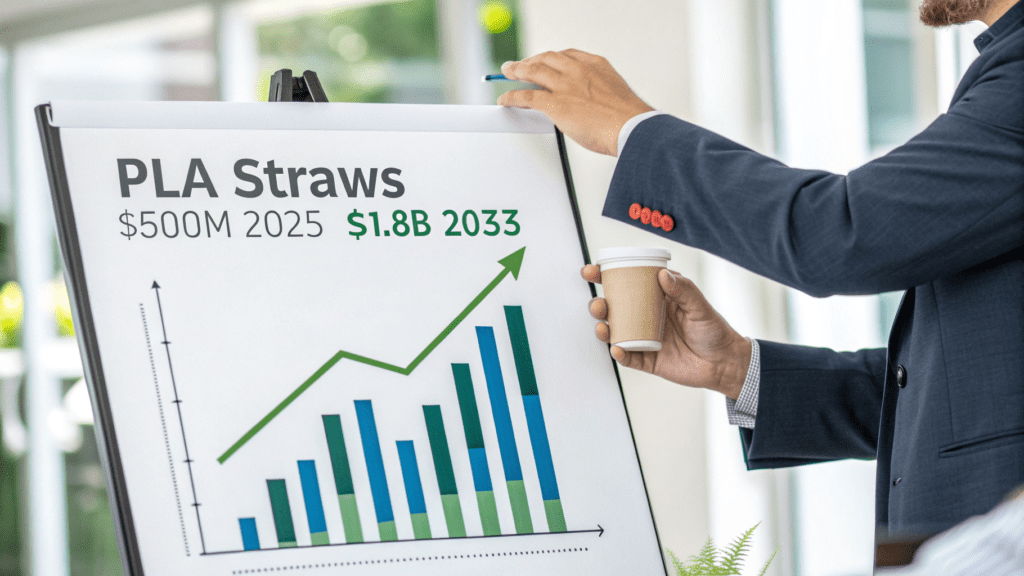
Tá an t-aistriú domhanda i dtreo na hinbhuanaitheachta tar éis sopanna Aigéad Polalachtach (PLA) a chur chun solais mar rogha éiceolaíoch seachas plaistigh traidisiúnta. Is deis shuntasach agus dúshlán casta araon é seo do bhainisteoirí soláthair, stiúrthóirí oibríochtaí, agus oifigigh inbhuanaitheachta. Meastar go n-ardóidh an margadh le haghaidh sopaí in-dhíghrádaithe PLA amháin ó $500 milliún measta in 2025 go dtí thart ar $1.8 billiún faoi 2033, arna thiomáint ag rialacháin chomhshaoil atá ag méadú agus éileamh tomhaltóirí, agus b’fhearr le breis agus 70% de thomhaltóirí gnólachtaí a úsáideann roghanna atá neamhdhíobhálach don chomhshaol. Mar sin féin, tá sé ríthábhachtach fíor-nádúr inmhúirín PLA a thuiscint. D'fhéadfadh rioscaí tromchúiseacha comhlíonta a bheith mar thoradh ar earráidí i rogha ábhar agus i mbainistíocht dramhaíola, go ndéanfaí dochar do cháil an bhranda, agus d'fhéadfadh neamhéifeachtúlachtaí oibríochtúla a bheith mar dhliteanas costasach ar thionscnamh glas.
Understanding PLA’s true compostability is crucial for hospitality and foodservice businesses to avoid compliance risks and reputational damage.
What are PLA Straws, and Why the Hype?
Is cineál bithphlaisteacha iad sopaí PLA, a dhéantar de ghnáth ó stáirsí plandaí coipthe mar arbhar, cána siúcra, casabhaigh, nó laíon biatais siúcra. Is cuid shuntasach dá n-achomharc é an tionscnamh planda-bhunaithe seo, toisc go n-úsáideann a dtáirgeadh thart ar 68% níos lú acmhainní breosla iontaise i gcomparáid le plaistigh traidisiúnta, ag ailíniú go díreach le spriocanna corparáideacha laghdaithe lorg carbóin. Deartha chun aithris a dhéanamh ar chuma, ar mhothú agus ar neart na sopaí plaisteacha traidisiúnta, cuireann PLA eispéireas eolach ar fáil don úsáideoir agus é á mhargú mar “bhithdhíghrádaithe, éicea-chairdiúil agus inmhúirín”. Mar gheall ar an leas timpeallachta braite seo is réiteach tarraingteach iad do ghnólachtaí atá ag iarraidh freastal ar éileamh méadaitheach na dtomhaltóirí ar chleachtais inbhuanaithe.
PLA straws, made from plant starches, offer a familiar user experience while reducing fossil fuel reliance.
The Nuance of “Compostable”: Understanding PLA Straws’ Requirements
Despite the prevalent marketing, the term “compostable” for PLA straws comes with critical conditions. Unlike truly biodegradable materials that break down naturally in diverse environments, PLA’s decomposition is highly dependent on a controlled setting. This distinction is crucial for B2B decision-makers assessing their environmental impact and regulatory compliance.
The Industrial Composting Imperative: Temperatures and Timeframes for PLA Straws
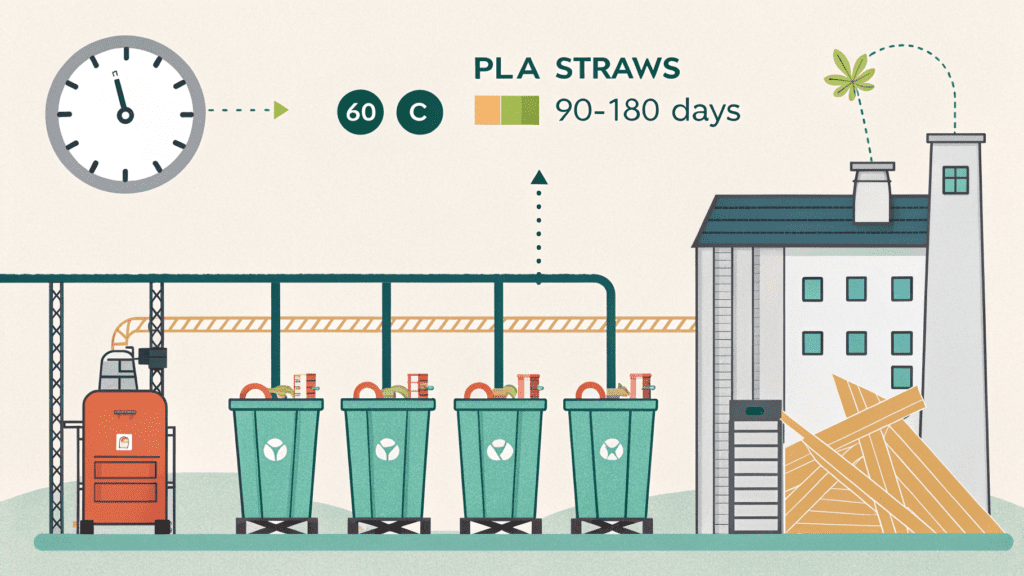
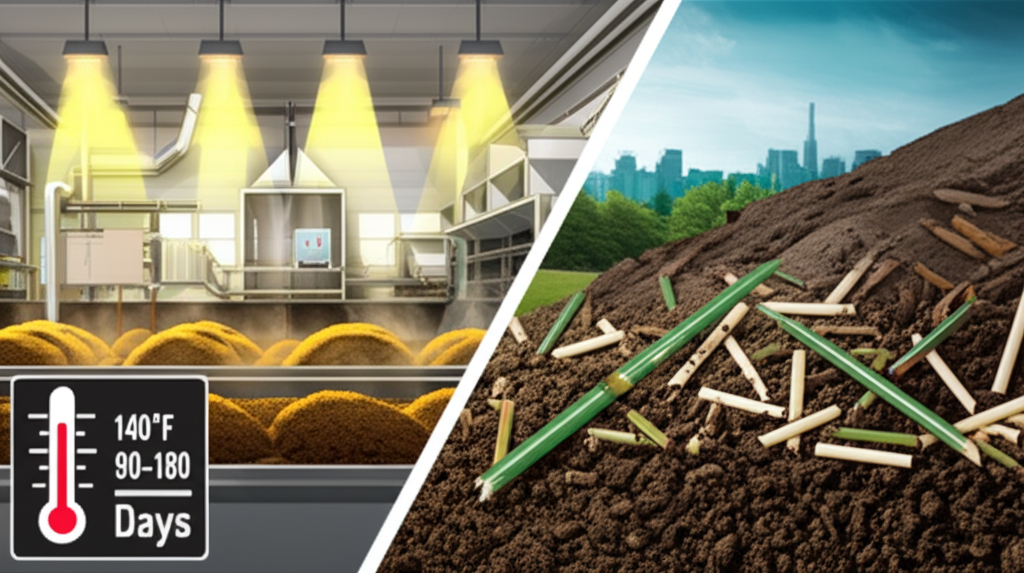
PLA straws unequivocally require industrial composting facilities to break down effectively. These specialized environments maintain sustained high temperatures, typically above 140 degrees Fahrenheit (60 degrees Celsius), for at least 10 consecutive days. Under these ideal, controlled conditions, PLA straws are designed to decompose into water, carbon dioxide, and organic matter, generally within 90 to 180 days. Peer-reviewed research, such as studies utilizing the EN ISO 14855-1:2012 European Standard, confirms PLA’s ability to compost within 90 days when subjected to these rigorous conditions, measuring CO2 generation as an indicator of biodegradation.
The Home Composting & Landfill Limitations of PLA Straws
The effectiveness of PLA composting drastically changes outside of industrial settings. PLA straws generally do not decompose in home composting bins or backyard systems because these environments simply lack the sustained high temperatures and controlled microbial activity necessary for their breakdown. More critically, if PLA straws end up in landfills or natural environments like oceans, they can persist for hundreds or even thousands of years, behaving similarly to traditional plastics. Studies have explicitly shown that PLA straws do not readily degrade in ocean water, posing a threat to marine wildlife akin to conventional plastic pollution.
Certification Standards for PLA Straws: BPI, EN 13432, and ASTM D6400
Chun inmúirín thionsclaíoch a chinntiú go fírinneach agus chun imní maidir le “glasnuchadh” a mhaolú, ní mór do ghnóthais tosaíocht a thabhairt do tháirgí deimhnithe PLA. Deimhníonn deimhnithe agus cáil mar BPI (Institiúid Táirgí Bith-dhíghrádaithe) i Meiriceá Thuaidh nó “OK compost INDUSTRIAL” de chuid TÜV na hOstaire go gcomhlíonann táirgí caighdeáin dhian. Tá na deimhnithe seo ar aon dul le tagarmharcanna domhanda amhail ASTM D6400 (Meiriceá Thuaidh) agus EN 13432 (An Eoraip), a shainíonn go mbrisfidh táirgí síos ina n-ábhar orgánach gan iarmhair tocsaineacha a fhágáil laistigh de thréimhsí ama sonracha. Tá anTreoir an AE maidir le Plaistigh Aonúsáide (2019/904), enforced since 2021, prohibits non-certified single-use plastic straws, even if “bio-sourced,” making certified compostable straws the compliant choice for European market access. Understanding these distinctions is critical for procurement and sustainability teams, as explored in depth in our guide onsopanna inmhúirín vs in-bhithmhillte.
PLA straws require industrial composting facilities and specific certifications like BPI or EN 13432 for true breakdown.

Operational Challenges and Environmental Misconceptions of PLA Straws
Despite their perceived environmental benefits, integrating PLA straws into existing waste management systems presents significant hurdles for businesses. These challenges often stem from PLA’s unique physical characteristics and the limitations of current infrastructure, leading to operational complexities and environmental inefficiencies if not properly addressed.
Contamination Risks in Recycling Streams with PLA Straws
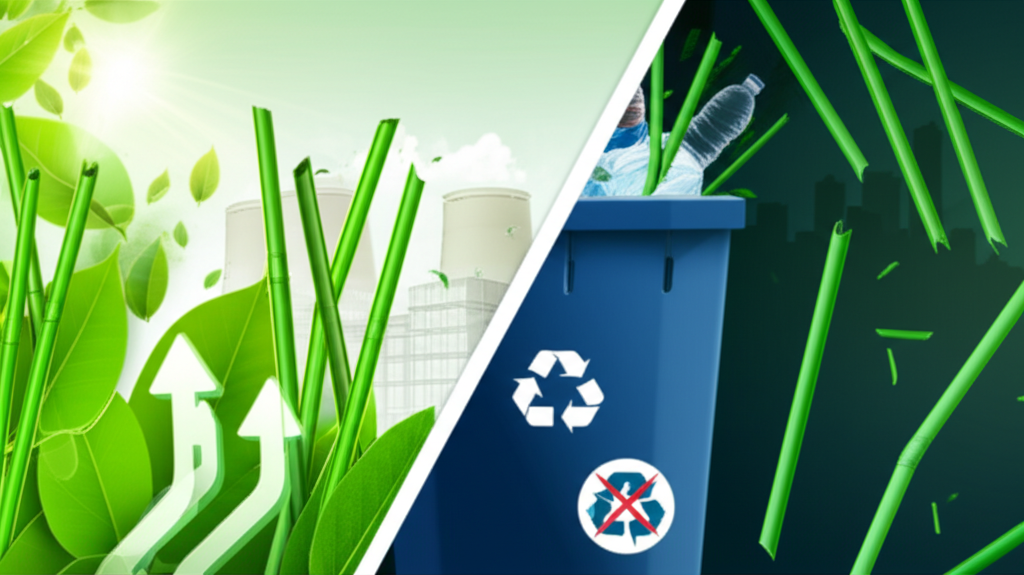
A major operational headache for businesses is the contamination risk posed by PLA straws in recycling streams. PLA straws cannot be mixed with other common types of plastics, such as PET (polyethylene terephthalate) or HDPE (high-density polyethylene), for curbside recycling. This is due to PLA’s lower melting temperature, which, if mixed, contaminates the entire batch of recyclable plastics, often rendering it unsellable and destined for a landfill. Many municipalities and recycling facilities simply do not accept PLA, labeling it a contaminant, thus complicating proper disposal and increasing waste management costs.
The Infrastructure Gap: Limited Industrial Composting Facilities in the U.S.
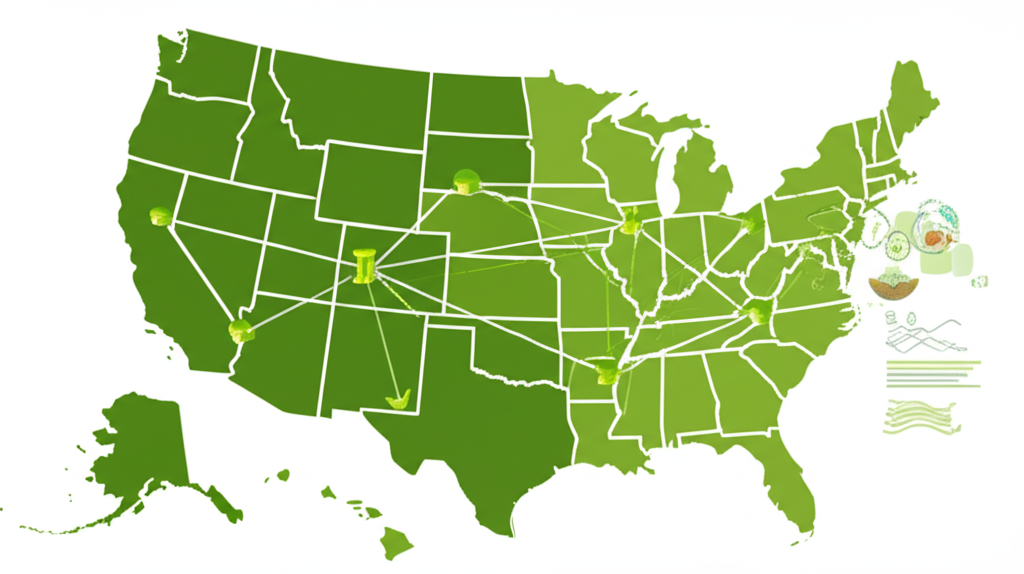
Bac suntasach sistéamach ar mhúiríniú PLA éifeachtach é an ghanntanas áiseanna cuí. In ainneoin inmhúirín theicniúil PLA, tá an bonneagar riachtanach chun é a phróiseáil in easnamh go mór. Ó Eanáir 2023, ní ghlacann ach thart ar 49 as 47,000 saoráid múirínithe sna SA le hábhair phlaisteacha inmhúirín, agus a bhformhór dírithe ar an gCósta Thiar. Ciallaíonn an bhearna mhór infreastruchtúir seo go dtéann tromlach mór na sopaí PLA, in ainneoin go bhfuil siad “in-múirín go teoiriciúil,” i láithreáin líonta talún ar deireadh, rud a dhiúltaíonn a gcuspóir comhshaoil. Do ghnóthais a bhfuil sé mar aidhm acu táirgí inmúirín deimhnithe BPI a bhainistiú go héifeachtach, tá sé ríthábhachtach an dúshlán bonneagair seo a thuiscint agus a threorú, mar atá sonraithe inárLeabhar súgartha B2B do bhainistiú dramhaíola inbhuanaithe.
Buarthaí “Glasnúcháin” agus Astuithe Meatán ó thuí PLA
The marketing of PLA straws as broadly “biodegradable” or “eco-friendly” without clear, precise disposal instructions contributes significantly to “greenwashing” concerns. When bioplastics like PLA end up in anaerobic landfill conditions—where oxygen is scarce—they can still release methane, a potent greenhouse gas that is far more impactful than carbon dioxide over a 20-year period. This paradox undermines the very environmental benefits they are intended to provide. The lack of standardized federal regulations in the U.S. for terms like “bioplastic” or “compostable” products further exacerbates this confusion, making it challenging for businesses and consumers alike to make truly informed, environmentally responsible choices.
PLA straws pose contamination risks in recycling and face infrastructure gaps, leading to “greenwashing” concerns and methane emissions.
Market Dynamics: The Growing Demand for Sustainable Straws, Including PLA Straws
The escalating demand for sustainable alternatives is a powerful force reshaping the B2B market, presenting both significant opportunities and competitive pressures for businesses. Companies are increasingly leveraging eco-friendly options not only to meet evolving regulatory demands but also to profoundly enhance their brand appeal and deepen customer loyalty.
Global Market Growth and Regulatory Tailwinds for Bioplastic Straws
The global eco-friendly straws market is projected to grow from approximately USD 12.3 billion in 2025 to nearly USD 25.1 billion by 2035, at a robust Compound Annual Growth Rate (CAGR) of 7.3%. Within this burgeoning sector, the PLA degradable straw market specifically is estimated at $500 million in 2025 and is projected to reach $1.8 billion by 2033, demonstrating an impressive 15% CAGR. This rapid expansion is significantly bolstered by stringent regulations, such as the EU Single-Use Plastics Directive, which became effective in 2021, and a growing number of U.S. state-level bans on single-use plastics. These legislative mandates compel businesses across the foodservice and hospitality sectors to adopt sustainable alternatives, making compliant, certified options a business imperative.
Deiseanna B2B do Bhainisteoirí Soláthair i Margadh Tuí PLA
For astute procurement managers, the expanding market for sustainable straws, including PLA, presents clear opportunities. There is significant potential to capitalize on the increasing demand from the foodservice and hospitality sectors, driven by corporate social responsibility initiatives and strong consumer preference for eco-conscious products. Leading suppliers, such as Pando EP Technology, established in 1996, have already forged partnerships with major Quick-Service Restaurant (QSR) and Fast-Moving Consumer Goods (FMCG) companies globally, including Nestlé and Yum!, demonstrating the viability and scale of this market. Adopting certified compostable PLA straws not only ensures regulatory compliance but also significantly enhances brand positioning, attracting and retaining eco-conscious customers who are often willing to pay a premium for businesses committed to sustainable practices.
The sustainable straw market is rapidly growing, offering B2B opportunities for procurement managers to enhance brand and ensure compliance.
Comparison of Eco-Friendly Straw Alternatives
Choosing the optimal straw alternative requires a comprehensive evaluation of operational impact, compliance considerations, and potential return on investment. The market offers a diverse range of materials, each with distinct advantages and limitations.
| Gné | Tionchar Oibriúcháin B2B | Nóta Comhlíonta | Acmhainneacht ROI |
|---|---|---|---|
| Strains PLA | Require separate waste streams for industrial composting; high potential for recycling contamination if mis-sorted. Sensitive to high heat, may soften with hot liquids. | BPI/EN 13432 certification for industrial compostability is essential for true environmental claims and regulatory compliance. | Reduces fossil fuel reliance (-68%); brand enhancement; often a higher initial cost than traditional plastic, but lower than some advanced bioplastics. Cost savings on fines for non-compliance. |
| Tuí PHA | Offer broader disposal options, including home and marine compostability, reducing the burden on specialized infrastructure. Potential for premium product positioning. | Certifiable for home, commercial, and marine degradation (e.g., TÜV AUSTRIA OK compost HOME/MARINE), offering more versatile environmental compliance pathways. | Stronger long-term sustainability ROI due to wider degradation capabilities and reduced risk of landfilling. May have a higher initial cost than PLA but offers enhanced eco-credentials and market differentiation. |
| Tuí Páipéir | Widely accepted and familiar disposal methods; prone to sogginess unless specifically coated. | Generally compliant with plastic bans; check for certifications verifying biodegradability, compostability, and importantly, PFAS-free status. | Lower initial cost than most bioplastics; rapid breakdown (typically 30-60 days) in industrial composting; high consumer familiarity. Potential for negative customer experience if performance is poor (e.g., sogginess). |
| Bagasse Sugarcane | Durable, water-resistant, and generally maintains structural integrity well. Typically compostable in home or industrial facilities. | Often home compostable and industrially compostable, aligning with broad sustainability goals and diverse disposal scenarios. | Strong eco-friendly image due to upcycling agricultural byproduct; effective performance; competitive pricing with other compostable options. Good for brand value and avoids performance complaints. |
| In-athúsáidte (Miotal/Gloine) | Requires significant operational overhead including washing, sanitization, storage, and inventory management. Higher upfront investment. | Reduces waste to near zero, meeting the strictest sustainability mandates and promoting a circular economy. | High long-term ROI through repeat use, eliminating recurring straw procurement costs. Strongest brand commitment to circularity and deep consumer loyalty. Requires consumer buy-in for off-premise use. |
PHA Straws: A Next-Generation Bioplastic Alternative
PHA (Polyhydroxyalkanoate) straws, often derived from renewable sources like canola oil, represent a significant advancement over PLA in terms of biodegradability. They are engineered to break down in a wider array of environments, including commercial composting facilities, home composting bins, and even marine settings, typically within months. This broader degradability profile addresses many of the infrastructure limitations associated with PLA, offering a more universally viable end-of-life solution. Companies like Good Start Packaging have notably transitioned from PLA to PHA straws, recognizing the latter’s faster and more versatile compostability as a key differentiator for their B2B clients.
Other Compostable Straw Materials: Paper, Sugarcane, and More
Beyond PLA and PHA, the market offers several other compelling compostable straw materials. Paper straws are a leading alternative, projected to hold a substantial 44.3% market share in 2025 due to their widespread availability, relative cost-effectiveness, and full biodegradability and compostability. However, their performance can vary, with some prone to sogginess unless treated with advanced, food-safe coatings. Sugarcane bagasse straws, made from a fibrous byproduct of sugarcane processing, offer a durable, water-resistant, and versatile option, being compostable in both home and industrial settings. Emerging alternatives include straws made from rice, wheat, pasta (which can be edible), agave, and coffee grounds, each presenting unique properties and environmental benefits. For a comprehensive look at how different materials are classified, see our guide onBPI Compostable vs. Biodegradable.
PHA straws offer broader degradability than PLA, while paper and sugarcane provide other viable compostable alternatives.
Case Study: Good Start Packaging’s Shift to Truly Compostable PHA Straws
In a pivotal strategic move within the eco-friendly foodservice industry, Good Start Packaging, a prominent supplier of sustainable products, made the decision to phase out its offerings of PLA straws in favor of PHA (polyhydroxyalkanoate) straws. This significant transition, observed within the last three years, was directly motivated by a clear-eyed assessment of PLA’s practical limitations. While PLA is technically industrially compostable, the widespread lack of accessible commercial composting infrastructure across many regions meant that Good Start Packaging’s PLA products frequently ended up in landfills.
Recognizing this critical gap between ideal conditions and real-world disposal, the company sought a more genuinely sustainable solution. PHA straws, in contrast, offered a superior environmental profile with certified home compostability and marine degradability, providing a robust end-of-life solution that was not reliant on scarce industrial facilities. This proactive and transparent shift by an industry leader underscores the importance of rigorous due diligence in sustainable procurement. It highlights a business responding directly to the challenges of PLA disposal and prioritizing a more universally viable and truly compostable alternative, thereby aligning its product offerings with its deep commitment to genuine environmental impact.
Good Start Packaging transitioned from PLA to PHA straws due to PHA’s superior, more versatile compostability and broader infrastructure compatibility.
Strategic Considerations for B2B Decision-Makers
For procurement managers, operations directors, and sustainability officers, navigating the landscape of sustainable straws transcends mere label reading. It necessitates a strategic, holistic approach that considers the entire lifecycle of a product, from sourcing to its ultimate end-of-life. Understanding the disposal realities and infrastructure limitations is paramount for ensuring genuine environmental impact and effectively mitigating operational risks.
Due Diligence Beyond the “Compostable” Label for PLA Straws
The initial step in responsible procurement is rigorous due diligence. Simply seeing the term “compostable” is insufficient. Decision-makers must actively verify certifications, such as BPI (Biodegradable Products Institute) or TÜV AUSTRIA’s “OK compost INDUSTRIAL,” to ensure products meet stringent industrial composting standards. Furthermore, a critical understanding of local composting infrastructure availability is indispensable. With only approximately 15% of U.S. composting facilities currently accepting bioplastics, many “compostable” items, including PLA straws, are diverted to landfills where they may persist for centuries. Prioritize transparent suppliers who can provide clear information regarding material composition, end-of-life instructions, and ideally, proof of partnerships with commercial composting facilities in your operational areas to avoid the pitfalls of “greenwashing.”
Optimizing Waste Management for PLA Straws and Other Bioplastics
Effective waste management is the linchpin for realizing the environmental benefits of PLA and other bioplastics. Businesses must implement clear, unambiguous internal sorting protocols to prevent PLA straws from contaminating traditional recycling streams. Given PLA’s lower melting temperature compared to common plastics like PET, commingling can render entire recycling batches unusable. Therefore, establishing dedicated collection bins for compostable materials is essential. Beyond internal protocols, businesses should actively partner with commercial composting facilities or waste management providers specifically equipped to handle bioplastics. For regions lacking such infrastructure, exploring advanced bioplastics like PHA, which offer more flexible disposal options including home and marine degradation, becomes a strategic imperative.
Enhancing Brand Reputation and Compliance with Sustainable Straws
Proactive adoption of genuinely sustainable straw solutions is a powerful lever for enhancing brand reputation and ensuring regulatory compliance. Communicate transparently with your customers about your sustainable choices and provide clear instructions for proper disposal, fostering trust and aligning with the values of eco-conscious consumers. This commitment directly contributes to broader Corporate Social Responsibility (CSR) and Environmental, Social, and Governance (ESG) goals, which are increasingly important for investor relations and market positioning. By proactively adopting certified compostable solutions, such as those meeting theASTM D6400standard for industrial compostability, businesses can ensure compliance with evolving regulations, like the EU Single-Use Plastics Directive and various U.S. state-level bans, mitigating the risk of penalties and positioning themselves as industry leaders.
B2B decision-makers must conduct due diligence, optimize waste management, and enhance brand reputation through certified sustainable straw choices.
Future Trends & Innovation
The landscape of sustainable straws is dynamic, driven by continuous innovation and evolving regulatory pressures. Looking 5–10 years ahead, we anticipate several key trends that will redefine B2B procurement in this space:
- Rise of Truly Degradable Materials: There will be an accelerated shift towards materials with genuinely broader degradability profiles, moving beyond reliance on specialized industrial facilities. PHA and other next-generation bioplastics capable of decomposing in home composting, soil, and marine environments will see increased adoption.
- AI-Driven Material Science: Artificial intelligence will play a transformative role in research and development, rapidly identifying and optimizing new high-performance bio-based polymers, accelerating the discovery of even more sustainable and efficient materials.
- Advanced Performance & Functionality: Innovations will overcome historical performance issues such as sogginess, brittleness, and heat sensitivity. We’ll see compostable straws that perform identically to, or even surpass, traditional plastics in durability, temperature resistance (up to 90°C/194°F for hot beverages), and user experience.
- Comhtháthú Geilleagar Ciorclach: The industry will increasingly focus on closed-loop systems, integrating agricultural byproducts and waste streams directly into straw production. This includes scaling up production of straws made from materials like seaweed, coffee grounds, and agricultural residue, contributing to a more circular economy.
- Standardization & Transparency: Greater regulatory clarity and widespread adoption of standardized evaluation criteria for biodegradability and compostability will reduce “greenwashing” and foster true environmental accountability. This will make procurement decisions clearer and more impactful.
- Localized Solutions & Infrastructure Expansion: Investment in regional industrial composting facilities will grow, complemented by decentralized composting solutions, making proper disposal of compostable materials more accessible and economically viable across diverse geographies.
These trends will reshape supply chains and offer new avenues for businesses committed to genuine environmental leadership.
Future trends in sustainable straws include truly degradable materials, AI-driven innovation, enhanced performance, and circular economy integration.
Competitive Advantage & Business Case
For B2B decision-makers, the transition to genuinely compostable straws is not merely a cost center; it is a strategic investment that delivers tangible competitive advantages and a compelling business case.
Quantifiable Impact:
- Maolú Riosca: By aligning with rigorous certifications (e.g., BPI, EN 13432) and ensuring proper disposal, businesses can virtually eliminate the risk of non-compliance with evolving single-use plastic bans, avoiding hefty fines and legal complications. Proactive compliance future-proofs your operations in a tightening regulatory landscape.
- Ardú Luach Branda: Adopting certified, truly compostable solutions significantly enhances your brand’s reputation as an environmental steward. This resonates deeply with the over 70% of consumers who prioritize eco-friendly businesses, translating into increased customer loyalty and a willingness to pay a premium for your products or services.
- Deis Comhroinnte Margaidh: As the global eco-friendly straws market approaches $25.1 billion by 2035, early and authentic adoption allows businesses to capture a larger share of this expanding segment. By appealing to environmentally conscious consumers and partnering with like-minded suppliers, companies can outpace competitors clinging to outdated, non-compliant solutions.
- Operational Efficiency through Reduced Waste: While initial costs might be higher, efficient waste management systems for compostable materials can lead to long-term cost savings by diverting waste from landfills, potentially reducing landfill fees and streamlining waste streams.
- Investor Appeal: Strong ESG (Environmental, Social, and Governance) performance, driven by verifiable sustainability initiatives, increasingly attracts socially responsible investors. Demonstrating a clear commitment to genuine compostability can improve your company’s investment profile and access to capital.
By meticulously evaluating and investing in truly compostable alternatives, your business transcends mere compliance, unlocking substantial market share, fortifying brand equity, and securing a sustainable, profitable future.
Investing in truly compostable straws offers B2B businesses risk mitigation, brand uplift, market share growth, and investor appeal.
Conclúid
Is ionann sopaí PLA agus céim shuntasach chun cinn i nuálaíocht pacáistiú inbhuanaithe. Mar sin féin, tá a bhfíor-inmhúirín ceangailte go dlúth le coinníollacha tionsclaíocha an-sonrach agus le bonneagar láidir atá, den chuid is mó, fós tearcfhorbartha go mór. Maidir le cinnteoirí géarchúiseacha B2B - bainisteoirí soláthair, stiúrthóirí oibríochtaí, agus oifigigh inbhuanaitheachta - tá i bhfad níos mó ná dea-intinn ag teastáil chun dul tríd an gcastacht seo. Éilíonn sé díchill chuí dhian, cur chuige straitéiseach maidir le bainistiú dramhaíola, agus tiomantas gan staonadh d’inbhuanaitheacht thrédhearcach infhíoraithe. Trí na hidirdhealuithe criticiúla idir ábhair a thuiscint agus iniúchadh a dhéanamh ar roghanna fíor-ilúsáideacha cosúil le PHA, is féidir le do ghnó aistriú go muiníneach i dtreo todhchaí a bhfuil freagracht chomhshaoil bharántúil ag baint leis, ag cur le héifeachtúlacht oibriúcháin ag an am céanna agus ag daingniú clú do bhranda mar cheannaire i gcleachtais éicea-chomhfhiosacha.
Gníomhaigh anois chun todhchaí inbhuanaithe do shlabhra soláthair a chinntiú; téigh i gcomhairle le soláthraithe deimhnithe tuí inmhúirín agus déan do straitéis bainistíochta dramhaíola a mheas inniu chun fíorthionchar comhshaoil a chinntiú!
Teastaíonn dian-dícheall cuí agus bainistíocht straitéiseach dramhaíola le haghaidh inmhúirín dáiríre do ghnólachtaí B2B chun fíorfhreagracht comhshaoil a bhaint amach.
Ceisteanna Coitianta (CCanna)
C: An mbristear sopaí PLA go fírinneach in araid dramhaíola tipiciúil óstán nó bialainne?
A: Ní hea, teastaíonn saoráidí múirínithe tionsclaíochta ar leith ó shíbeanna PLA le teochtaí arda marthanacha (os cionn 140 ° F) le briseadh síos go héifeachtach. Ní dhianscaoilfidh siad i gcoinníollacha líonta talún caighdeánach nó i ngnáth-araidí dramhaíola tráchtála, agus iad féin cosúil le plaistigh traidisiúnta.
C: An féidir le sopaí PLA na sruthanna athchúrsála atá agam faoi láthair a éilliú in oibríocht seirbhíse bia?
A: Sea, go hiomlán. Tá leáphointe níos ísle ag PLA ná mar a bhíonn plaistigh choitianta mar PET nó HDPE. Má dhéantar sopaí PLA a mheascadh isteach i do athchúrsáil plaisteach, féadfaidh siad an baisc iomlán a éilliú, rud a fhágann nach féidir é a úsáid le haghaidh athchúrsála agus a atreorú chuig líonadh talún.
C: Cad iad na deimhnithe ba chóir do bhainisteoirí soláthair a lorg agus sopanna inmhúirín á bhfoinsiú acu dá gcuid riachtanas B2B?
A: Ba cheart do bhainisteoirí soláthair tosaíocht a thabhairt do shíbeanna atá deimhnithe ag eagraíochtaí creidiúnacha mar BPI (Institiúid Táirgí In-bhithmhillte) i Meiriceá Thuaidh nó “OK compost INDUSTRIAL” de chuid TÜV Ostair. Cinntíonn na deimhnithe seo go gcomhlíonann an táirge dianchaighdeáin inmhúirín thionsclaíocha amhail ASTM D6400 nó EN 13432.
Q: Are there truly compostable straw alternatives that don’t rely on industrial composting facilities?
A: Yes, PHA (Polyhydroxyalkanoate) straws are a next-generation bioplastic that can break down in a wider range of environments, including home composting and marine settings. Other options like sugarcane bagasse straws also offer broader compostability profiles.
Q: How can a hospitality business ensure proper disposal of PLA straws if industrial composting isn’t readily available locally?
F: Mura bhfuil múiríniú tionsclaíoch ar fáil, smaoinigh ar aistriú chuig roghanna eile cosúil le sopaí PHA a thairgeann inmhúirín baile nó mara. De rogha air sin, dul i gcomhpháirtíocht le sainchomhlachtaí bainistithe dramhaíola ar féidir leo bithphlaisteach a iompar chuig saoráidí cuí, nó tionscnaimh áitiúla a fhiosrú chun bonneagar múirínithe a fhorbairt.