
Introduction: Navigating California’s Evolving Plastic Landscape
California has long been at the forefront of environmental legislation, setting precedents that often reverberate across the nation and even globally. For businesses operating within the state, this leadership translates into a dynamic regulatory environment, particularly concerning single-use plastics. Understanding these evolving mandates is not merely about legal compliance; it’s a strategic imperative for operational efficiency, risk mitigation, and brand reputation in an increasingly sustainability-conscious market.
Ignoring California’s plastic straw regulations, or misinterpreting their nuances, can have tangible operational and commercial impacts. Beyond the direct financial penalties, businesses risk alienating a growing segment of environmentally aware consumers, tarnishing their brand image, and falling behind competitors who proactively embrace sustainable practices. This comprehensive guide will dissect the current statewide and local mandates governing plastic straws in California, offering procurement managers, operations directors, sustainability officers, and supply chain executives the insights needed to adapt proactively, minimize plastic pollution, and secure a competitive advantage in a shifting landscape.Proactive adaptation to California’s plastic straw regulations is crucial for business success and brand reputation.
The Core of California’s Plastic Straw Regulations for Businesses
Contrary to a common misconception, California does not enforce a complete statewide ban on plastic straws. Instead, the state’s primary legislation focuses on restricting theautomatic distributionof single-use plastic straws, rather than an outright prohibition. This distinction is crucial for businesses, as compliance hinges on understanding where and when these restrictions apply. Navigating this regulatory framework is paramount for any enterprise to avoid fines, maintain a positive public image, and align with California’s broader environmental objectives.
Understanding AB 1884: The “Straws-Upon-Request” Policy
The foundational piece of California’s plastic straw regulation is Assembly Bill 1884 (AB 1884), which officially took effect on January 1, 2019. This landmark legislation introduced a “straws-upon-request” policy primarily for full-service restaurants. Under AB 1884, these establishments are explicitly prohibited from automatically providing single-use plastic straws to customers. Instead, a customer must specifically ask for a straw to receive one.
When signing AB 1884 into law in 2018, then-Governor Jerry Brown emphasized its modest yet symbolic intent, stating that “plastic, in all forms, are choking our planet.” He viewed the bill as a “small step” aimed at increasing public awareness and reducing the pervasive impact of plastic pollution on the environment. For businesses, this translates into a fundamental shift in operational protocol, moving from a default offering to an opt-in system.
Defining “Full-Service Restaurants” and Key Exemptions
Un aspect critic al AB 1884 constă în definiția sa specifică a unităților pe care le guvernează. Legea se aplică „restaurantelor cu servicii complete”, caracterizate ca unități în care personalul de așteptare preia comenzi la mese și servește alimente pentru consumul la sediu. Această formulare precisă înseamnă că multe unități cu volum mare, fără șezut, au fost inițial scutite de cerința „paie la cerere” la nivel de stat.
Fast-food restaurants, delis, coffee shops, and drive-throughs, for instance, were not subject to AB 1884 at its inception. This legislative nuance created what many observers termed a “loophole” for a significant portion of the food service industry, allowing them to continue offering plastic straws automatically. For operations directors and procurement teams, this meant a bifurcated compliance strategy, where rules varied significantly based on the service model.
Penalties for Non-Compliance with California Plastic Straw Law
Deși legea la nivel de stat nu este o interdicție totală, nerespectarea AB 1884 implică sancțiuni crescânde menite să încurajeze aderarea. Ofițerii de sănătate publică de stat sunt în primul rând responsabili pentru aplicarea legii, de obicei inițiate prin diviziile locale de sănătate a mediului, cum ar fi Divizia de sănătate a mediului din județul Tulare. Companiile constatate în încălcarea AB 1884 vor primi mai întâi două avertismente. Aceste notificări inițiale servesc ca o oportunitate pentru unități de a-și rectifica practicile și de a instrui personalul cu privire la politica de „pai la cerere”.
However, subsequent non-compliance following these warnings incurs financial repercussions. Violations can result in a fine of $25 per day. To prevent undue financial burden, the law caps the maximum annual fine for AB 1884 violations at $300. While this might seem a modest sum for larger enterprises, repeated fines can accumulate, and more importantly, the associated reputational damage from being identified as non-compliant can far outweigh the monetary penalty.California’s AB 1884 mandates “straws-upon-request” for full-service restaurants, with penalties for non-compliance.

Beyond Statewide: Local Plastic Straw Bans in California
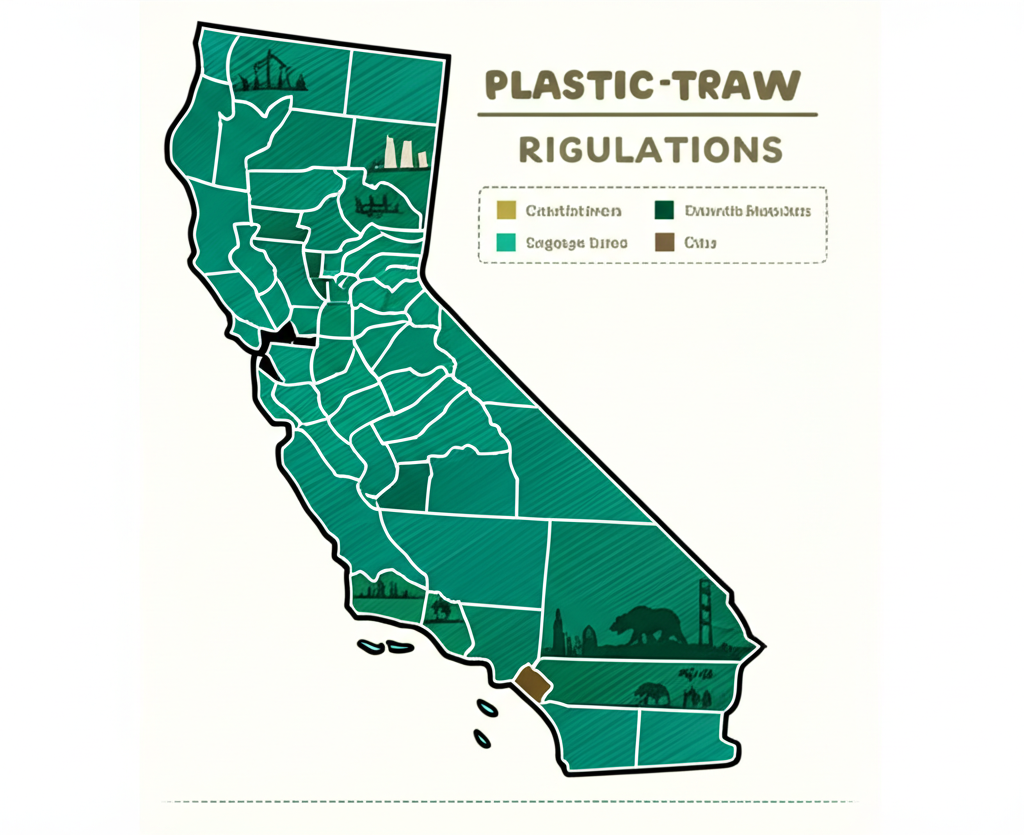
While AB 1884 sets a baseline for plastic straw regulations statewide, it is crucial for businesses, especially those operating across multiple locations, to understand that individual cities and counties in California possess the authority to implement stricter ordinances. This decentralized regulatory power has led to a patchwork of local laws that often go beyond the “straws-upon-request” policy, demanding a localized strategy for true compliance and sustainability leadership.
Cities with Complete Plastic Straw Bans
Numeroase orașe din California au adoptat o atitudine mai agresivă împotriva paielor de plastic de unică folosință, adoptând interdicții absolute în jurisdicțiile lor. Aceste ordonanțe locale înseamnă că paiele de plastic nu sunt adesea furnizate deloc, chiar și la cererea clienților, cu unele excepții pentru nevoi medicale sau de handicap.
- San Francisco: Un pioner în politica de mediu, San Francisco a implementat o interdicție totală a paielor din plastic, agitatoarelor și altor accesorii alimentare din plastic în vigoare de la 1 iulie 2019. Această ordonanță este deosebit de strictă, deoarece restricționează, de asemenea, paiele din plastic compostabile și obligă ca paiele acceptabile de unică folosință (cum ar fi hârtia) să fie disponibile numai la cerere. Paiele din plastic trebuie furnizate numai pentru nevoi medicale sau de handicap.
- Malibu: Even earlier, in June 2018, Malibu moved to bar all single-use plastic straws, stirrers, and cutlery, reflecting its strong commitment to protecting its coastal environment.
- Monterey, Santa Barbara, and Del Mar: These cities, along with others such as Calabasas, Davis, Alameda, Carmel, San Luis Obispo, Oakland, and Berkeley, have also enacted outright bans on plastic straws, underscoring a growing municipal trend.
- Considerations for Accessibility: It’s important to note that while some bans are comprehensive, many local ordinances, like San Francisco’s, include provisions for individuals with disabilities, ensuring that plastic straws can be provided upon request if they are deemed medically necessary. This acknowledges legitimate accessibility needs while still driving the broader goal of plastic reduction.
Los Angeles County’s Extended “Straws on Request”
Județul Los Angeles, care găzduiește o populație vastă și numeroase afaceri, și-a extins, de asemenea, reglementările dincolo de domeniul de aplicare inițial al AB 1884. Începând cu aprilie 2019, Los Angeles a extins cerința „paie la cerere” la o gamă mai largă de vânzători de alimente. Această politică extinsă s-a aplicat nu numai restaurantelor cu servicii complete, ci și lanțurilor de fast-food, magazinelor alimentare mari și altor vânzători mari de alimente care operează în zonele neîncorporate ale județului. În plus, ordonanța județului Los Angeles interzice în mod specific distribuitoarele de paie de plastic cu autoservire, având ca scop eliminarea disponibilității imediate care încurajează consumul inconștient. Această mișcare a închis în mod semnificativ „lacuna” prezentă inițial în legea la nivel de stat pentru unitățile de fast-food, impactând un segment de piață cu volum mare.
Navigarea diverselor reglementări locale pentru paiele din plastic
Existența unui patchwork variat de reglementări în orașele și județele din California prezintă o provocare complexă de conformitate pentru companii, în special pentru cele cu mai multe locații sau lanțuri de aprovizionare extinse. Un manager de achiziții pentru un lanț de restaurante, de exemplu, nu poate aplica o singură politică la nivel de stat, ci trebuie să efectueze cercetări diligente pentru a se conforma fiecărei jurisdicții locale specifice. Acest lucru necesită adesea o strategie localizată pentru achiziții, gestionarea stocurilor și formarea angajaților.
The broader context of these varied local rules signals a clear trend: increasing restrictions on single-use plastics. Businesses that proactively anticipate and adapt to this trajectory, rather than merely reacting to individual mandates, will be better positioned for long-term success. Understanding these nuances is crucial for supply chain executives who must ensure their procurement strategies align with both state and municipal environmental objectives.Local California ordinances often impose stricter plastic straw bans, requiring localized business compliance strategies.
Operational Impacts and Strategic Shifts for Businesses
Peisajul de reglementare din jurul paielor de plastic din California nu este doar un obstacol legal; prezintă o provocare operațională semnificativă și o oportunitate strategică. Adaptarea la aceste mandate necesită mai mult decât schimbarea unui material cu altul. Necesită o reevaluare holistică a proceselor de achiziție, strategii privind experiența clienților și angajament general față de sustenabilitate. Acest pivot este influențat de un impuls global pentru reducerea plasticului, care modelează rapid politica, comportamentul consumatorilor și diferențierea competitivă.
Îmbrățișarea alternativelor la paiele de plastic de unică folosință
AB 1884, deși restricționează paiele din plastic, permite în mod explicit utilizarea alternativelor non-plastice. Această flexibilitate a stimulat inovația și creșterea pieței în opțiunile durabile de paie. Pentru echipele de operațiuni și achiziții, decizia asupra alternativelor de adoptat implică considerații de cost, durabilitate, preferința clienților și impactul asupra mediului.
- Pai de hartie: O alternativă comună și disponibilă pe scară largă, paiele de hârtie îndeplinesc cerințele de conformitate atât pentru AB 1884, cât și pentru majoritatea interdicțiilor locale. Progresele în producție le-au îmbunătățit durabilitatea, deși percepțiile cu privire la umiditate persistă.
- Paie metalice: Often offered as reusable options, metal straws are permissible if they adhere to California Retail Food Code standards for cleanliness and sanitization. These can be a premium offering for dine-in establishments or sold as retail items.
- Paie de bambus: Made from natural, fast-growing resources, bamboo straws offer a rustic, sustainable appeal. They can be single-use or reusable depending on processing.
- Paie de trestie de zahar: Derived from a byproduct of the sugar industry, sugarcane straws are notable for their sturdy feel and biodegradability, offering a compelling blend of functionality and environmental benefit.
- Pasta Straws: Edible and biodegradable, pasta straws offer a unique, zero-waste solution, though their application might be limited to certain beverage types.
For businesses aiming for comprehensive sustainability beyond just straws, exploring a broader range of sustainable disposables is key. A comprehensive B2B guide to non-plastic drinking straws can provide further insights into material properties, certifications, and supplier options, helping procurement managers make informed decisions.Learn more about Non-Plastic Drinking Straws for B2B.
Cost-Benefit Analysis: Transitioning to Straw Alternatives
Transitioning away from conventional plastic straws involves an initial investment that supply chain executives and operations directors must carefully evaluate. Alternative materials often have a higher unit cost compared to their plastic counterparts. This requires adjusting budgets and potentially negotiating new new terms with suppliers. However, this initial outlay is quickly offset by significant long-term ROI potential.
The benefits extend beyond simply avoiding regulatory fines. By embracing sustainable alternatives, businesses enhance their brand image, appeal to eco-conscious consumers, and contribute positively to their corporate social responsibility profile. Consumer preference is undeniably shifting towards sustainable options; studies consistently show that customers are willing to support businesses aligned with their environmental values. This shift translates into increased customer loyalty, positive public relations, and a strengthened market position. Furthermore, proactive adoption can mitigate future compliance risks as regulations inevitably become stricter.
Here’s a strategic breakdown of common options for procurement and operations teams:
| Caracteristică | Impact operațional B2B | Notă de conformitate | Potențial de rentabilitate a investiției |
|---|---|---|---|
| Paiele din plastic | Low immediate unit cost, established supply chains, high inventory ease. | AB 1884 “upon request” for full-service restaurants; outright bans in numerous California cities. | Risk of recurring fines (up to $300/year after warnings), significant negative public relations, erosion of brand trust among sustainability-conscious consumers. |
| Paie de hârtie | Higher unit cost, potential for faster degradation in beverages, shelf-life concerns. | Meets AB 1884 “upon request” policy; acceptable for most local bans. | Enhanced “green” brand image, avoids all fines related to plastic straw distribution, positive customer perception, potential for increased customer loyalty from eco-conscious demographics. |
| Reusable Straws | Higher initial investment per unit, requires robust cleaning and sanitation protocols, inventory management for reuse cycles. | Meets all existing California state and local regulations for single-use plastics, aligns with strong sustainability mandates. | Significant long-term cost savings by reducing recurring disposable straw purchases, positioned as a premium offering, strong environmental leadership, appeals to high-value, environmentally committed customers, potential for retail sales of branded reusable options. |
| No Straws/Opt-in | Minimal product cost for the business, operational simplicity by reducing inventory items and handling. | Compliant with “upon request” laws for full-service restaurants; aligns with outright bans where applicable. | Maximal waste reduction, substantial cost savings on straw procurement, strong and unequivocal “green” stance, appeals to a segment of consumers who prefer to avoid straws entirely, contributes to overall waste reduction goals. |
For businesses seeking to transition specifically to biodegradable options, a guide on selecting the best biodegradable plastic straws for B2B needs can offer detailed insights into material composition, performance, and certifications crucial for compliance and sustainability claims.Discover the Best Biodegradable Plastic Straws for B2B.Transitioning to sustainable straw alternatives offers long-term ROI through enhanced brand image and reduced compliance risks.
Mini Case Study: San Luis Obispo’s Full Ban (2019) and Business Adaptation
The City of San Luis Obispo provides a compelling real-world example of how local regulations can drive business adaptation. In 2019, the city enacted a comprehensive ban on plastic straws, mandating a complete shift away from their use in all food service establishments. This ordinance went beyond the statewide “straws-upon-request” model, requiring businesses to proactively seek out and implement alternative solutions.
Local restaurants, including popular spots like Splash Café, responded by transitioning proactively to non-plastic alternatives. They embraced paper and other compostable straws, ensuring a seamless experience for customers while adhering to the new regulations. A key aspect of their successful adaptation involved diligent customer communication. Staff were trained to explain the new policy, educate patrons about the environmental benefits of the change, and introduce the new straw materials. This transparency helped mitigate potential customer friction and built goodwill.
Key Takeaways for Procurement and Operations
The experience of businesses in San Luis Obispo offers valuable lessons for procurement and operations leaders statewide:
- Proactive Supplier Diversification: Relying on a single source for single-use items is risky in a volatile regulatory environment. Businesses need to identify and vet multiple suppliers for alternative straw materials to ensure supply chain resilience and competitive pricing.
- Employee Training: Front-line staff are the direct interface with customers. Comprehensive training on “straws on request” policies, local ban specifics, and the benefits of alternative materials is critical for smooth implementation and positive customer interactions.
- Comunicare cu clientul: Proactively informing customers about new policies and sustainable choices can transform a regulatory challenge into a positive brand narrative. Explaining the “why” behind the change fosters understanding and builds positive brand perception.
- Competitive Advantage through Compliance: Embracing compliance as an opportunity for innovation, rather than a burden, allows businesses to position themselves as leaders in sustainability. In a market where environmental consciousness is growing, this proactive stance can become a significant competitive advantage. Businesses that lead the charge in sustainable foodware, like focusing on biodegradable straws for restaurants, often see a boost in customer loyalty and brand reputation. Explore biodegradable straw options for restaurants.
San Luis Obispo’s ban highlights the importance of proactive supplier diversification, training, and communication for business adaptation.
The Broader Context: California’s Leadership in Plastic Reduction
California’s regulations concerning plastic straws are not an isolated policy but a deliberate component of the state’s far-reaching and consistent commitment to environmental stewardship. For decades, California has historically led the nation in enacting stringent environmental legislation, often serving as a blueprint for other states and even countries. Understanding this broader strategic context is vital for businesses, as it indicates a clear trajectory of increasing regulations that will continue to impact B2B supply chains, product design, and operational mandates for years to come.
California’s Historic Stand Against Plastic Pollution
California’s efforts to combat plastic pollution extend far beyond straws:
- Single-Use Plastic Bags: The state was the first in the U.S. to implement a statewide ban on single-use plastic bags. Enacted in 2014, Proposition 67 further solidified this stance in 2016, prohibiting major retailers from distributing plastic bags and imposing a minimum 10-cent charge for alternative bags. This groundbreaking move drastically reduced plastic bag litter and set a powerful precedent.
- Plastic Microbeads: Reflecting its commitment to protecting marine ecosystems, California also banned plastic microbeads in personal care products, with the prohibition becoming effective in 2020. These tiny plastic particles, commonly found in exfoliants and toothpastes, were identified as significant contributors to microplastic pollution in waterways and oceans.
- Combatting Marine Debris: These legislative actions collectively reflect a consistent and unwavering commitment to combating marine debris. Plastic straws, although a small fraction of overall plastic waste by weight, are a highly visible symbol of single-use plastic consumption and are consistently ranked among the top ten contributors to plastic marine debris globally. The difficulty in recycling them—as most recycling machines are not equipped to process straws—means that only about 9% of all used plastic has been recycled worldwide, making reduction and alternative materials critical. (Source: The Guardian)
Future of Plastic Reduction: SB 54 Mandates and Projections
The regulatory landscape in California is poised for even more transformative changes with the enactment of Senate Bill 54 (SB 54), also known as the Plastic Pollution Prevention and Packaging Producer Responsibility Act. Signed into law in 2022, SB 54 represents the nation’s most ambitious extended producer responsibility (EPR) policy for packaging. It mandates aggressive targets for plastic waste reduction and recycling, fundamentally shifting the burden of plastic pollution from consumers and municipalities to manufacturers.
Key mandates and projections under SB 54 include:
- 25% Less Single-Use Plastic Packaging: By 2032, California mandates that 25% less single-use plastic packaging must be sold within the state. This target compels manufacturers to reduce plastic use at the source, innovate in product design, or switch to alternative materials.
- Recyclable or Compostable by 2032: All single-use plastic packaging and foodware sold in California must be recyclable or compostable by 2032. This requires significant investment in material science and infrastructure to ensure proper end-of-life solutions. (Source: UCLA Institute of the Environment and Sustainability)
- 65% Recycling Rate by 2032: The law also sets a challenging target of a 65% recycling rate for single-use plastic packaging by 2032. This will necessitate substantial improvements in collection, sorting, and reprocessing capabilities.
- $5 Billion Industry Fund: SB 54 establishes a $5 billion industry fund, financed by plastic producers, to address plastic pollution initiatives. This fund will support infrastructure improvements, consumer education, and environmental restoration efforts, creating a collective responsibility model. (Source: Stanford University)
These comprehensive mandates under SB 54 signal a clear direction for businesses: proactive engagement with sustainability is no longer optional. The plastic straw legislation, in this broader context, serves as a “gateway plastic” initiative, preparing consumers and industries for more extensive regulations aimed at a circular economy.California’s comprehensive plastic reduction efforts, including SB 54, signal a clear trajectory towards a circular economy.

Competitive Advantage and Business Case
In a market increasingly driven by environmental awareness, strategic compliance with plastic reduction mandates offers more than just risk mitigation—it presents a profound opportunity for competitive advantage. For B2B decision-makers, quantifying the benefits of proactive sustainability can build a compelling business case for investment.
First, considereconomii de costuri. While initial investments in alternative straws may be higher, the avoidance of recurring fines (up to $300 annually per violation of AB 1884) is a direct financial benefit. More significantly, optimized supply chains focused on sustainable, compliant materials can yield long-term savings by reducing waste disposal costs and future-proofing against increasingly stringent regulations.
Second,atenuarea risculuiextends beyond financial penalties. Adhering to evolving plastic laws minimizes legal exposure and protects against reputational damage. In an era where negative social media attention can spread rapidly, being perceived as environmentally irresponsible can erode customer trust and brand equity.
Conversely, investing in sustainable solutions can lead to a significantcreșterea valorii mărcii. Consumers, particularly in environmentally conscious markets like California, are increasingly choosing brands that align with their values. A strong commitment to plastic reduction enhances brand perception, fosters customer loyalty, and attracts new business opportunities. This positive brand association translates into higher sales and a more resilient market position.
Finally, there is a clearoportunitate de cota de piata. Businesses that proactively transition to sustainable alternatives and communicate their efforts effectively can capture market share from slower-moving competitors. As regulations tighten and consumer preferences solidify, being a recognized leader in sustainable practices can differentiate a company, attract top talent, and open doors to partnerships with environmentally aligned organizations. This forward-looking approach positions businesses not just for compliance, but for sustained growth in a greener economy.Proactive sustainability offers significant competitive advantages through cost savings, risk mitigation, and brand value uplift.

Întrebări frecvente (FAQ)
Q: Is there a complete statewide ban on plastic straws in California?
A: No, California’s AB 1884 primarily implements a “straws-upon-request” policy for full-service restaurants, not an outright ban. However, many individual cities and counties have enacted stricter, complete bans.
Q: What are the penalties for hospitality businesses not complying with AB 1884?
A: Businesses receive two warnings, after which violations can incur a $25 daily fine, capped at $300 annually. Reputational damage can be more significant than monetary penalties.
Q: How can a multi-location restaurant chain ensure compliance across California?
A: Chains must research and comply with specific local ordinances in each jurisdiction, often requiring a localized strategy for procurement, inventory, and staff training beyond statewide rules.
Q: Are there exceptions for plastic straws for medical or disability needs?
A: Yes, many local bans and even some statewide interpretations include provisions allowing plastic straws to be provided upon request for individuals with disabilities or medical needs.
Q: What are the best sustainable straw alternatives for high-volume foodservice operations?
A: Paper, bamboo, and sugarcane straws are popular biodegradable options. Reusable metal straws are also viable for dine-in, requiring robust cleaning protocols.
Conclusion: Strategic Compliance for a Sustainable Future
California’s progressive approach to regulating plastic straws is a clear and unequivocal signal of its unwavering commitment to environmental stewardship and a broader vision for a circular economy. For procurement managers, operations directors, sustainability officers, and supply chain executives, this landscape demands more than mere reactionary compliance. It’s a strategic imperative that directly impacts operational costs, brand reputation, and future market positioning.
Proactive adaptation, including a thoughtful transition to viable alternatives and a deep understanding of the nuanced local mandates, will ensure not only the avoidance of penalties but also a robust competitive edge. By aligning with evolving consumer values and preparing for an accelerating trend of plastic reduction, businesses can transform regulatory challenges into powerful opportunities for innovation, efficiency, and enhanced brand value. The time to act is now.
Optimize your operations for compliance and sustainability. Review your current single-use plastic inventory and develop a comprehensive transition plan for alternative straws today to secure your market position in California’s green economy.Contact Us for Sustainable Solutions