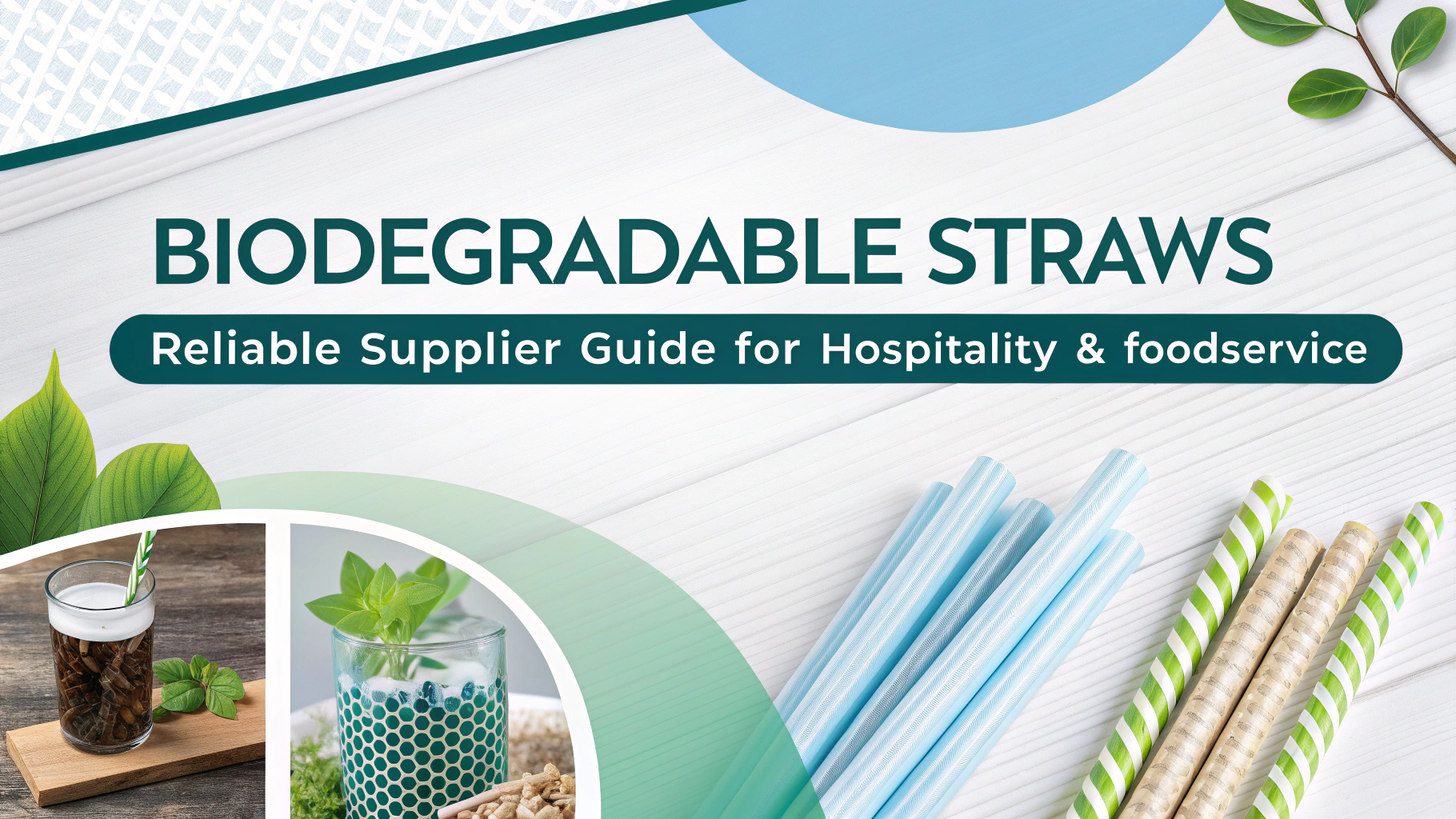
De mondiale verschuiving naar duurzaamheid hervormt industrieën en dwingt bedrijven om elk aspect van hun activiteiten opnieuw te evalueren, inclusief producten voor eenmalig gebruik. Plasticvervuiling, waarbij jaarlijks naar schatting 8,3 miljard plastic rietjes de stranden vervuilen (Bron: National Geographic, 2018), vereist dringende actie. Dit duizelingwekkende cijfer vertegenwoordigt niet alleen een milieucrisis, maar ook een aanzienlijk operationeel en commercieel risico voor bedrijven in de horeca- en foodservicesector die zich niet kunnen aanpassen. Hoewel termen als ‘biologisch afbreekbaar’ dubbelzinnig kunnen zijn en vaak tot verwarring bij de consument en beschuldigingen van ‘greenwashing’ leiden, biedt de BPI-certificering (Biodegradable Products Institute) een duidelijke, verifieerbare standaard voor echt composteerbare oplossingen die veilig afbreken in industriële faciliteiten.
For procurement managers, operations directors, sustainability officers, and supply chain executives in hotels, cafes, airlines, and healthcare facilities, understanding BPI certification for compostable straws is not merely about environmental responsibility; it’s a strategic imperative. Ignoring the rising tide of plastic bans and consumer preference for eco-friendly alternatives can lead to supply chain disruptions, brand damage, and missed market opportunities. This guide provides an in-depth look into the certification process, compliance requirements, and the distinct advantages that BPI Compostable Straws offer for your business.
The Imperative for BPI Compostable Straws in Modern Business
Duurzame inkoop is niet langer een optionele toevoeging, maar een kernbedrijfsstrategie, gedreven door zowel de onmiskenbare milieucrisis als de stijgende consumentenvraag. Bedrijven die proactief milieuvriendelijke alternatieven zoals BPI-gecertificeerde composteerbare rietjes adopteren, kunnen een aanzienlijk concurrentievoordeel behalen.
Plasticvervuiling, een alomtegenwoordig mondiaal probleem, wakkert de toenemende vraag van consumenten naar werkelijk milieuvriendelijke alternatieven aan. Consumenten houden steeds meer rekening met de ecologische voetafdruk van de producten die ze kopen en de bedrijven die ze ondersteunen. Parallel hieraan beperken overheidsregels over de hele wereld steeds meer plastic voor eenmalig gebruik, waardoor bedrijven gedwongen worden om conforme oplossingen te vinden of boetes te riskeren. Proactieve acceptatie van gecertificeerde composteerbare producten verbetert niet alleen het merkimago en vergroot de loyaliteit van de consument, maar zorgt ook voor naleving van de regelgeving, waardoor markttoegang en operationele continuïteit worden gewaarborgd.
Groeiende markt voor composteerbare rietjes, gedreven door regelgeving en consumentenvraag
The market trajectory for eco-friendly straws underscores this imperative. The global eco-friendly straws market is projected to reach nearly $25.1 billion by 2035, growing at a robust 7.3% Compound Annual Growth Rate (CAGR) (Source: Future Market Insights, 2023). This surge reflects a profound and lasting shift in environmental consciousness among consumers and businesses alike. The foodservice sector, a major user of single-use items, is projected to hold a substantial 52.8% market share in 2025 for compostable straws, demonstrating the industry’s rapid pivot towards sustainability (Source: Grand View Research, 2022). This micro-trend is part of a larger movement within the packaging industry, with the broader compostable packaging market forecast to reach an impressive $232.47 billion by 2034 (Source: MarketsandMarkets, 2023). Businesses that align with this growth, as explored in our guide onde zakelijke noodzaak voor composteerbare rietjes, positioneren zich voor succes op de lange termijn.Het gebruik van BPI-gecertificeerde composteerbare rietjes is een strategische noodzaak voor horeca en foodservice om aan de stijgende vraag en regelgeving te voldoen.

BPI-certificering begrijpen: de gouden standaard voor composteerbare rietjes van BPI
BPI biedt op wetenschap gebaseerde verificatie door derden dat een product daadwerkelijk zal afbreken in industriële composteringsinstallaties. BPI, opgericht in 1999, heeft meer dan 20 jaar ervaring in het certificeren van composteerbare producten en is daarmee de leidende autoriteit van Noord-Amerika op dit gebied geworden. Deze certificering wekt vertrouwen bij zowel composteerders als eindgebruikers over de productprestaties, en zorgt ervoor dat artikelen met het label 'composteerbaar' deze belofte ook daadwerkelijk waarmaken. Het BPI-certificeringsmerk is het bepalende symbool van composteerbaarheid in Noord-Amerika en fungeert als een vertrouwd baken op een markt die vaak wordt overschaduwd door misleidende milieuclaims.
Onderscheid maken tussen ‘composteerbaar’ en dubbelzinnige ‘biologisch afbreekbare’ claims
De termen ‘biologisch afbreekbaar’ en ‘composteerbaar’ worden vaak door elkaar gehaald, maar de BPI-certificering definieert duidelijk de composteerbaarheid, in tegenstelling tot de algemene term ‘biologisch afbreekbaar’, die geen specifieke, verifieerbare afbraakcriteria kent. ‘Biologisch afbreekbaar’ houdt in grote lijnen in dat een product gedurende een ongedefinieerde, potentieel zeer lange periode zal afbreken en soms microtoxische afvalresten kan achterlaten. Daarentegen betekent “composteerbaar” de volledige afbraak tot veilige, niet-giftige compost binnen een bepaald tijdsbestek, onder gecontroleerde omstandigheden zoals te vinden in industriële composteringsfaciliteiten. BPI-certificering zorgt ervoor dat producten terugkeren naar de aarde als waardevolle bodemverbeteraars zonder schadelijke residuen of microplastics, waardoor ze actief bijdragen aan een circulaire economie. De BPI verbiedt expliciet de term ‘biologisch afbreekbaar’ op gecertificeerde productafbeeldingen of verpakkingen om deze verwarring te voorkomen. Meer informatie over de missie en normen van BPI kunt u vinden op hun officiële website:BPIworld.org.BPI certification is the gold standard, ensuring products genuinely compost without harmful residues.
Navigating the BPI Certification Process for Compostable Straws
Achieving BPI certification for compostable straws involves a rigorous process of testing and adherence to scientific standards. This multi-step journey is designed to ensure that products will break down completely and safely in industrial composting facilities, without compromising the quality of the finished compost. Third-party accredited laboratories conduct comprehensive tests, with compliance verified at every stage, from raw material sourcing to final product labeling.
Adherence to ASTM Standards: The Foundation of BPI Compostable Straws
BPI-certificering is gebaseerd op het voldoen aan de strenge internationale ASTM-normen, waardoor controleerbare composteerbaarheid wordt gegarandeerd. Deze wereldwijd erkende normen bieden een wetenschappelijk raamwerk voor het evalueren van composteerbare materialen:
- ASTM D6400: Deze norm is specifiek van toepassing op kunststoffen en producten gemaakt van kunststoffen die zijn ontworpen voor aerobe compostering in gemeentelijke of industriële faciliteiten. Het vereist 90% fysieke desintegratie van het product binnen 84 dagen, wat betekent dat na deze periode niet meer dan 10% van het oorspronkelijke droge gewicht op een zeef van 2 millimeter mag achterblijven. Bovendien vereist het binnen 180 dagen (ongeveer zes maanden) 90% biologische afbraak tot koolstofdioxide, water en biomassa, in een tempo dat vergelijkbaar is met dat van natuurlijke composteerbare materialen.
- ASTM D6868: This standard covers products with plastic coatings on compostable substrates, such as paper straws that include a compostable lining or coating. It ensures that the entire product, including all its layers, meets the stringent compostability criteria for industrial facilities.
Rigorous Testing Criteria for BPI Compostable Straws
Products undergo a battery of tests to confirm full disintegration, biodegradation, and ecotoxicity, ensuring they leave no harmful environmental footprint:
- Disintegration Test: This physical test measures the breakdown of the product. As per ASTM D6400, it requires 90% physical breakdown within 12 weeks (84 days) into a 2mm screen, proving the product can physically blend into the compost matrix.
- Biodegradation Test: This biological test measures the conversion of organic material into CO2. It requires 90% biological conversion to CO2 within 180 days (approximately six months), demonstrating that microorganisms are actively consuming the material.
- Ecotoxicity Test: This crucial test ensures the resulting compost is safe for plant growth and contains no harmful substances or heavy metals. The compost is used to grow plants, and their health and growth are compared to a control, ensuring no negative effects.
- PFAS and Heavy Metals: A critical aspect of BPI certification is the strict regulation of fluorinated chemicals. Since January 1, 2020, BPI requires all certified items to contain no intentionally added per- and polyfluoroalkyl substances (PFAS). Furthermore, the total organic fluorine levels must be below 100 ppm, a limit rigorously verified by test reports. This ensures the compost is free from these persistent “forever chemicals.”
The Five-Step Certification Journey for BPI Compostable Straws
The certification process is a structured, five-step approach, ensuring thorough evaluation and compliance:
- Step 1: Submit product to a BPI-approved lab for comprehensive testing against the relevant ASTM standards (D6400 or D6868).
- Step 2: Sign a Non-Disclosure Agreement (NDA) and disclose the full product description and formulation, including maximum thicknesses, to BPI. This ensures transparency about all components.
- Step 3: BPI compiles all provided information and test results and submits them to DIN CERTCO for independent approval and verification, adding another layer of credibility.
- Step 4: Establish a 3-year renewable licensing agreement with BPI, granting your company permission to use the BPI certification mark on your products and marketing materials.
- Step 5: Prepare and submit artwork samples for BPI review to ensure correct usage and placement of the BPI logo on the product and its packaging, adhering to all labeling guidelines.
The BPI certification process ensures compostable straws meet rigorous scientific and safety standards.

Compliance Guide: Ensuring Proper Use and Disposal of BPI Compostable Straws
Beyond achieving certification, continuous compliance with BPI guidelines and evolving regulations is vital for maximizing the environmental benefits of compostable straws and avoiding potential pitfalls. This includes proper labeling for end-user identification, consistent material quality, and adherence to local and state-specific single-use plastic regulations.
Material Composition and PFAS-Free Straws Mandate for BPI Compostable Straws
BPI-gecertificeerde rietjes zijn doorgaans gemaakt van geavanceerde plantaardige polymeren, waardoor de afbraak in natuurlijke elementen wordt gegarandeerd en schadelijke chemicaliën strikt worden vermeden. Veelgebruikte materialen zijn onder meer PHA (polyhydroxyalkanoaat) en PLA (polymelkzuur), afgeleid van hernieuwbare bronnen zoals maïszetmeel, suikerriet of plantaardige oliën. Deze materialen zijn gekozen vanwege hun vermogen om effectief af te breken in industriële composteringsomgevingen.
Een belangrijke nalevingsmaatregel die door BPI wordt opgelegd betreft per- en polyfluoralkylstoffen (PFAS). Sinds 1 januari 2020 vereist BPI dat gecertificeerde artikelen geen opzettelijk toegevoegde PFAS bevatten, ook wel ‘forever chemicaliën’ genoemd vanwege hun duurzaamheid voor het milieu. Om de veiligheid verder te garanderen, moeten de totale organische fluorgehalten, een marker voor de aanwezigheid van PFAS, lager zijn dan 100 ppm, een drempel die wordt geverifieerd door strenge testrapporten en een ondertekende verklaring van de fabrikant. De U-vormige PLA-rietjes van Naturepoly worden bijvoorbeeld expliciet op de markt gebracht als PFAS-vrij, BPA-vrij, vrij van zware metalen en voedselveilig, wat hun toewijding aan een schone samenstelling benadrukt.
Etiketteringsvereisten voor BPI-gecertificeerde composteerbare rietjes
Clear and consistent labeling is crucial for proper disposal and preventing contamination in organics streams. This helps consumers and composting facilities accurately identify genuinely compostable items. BPI mandates specific labeling requirements:
- Certified items and their consumer-facing packaging must prominently display the BPI certification mark, including its distinctive swirl design.
- Required accompanying text must be visible, stating: “Commercially Compostable Only. Facilities May Not Exist in Your Area.” This educates consumers on proper disposal infrastructure.
- Labeling guidelines suggest using green, brown, or beige colors or tints for compostable straws or a stripe of these colors, aiding visual identification and preventing misleading claims.
- As noted earlier, the term “biodegradable” is strictly prohibited on BPI-certified product artwork or packaging to avoid confusion with the more specific “compostable” claim.
Navigating Regulatory Landscapes and Single-Use Plastic Bans
Evolving legislation at all levels increasingly mandates third-party certification and specific labeling for compostable products, reflecting a global push against plastic waste. Businesses must proactively track and comply with these regulations to maintain market access and avoid fines.
- California’s AB 1201: This landmark legislation requires third-party certification like BPI for any product claiming to be compostable, establishing a clear standard for environmental claims.
- Washington State: Similar to California, Washington state mandates third-party certification for most “compostable” labeled items sold within its borders, ensuring products compost as advertised.
- San Francisco: This progressive city goes a step further, prohibiting compostable plastic (PLA) straws and mandating that only natural fiber or paper straws can be provided upon request. This reflects a local preference for materials that decompose more readily in diverse environments.
- Europese Unie: A significant regulatory shift occurred in Europe, where the EU banned single-use plastic straws in 2021, a move that has substantially driven demand for certified compostable alternatives and accelerated market innovation.
Navigating these varied and often complex regulations is a key aspect of supply chain management, underscoring the value of certified products that meet stringent compliance criteria. Our guide onhow to choose a compostable straw distributorprovides insights into selecting partners who understand and adhere to these evolving standards.Compliance with BPI standards and evolving regulations is crucial for proper disposal and market access.
Strategic Advantages of Adopting BPI Compostable Straws for B2B Operations
Investing in BPI-certified straws offers significant operational and brand benefits that extend far beyond mere compliance, positioning your business as a leader in sustainable practices. This strategic adoption translates into enhanced reputation, mitigated risks, and increased market appeal.
By choosing BPI-certified options, your organization demonstrates clear leadership in sustainability and corporate responsibility. This commitment future-proofs your supply chains against evolving plastic bans and increasingly stringent environmental regulations, ensuring business continuity. Furthermore, it actively attracts environmentally conscious customers, a rapidly growing demographic, thereby boosting loyalty and expanding your market reach.
| Functie | B2B operationele impact | Nalevingsopmerking | ROI-potentieel |
|---|---|---|---|
| BPI-certificering | Streamlines procurement, ensures product efficacy. | Meets ASTM D6400/D6868 standards; avoids greenwashing. | Reduces risk of fines; enhances brand value. |
| PHA Material | Superior durability, heat/cold resistance. | Biodegrades in commercial/home compost; PFAS-free. | Improves customer experience; reduces waste management costs. |
| Clear Labeling | Reduces waste stream contamination, aids staff training. | Adheres to BPI guidelines; supports regional regulations. | Optimizes disposal processes; avoids misdirection costs. |
| Reduced Plastic Use | Aligns with corporate sustainability goals. | Addresses single-use plastic bans (e.g., EU, CA). | Boosts customer loyalty; opens new market segments. |
Mini Case Study: Eco-Products’ PHA Straws Embrace Sustainability
A tangible example of strategic adoption comes from Eco-Products, a leading provider of sustainable foodservice ware. In November 2022, Eco-Products launched a new line of BPI-certified compostable straws made from PHA, a versatile plant-based plastic derived from canola oil. Nicole Tariku, Eco-Products’ Director of Product Development, affirmed that these PHA straws match the durability and functionality of traditional plastic straws, offering a high-performance alternative. They meet the stringent ASTM D6400 standard, ensuring they biodegrade effectively in both commercial and home compost piles. This innovation not only addresses a critical market need but also aligns with the broader growth trajectory of the eco-friendly straws market, projected at $25.1 billion by 2035.
Enhancing Brand Reputation & Consumer Loyalty with BPI Compostable Straws
Adopting BPI-certified options fundamentally strengthens your brand’s commitment to the environment, resonating powerfully with a growing demographic of conscious consumers. Research indicates that 71% of Millennials view companies using compostable packaging positively (Source: NielsenIQ, 2021), highlighting the direct link between sustainable practices and consumer perception. By switching to BPI-certified PHA straws, businesses actively contribute to protecting marine life by reducing plastic pollution and microplastics, which can take centuries to break down. Products like Phade® straws exemplify this commitment, achieving 90% biodegradation within 90 days and 100% disintegration within 61 days, far exceeding typical standards and providing clear proof of environmental benefit.
Mitigating Supply Chain Risk: Proactive Compliance with BPI Standards
Proactively integrating BPI Compostable Straws helps businesses navigate increasingly complex and evolving regulatory landscapes, avoiding costly disruptions and ensuring operational stability. This strategic foresight protects against the financial repercussions and reputational damage associated with non-compliance. For instance, cities like Seattle implemented plastic straw bans in 2018, followed by California’s “straw upon request” policy in 2019. By aligning with BPI standards, businesses comply with such state and local plastic bans, avoiding potential fines and legal challenges associated with non-compliant products. This proactive approach ensures consistent product availability in a market where environmental regulations are continuously tightening, a critical consideration detailed in our comprehensiveB2B guide to bulk compostable straws.Adopting BPI-certified straws offers significant brand, operational, and risk mitigation advantages for businesses.

Future Trends and Innovations in BPI Compostable Straws
The compostable straw market is set for continuous innovation, with advancements in materials and disposal solutions shaping the next 5-10 years. This evolution will be driven by ongoing research, consumer demand for even more sustainable options, and a regulatory landscape that continues to push for true circularity.
PHA-based straws are projected for particularly robust growth, with a 15-20% CAGR between 2025 and 2033, signaling a significant shift towards this advanced bio-based polymer. Beyond PHA, emerging materials and processes are expected to diversify the market, including sugarcane bagasse, seaweed, rice, and even coffee grounds. Innovations will also focus on improved coatings and designs to prevent common issues like sogginess in paper straw alternatives, enhancing user experience and broader acceptance.
The Rise of Advanced Materials for BPI Compostable Straws
New bio-based polymers are enhancing performance and expanding the scope of compostability to diverse environments. This diversification moves beyond traditional PLA to offer more versatile and environmentally friendly solutions:
- PHA-rietjes: These represent a significant leap, offering high biodegradability across various conditions, including soil, home composting, industrial composting, and even marine environments. This broad degradability addresses concerns about end-of-life pathways for compostable products.
- Sugarcane Bagasse Straws: Derived from the fibrous byproduct of sugarcane juice extraction, these straws are durable, often PLA-free, and many are home compostable, breaking down within 360 days. They offer a robust alternative with a neutral taste profile.
- Novel Materials: Research and development are actively exploring innovative options such as edible straws (designed to be consumed after use, eliminating waste entirely), bacterial cellulose, and materials from other agricultural waste streams like coffee grounds and rice. These efforts aim to eliminate waste at the source and provide novel, sustainable experiences.
Expanding Home Compostable Options and Accessibility
The market will see a growing number of BPI-certified products suitable for less controlled home composting environments, enhancing accessibility and convenience for end-users. This expansion is crucial as industrial composting facilities remain limited.
- TUV-certified PHA straws: These advanced straws already exceed home composting standards, demonstrating over 90% biodegradation within 90 days, significantly faster than the typical one-year standard for home composting.
- Increased accessibility: By offering home compostable solutions, the market reduces reliance on the approximately 100 industrial composting facilities currently operating across the U.S., simplifying proper disposal for end-users and boosting adoption rates.
Optimizing Supply Chains and Reducing Costs for Compostable Straws
Technological advancements and economies of scale are expected to make BPI-certified straws more competitive in the market over the next decade. While initial costs for compostable cocktail straws are currently 2-5 times higher than plastic alternatives (ranging from $0.02-$0.04 vs. $0.005-$0.01 per straw), this is projected to change.
- AI-driven automation: The integration of AI and automation will streamline manufacturing and distribution processes, reducing inefficiencies and production costs.
- Increased demand: As demand for compostable straws grows due to regulatory pressures and consumer preference, greater production volumes will lead to economies of scale, driving down unit costs and making them more affordable for businesses of all sizes.
- Integratie van de circulaire economie: Innovations will also focus on integrating compostable straws more effectively into circular economy models, optimizing resource use and waste reduction throughout the product lifecycle. These trends point towards a future where sustainable options are not just environmentally preferable but also economically viable.
Future innovations in compostable straws will focus on advanced materials, home compostability, and cost optimization.

Conclusie
The transition to BPI Compostable Straws represents a pivotal shift for businesses committed to environmental stewardship and long-term sustainability. By understanding the rigorous BPI certification process, adhering to stringent compliance guidelines, and leveraging cutting-edge material innovations, your organization can lead the charge in reducing plastic pollution. Adopting BPI-certified compostable straws not only mitigates regulatory risks and aligns with global sustainability mandates but also profoundly enhances your brand reputation among increasingly eco-conscious consumers, securing a stronger market position.
Take the lead: Transform your supply chain by actively seeking BPI-certified compostable straw solutions and solidify your commitment to a truly circular economy. Request a consultation today to explore compliant, high-performance options tailored to your operational needs.Embrace BPI Compostable Straws to enhance brand reputation, mitigate risks, and lead in sustainability.
Veelgestelde vragen (FAQ)
What is BPI certification for compostable straws?
BPI (Biodegradable Products Institute) certification is a third-party verification that a product, like a straw, will genuinely break down safely in industrial composting facilities, meeting strict ASTM standards.
How do BPI-certified compostable straws benefit hospitality businesses?
They ensure compliance with plastic bans, enhance brand reputation, attract eco-conscious customers, and mitigate supply chain risks, positioning businesses as sustainability leaders.
What is the difference between ‘biodegradable’ and ‘compostable’?
Biodegradable means a product breaks down over an undefined period, potentially leaving residue. Compostable means it breaks down completely into non-toxic compost within a specific timeframe under industrial conditions, as verified by BPI.
Are BPI-certified compostable straws PFAS-free?
Yes, since January 1, 2020, BPI requires all certified items to contain no intentionally added PFAS, with total organic fluorine levels below 100 ppm, ensuring safety.
Can BPI-certified straws be composted at home?
While some advanced materials like PHA can be home composted, BPI certification primarily guarantees breakdown in industrial composting facilities. Always check product-specific labeling.
How does BPI certification help procurement managers avoid greenwashing?
BPI provides science-based, third-party verification, offering a clear, trusted standard that distinguishes genuinely compostable products from ambiguous or misleading ‘biodegradable’ claims.
What are the key ASTM standards for BPI compostable straws?
BPI certification relies on ASTM D6400 for plastics and ASTM D6868 for products with plastic coatings on compostable substrates, ensuring verifiable breakdown.