In an era demanding sustainable practices and efficient resource management, agricultural straw presents a significant, yet often underutilized, asset. Beyond being merely a byproduct or waste, it represents a valuable input for soil enrichment, a critical component in the burgeoning circular economy, and a pathway to enhanced corporate sustainability. Yet, for agricultural producers, waste management companies, and sustainable product manufacturers, the journey from raw straw to usable compost can be lengthy and inconsistent. This variability poses substantial operational and financial challenges for businesses reliant on predictable, high-quality organic amendments. What truly dictates the timeline for straw decomposition, and, more importantly, how can enterprises optimize this natural process for maximum efficiency, reduced costs, and a compelling return on investment? Understanding the science and strategy behind straw composting isn’t just an ecological concern; it’s a strategic imperative for any business aiming to reduce its environmental footprint, improve soil health, and unlock new revenue streams from what was once considered waste.
Illustration 1: The journey of straw from field to finished compost.
Decoding Decomposition: The Science and Variables Behind Straw Composting Timelines
The process of organic matter transformation is complex, and straw, with its fibrous nature, is no exception. Under typical backyard composting conditions, you might expect straw to break down into usable compost in about six to nine months. However, if left unattended in a passive pile, unshredded, this timeframe can extend to a year or more. Conversely, with optimal conditions and diligent management, this decomposition period can be significantly reduced to as little as three months. For businesses, this spectrum highlights the critical difference between passive waste management and active resource valorization. The speed and quality of decomposition are not random; they are meticulously controlled by a series of interconnected factors, each offering a lever for operational optimization.
At the heart of efficient straw composting lies theCarbon-to-Nitrogen (C:N) Ratio. Straw is inherently high in carbon (a “brown” material), boasting a C:N ratio typically ranging from 40:1 to 100:1. For rapid microbial activity and effective decomposition, the ideal compost C:N ratio hovers around 30:1. This means straw must be strategically balanced with nitrogen-rich “green” materials such as grass clippings, kitchen scraps, or, most effectively for large-scale operations, animal manure. An imbalance can lead to sluggish decomposition or even an unpleasant, moldy outcome. Beyond the chemical balance,Moisture Levelszijn van het grootste belang; de composthoop moet een constante vochtigheid behouden, vergelijkbaar met een uitgewrongen spons, idealiter tussen de 45-55% vochtigheid voor warme compostering. Te veel water leidt tot anaërobe omstandigheden, waardoor vieze geuren ontstaan en het proces wordt vertraagd, terwijl te weinig cruciale microbiële activiteit remt.
Beluchten en draaienare also non-negotiable for accelerating decomposition. Regular turning of the compost pile introduces oxygen, which is vital for aerobic microorganisms – the tireless workers breaking down organic matter. Turning also prevents compaction and helps maintain ideal temperatures, typically between 90-140°F (32-60°C). Consistent turning can cut composting time by as much as 50%. For materials like rice straw, turning every three to four weeks is recommended. TheParticle Sizeof the straw also profoundly influences decomposition speed; chopping or shredding straw into smaller pieces (ideally 1-3 inches) dramatically increases the surface area available for microorganisms to colonize and break down, ensuring a faster turnaround. Unshredded materials, by contrast, take considerably longer.
Temperature Managementwithin the pile is a natural byproduct of microbial activity. Monitoring and managing this heat are crucial; if temperatures exceed 140°F (60°C), turning the pile can cool it down and prevent the death of beneficial microbes. For agricultural waste, an initial hot phase (55-65°C) is particularly beneficial as it helps to kill weed seeds and pathogens, ensuring a cleaner, safer end product. Furthermore, theComposteringsmethode en beheerintensiteitsnelheid direct bepalen. Van passieve “gestorte” palen die een jaar in beslag kunnen nemen, tot goed beheerde aërobe systemen die binnen 40-60 dagen klaar zijn (of zelfs 20 dagen met optimale omstandigheden en rundermest), de keuze van de methode is een strategische zakelijke beslissing. Tenslotte de strategische toevoeging vanInoculanten en effectieve micro-organismen (EM)kan de afbraaksnelheid aanzienlijk verhogen, vooral in de beginfase. Deze microbiële middelen introduceren of versterken de nuttige bacteriën en schimmels die nodig zijn voor het afbreken van recalcitrante materialen zoals lignine en cellulose die in stro worden aangetroffen. Een cruciale overweging voor bedrijven is echter deType stro en potentiële verontreinigingen. While different straw types (e.g., wheat, rice) have varying decomposition rates, the presence of persistent herbicides, often found in hay, is a significant concern. These chemicals can remain active even after composting, posing a risk to crops and potentially rendering soil unusable for years. Sourcing straw carefully and ensuring it’s untreated is therefore paramount for end-product integrity and compliance. For a deeper dive into the factors influencing decomposition across various compostable materials, explore this resource oncomposteerbare stro-ontledingstijden.
Illustration 2: Ideal conditions for microbial activity in a compost pile.
Strategic Composting: Leveraging Straw for Enhanced Soil Health and Business Sustainability
Optimizing straw composting for commercial scale requires a strategic approach, blending proven methods with innovative technologies. For smaller, controlled volumes or specific applications,Electric Compostersoffer rapid decomposition, converting waste in weeks to a year. However, for larger agricultural operations, scalable methods are essential.Aerobic Composting, when well-managed with amendments, can achieve decomposition in 40-60 days, and in some intensive systems with daily turning and cattle manure, this can be as short as 20 days.Windrow Composting, a highly scalable method, typically matures in 110-120 days, making it suitable for high-volume agricultural waste streams.
The efficacy of these methods is significantly enhanced by intelligent use ofAdditives and Amendments. Carbon-rich additives like wood chips, mushroom residues, rice bran, and biochar are not just bulking agents; they actively improve porosity, regulate nitrogen loss, and control greenhouse gas emissions. Biochar, in particular, has shown promise in enhancing compost stability and nutrient retention. Conversely, nitrogen-rich additives like manure, grass clippings, and food scraps are vital for balancing straw’s high carbon content. Furthermore, the burgeoning field of microbial biotechnology offers powerful tools. SpecificMicrobial Inoculantssuch asC. iranensis(ZJW-6), Effective Microorganisms (EM), and Waste Decomposers (WD) have been scientifically proven to accelerate the degradation of complex lignocellulose in straw, significantly shortening composting periods and improving nutrient mineralization. Research from institutions like Iowa State University consistently highlights the critical interplay of these factors in achieving optimal compost.
Let’s consider the commercial viability of different composting methods:
| Functie | Passive Piles | Regularly Turned Piles | Windrow Systems | Mechanized Systems (e.g., IRRI Tech) | Electric Composter/Bio-digesters |
|---|---|---|---|---|---|
| B2B-impact | Minimal, disposal focus | Moderate, basic soil amendment | High volume, consistent output | High efficiency, premium quality | Niche, rapid, localized solution |
| Composting Time | 1 year+ | 6-9 months | 110-120 days | 20-60 days | Weeks to a year (variable) |
| Management Intensity | Minimaal | Gematigd | Higher, structured | High-tech, less manual | Low manual (automated) |
| Output Quality | Variable, often coarse | Good, consistent | Consistent, large scale | High, nutrient-rich, pathogen-free | High, concentrated |
| Capital Investment | Zeer laag | Laag-matig | Gematigd | Hoger | Hoog |
| Compliance Risk (Herbicides) | High (if unverified straw) | Moderate (if unverified straw) | Gematigd | Lower (controlled inputs) | Lower (controlled inputs) |
| ROI-potentieel | Low (disposal savings) | Moderate (soil health, some sales) | Good (large-scale sales) | Very High (premium product, efficiency) | Moderate-High (niche markets, speed) |
Illustration 3: Commercial viability of different composting methods.
A prime example of innovation in this space is the award-winning mechanized rice straw-based composting technology, a collaborative effort pioneered by the International Rice Research Institute (IRRI) and the Can Tho Department of Crop Production and Plant Protection in Vietnam. This system successfully converts agricultural residue into high-quality organic fertilizer, embodying a no-waste, low-carbon farming approach that aims to boost farming productivity, value, and profitability while significantly reducing the environmental footprint. Such advancements are propelling the agricultural waste market towards consistent growth, with projections suggesting it could reach USD 3.3 billion by 2033. This growth is driven by the escalating demand for sustainable waste management and the increasing valorization of agricultural residues for bioenergy, compost, and organic fertilizers.
De industrie ondergaat een belangrijke transformatie, waarbij de verschuiving plaatsvindt van een afvalgedreven model naar een productgedreven model. Dit betekent een grotere nadruk op het creëren van gespecialiseerde compostproducten die zijn afgestemd op diverse stedelijke en agrarische toepassingen, wat leidt tot gedifferentieerde prijzen en kwaliteit. Deze verschuiving stimuleert de mondiale markt voor composteerbare rietjes, die naar verwachting zal groeien van 1,9 miljard dollar in 2025 naar 3,8 miljard dollar in 2035, bij een samengesteld jaarlijks groeipercentage (CAGR) van 7,1%. Deze uitbreiding wordt grotendeels gestimuleerd door toenemende plasticverboden, een groter milieubewustzijn en de wijdverbreide adoptie van milieuvriendelijke alternatieven in de foodservice- en horecasector. U kunt dieper ingaan op de manier waarop bedrijven duurzaamheid omarmen door onderwerpen als: te onderzoekenontbinden bamboerietjes voor B2B-duurzaamheid.
The technological frontier in composting is rapidly evolving.Biotechnological Advancesare leading to new microbial technologies that accelerate organic material decomposition, enabling faster compost production and allowing for targeted composting processes optimized for specific agricultural needs. This includes innovations like vermicomposting integrated with traditional methods for enhanced nutrient content.Precision Compostingis also emerging, where GPS-guided spreaders and variable rate technologies enable precise compost application, minimizing waste and maximizing soil benefits. Furthermore,Smart Compostingis integrating IoT into composting machines to monitor temperature, moisture levels, and other critical parameters in real-time. These connected devices with automated controls minimize manual intervention, making large-scale composting more accessible and efficient.
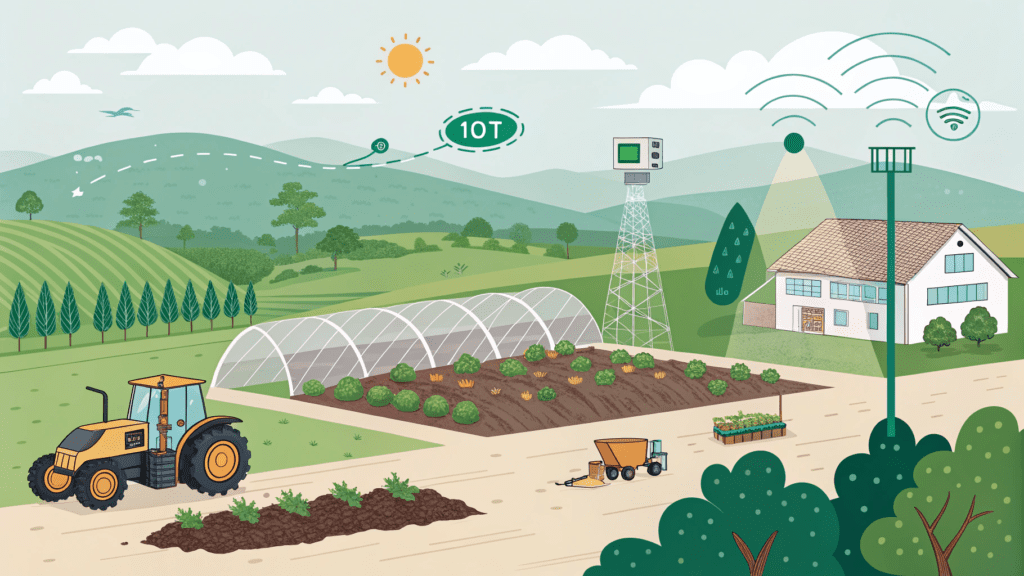
Illustration 4: Precision agriculture technology in compost application.
Central to this evolution is theCircular Economy Integration. Composting agricultural straw is becoming a cornerstone of a no-waste, low-carbon farming model. By diverting organic waste from landfills, it actively prevents methane emissions (a potent greenhouse gas). When applied to soil, the finished compost sequesters carbon, enhances drought resilience, and significantly reduces reliance on synthetic fertilizers, aligning perfectly with global climate mitigation efforts. While challenges persist, such as the long composting cycle, space requirements, greenhouse gas emissions, and the cost-competitiveness of compost versus chemical fertilizers, scientific interventions are actively exploring solutions. The increasing regulatory support from governments and environmental organizations, coupled with strategic partnerships between material suppliers, manufacturers, and waste management companies, are creating a robust framework for a sustainable, circular bioeconomy. Research into bio-based materials and the intricate dynamics of microbial diversity during composting will continue to shape the future, ensuring ever more efficient and effective methods of agricultural waste valorization.
Transform Your Waste Stream: Steps to Implement Optimized Straw Composting
Het transformeren van uw landbouwresidu van een verwijderingsuitdaging naar een waardevol bezit begint met een strategische beoordeling. Evalueer eerst uw huidige strovolume, de gewenste compostkwaliteit en uw beschikbare hulpbronnen. Deze beoordeling vormt de basis voor het ontwikkelen van een composteringsplan op maat. Selecteer op basis hiervan de meest geschikte methode – of het nu gaat om verbeterde zwaden, gemechaniseerde systemen of een combinatie ervan – en identificeer de noodzakelijke wijzigingen en technologieën. Het is van cruciaal belang dat u uw stro strategisch inkoopt, waarbij u prioriteit geeft aan materialen die vrij zijn van persistente herbiciden en de besmetting door onkruidzaden tot een minimum beperkt om een veilig eindproduct van hoge kwaliteit te garanderen. Implementeer de best practices zorgvuldig, met de nadruk op een nauwgezette C:N-verhoudingsbalans, consistent vochtbeheer, geoptimaliseerde deeltjesgroottereductie en regelmatige, consistente beluchting. Voor grootschalige activiteiten die op zoek zijn naar maximale efficiëntie, kunt u geavanceerde oplossingen verkennen, zoals gemechaniseerde systemen, specifieke microbiële inoculanten of slimme composteringstechnologieën. Maak ten slotte contact met experts uit de sector en landbouwvoorlichtingsdiensten. Hun gespecialiseerde kennis kan uw proces verder optimaliseren, waardoor u de volledige waarde van efficiënte strocompostering kunt realiseren: lagere verwijderingskosten, het genereren van waardevolle bodemverbeteringen, verbeterde gewasopbrengsten en een tastbare verhoging van de toewijding van uw merk aan duurzaamheid, waardoor mogelijk een groter marktaandeel wordt veroverd in een snel vergroenende economie.
Klaar om uw landbouwresidu om te zetten in een waardevol bezit, uw impact op het milieu te verminderen en nieuwe commerciële kansen te ontsluiten?Neem vandaag nog contact met ons op
Strocomposteren – Veelgestelde vragen
Onder typische omstandigheden in de achtertuin wordt er vaak stro gebruikt 6–9 maanden composteren. Bij optimaal beheer kan dit worden ingekort tot ≈3 maanden; als het onbeheerd en niet versnipperd wordt achtergelaten, het kan duren 12+ maanden.
Kritische hefbomen zijn onder meer: C:N-verhouding ≈30:1; vocht 45-55%; regelmatig beluchten/draaien; deeltjesgrootte 1-3 inch (2,5-7,5 cm); temperatuur 90–140°F (32–60°C); method (windrow, ASP, in-vessel); and use of microbial inoculants. Straw type and contaminants (e.g., persistent herbicides) also matter.
Use well-managed aerobic systems (e.g., windrows with scheduled turning, aerated static piles, in-vessel reactors), blend nitrogen-rich materials, add biochar, and apply microbial inoculants (e.g., EM, ZJW-6). Mechanization (turners, blowers, probes) improves throughput and quality.
Lower disposal costs; creation of high-quality soil amendments (new revenue); efficiency gains; reduced reliance on synthetic fertilizers; stronger brand and ESG credentials; and new circular-economy opportunities.
Shift from waste-driven to product-driven composting; ag-waste market projected toward USD 3.3B by 2033; biotech & smart-composting advances; deeper circular-economy integration (incl. carbon sequestration); and expanding policy support for sustainable waste management.