A Strategic Roadmap for Hospitality & Foodservice Leaders

Introductie van een boeiend industrieprobleem
The global bubble tea market faces an environmental crossroads due to single-use plastic waste and proliferating bans.
De mondiale bubble tea-markt, een levendige sector die in 2022 op 3,27 miljard dollar wordt gewaardeerd en tegen 2031 naar verwachting zal stijgen tot 6 miljard dollar (Grand View Research, 2023), staat op een cruciaal kruispunt op milieugebied. Nu er jaarlijks een alarmerende 8 tot 10 miljoen ton plastic in onze oceanen terechtkomt (Pew Charitable Trusts, 2020), vormt het escalerende tij van plastic afval voor eenmalig gebruik een onmiskenbare bedreiging. Over de hele wereld nemen de strenge verboden op plastic voor eenmalig gebruik snel toe. Van het uitgebreideEU-richtlijn voor eenmalig gebruik van kunststoffento city-specific regulations in Seattle and California, and Taiwan’s impending 2024 plastic cup ban (Taiwan Environmental Protection Administration, 2022), the industry faces an unavoidable paradigm shift. Ignoring this fundamental transformation jeopardizes not only environmental integrity but also operational compliance, brand reputation, and crucially, market share. This post outlines a strategic roadmap for B2B decision-makers, offering insights into implementing high-conversion, compliant, and cost-effective reusable boba straw programs designed for the future.
The escalating global plastic waste crisis and widespread single-use plastic bans necessitate a strategic shift for the boba tea industry to ensure compliance, protect brand reputation, and secure market share.
Market & Regulation Insights (EU, US, Asia-Pacific)
Global regulations and consumer demand are driving the shift towards sustainable boba solutions across key markets.
The pervasive wave of legislative actions, particularly the EU Single-Use Plastics Directive, is reshaping traditional boba tea operations. Taiwan’s proactive move towards a plastic-free future, including its comprehensive 2024 plastic cup ban, holds significant implications for the global boba supply chain, as the island nation is the birthplace of this popular beverage. A unique challenge arises with boba straws: their wider diameter, essential for tapioca pearls, demands specific attention when seeking compliant alternatives. Beyond mere compliance, a powerful force is at play: the eco-conscious consumer. Growing environmental awareness, especially among Gen Z and Millennials, is driving an undeniable demand for genuinely sustainable practices in food service. This demographic actively seeks out brands that align with their values, making transparent and effective sustainability initiatives critical for enhancing brand loyalty and mitigating “greenwashing” perceptions. While many businesses have turned to commonly perceived eco-friendly alternatives like paper and PLA straws, these often fall short due to functional limitations—paper straws becoming soggy or altering taste, and PLA straws requiring complex industrial composting facilities that are often scarce. For a deeper dive into materials that are truly reshaping the industry, explore our article on Materials Reshaping the Straw Industry B2B. For effective biodegradable options, consider learning about the Beste biologisch afbreekbare rietjes B2B 2025 en de Best Biodegradable Plastic Straws B2B.
Regulatory Landscape Comparison
| Region | Key Regulations/Trends | Impact on Boba Straws |
|---|---|---|
| Europese Unie | Single-Use Plastics Directive (SUPD) bans many single-use plastic items. | Direct ban on plastic straws; drives demand for reusable or certified compostable alternatives. |
| Verenigde Staten | Patchwork of state/city bans (e.g., California, Seattle); federal initiatives emerging. | Varied compliance requirements; strong consumer preference for sustainable options in key markets. |
| Azië-Pacific | Taiwan’s 2024 plastic cup ban; South Korea’s deposit scheme; China’s plastic reduction plans. | Significant shift in supply chain and consumer behavior, especially in boba’s birthplace. |
For a comprehensive guide on global regulations, refer to ourFull Regulatory Guide on Single-Use Plastics.

Global regulations, particularly in the EU, US, and Asia-Pacific, coupled with rising eco-conscious consumer demand, are compelling the boba industry to adopt reusable solutions.
Solution: Reusable Boba Straw Programs
Reusable boba straw programs offer a sustainable, cost-effective alternative to single-use plastics for hospitality.
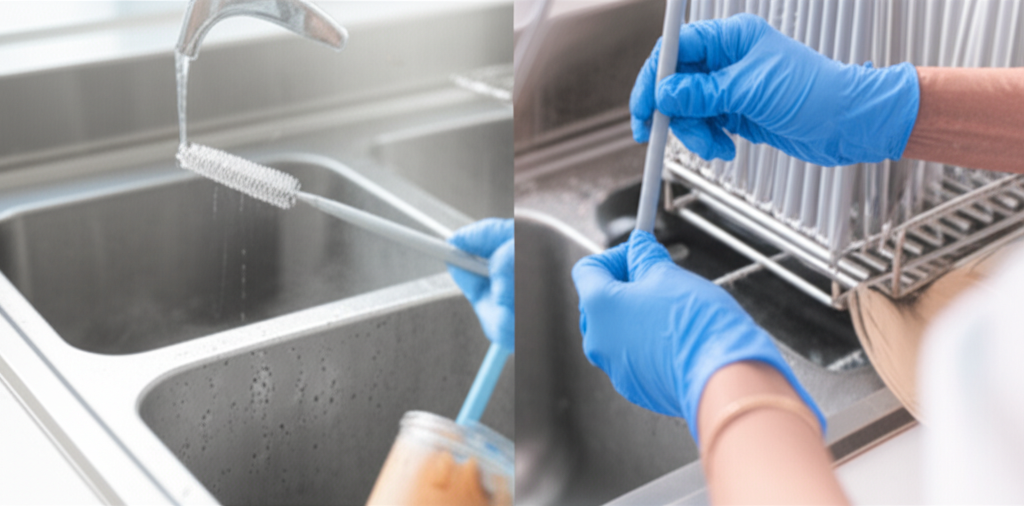
De implementatie van een herbruikbaar boba-stro-programma met grote impact hangt af van twee kerncomponenten: een robuuste Standard Operating Procedure (SOP) voor reiniging en een naadloos statiegeld-turnaround-model. Voor commercieel gebruik is een grondige reiniging van het grootste belang. De essentiële stappen omvatten voorspoelen om direct vuil te verwijderen, wassen met speciale borstels en geschikte schoonmaakmiddelen, zorgvuldig spoelen en effectief ontsmetten – hetzij door onderdompeling in warm water (bijvoorbeeld 160°F / 71°C of hoger gedurende minstens 30 seconden) of chemische ontsmetting met behulp van goedgekeurde commerciële ontsmettingsmiddelen van voedingskwaliteit. Naleving vanFDA Food Code-normenis niet onderhandelbaar, aangezien commercieel afwassen superieure hygiënische veiligheid biedt. Belangrijke hygiëneproblemen, zoals het voorkomen van de opbouw van bacteriën, de uitdagingen van het reinigen van ondoorzichtige materialen en de absolute noodzaak van een goede opleiding van het personeel, moeten rigoureus worden aangepakt. Geïnspireerd door initiatieven als het herbruikbare containerprogramma van de University of California, Santa Barbara (UCSB), zorgt een gecentraliseerde, commerciële afwasaanpak voor optimale ontsmetting en operationele efficiëntie.
Complementing this, a well-designed deposit-return system incentivizes customer returns. This model involves a small, refundable fee charged at the point of purchase, which encourages high return rates, significantly reduces waste and litter, and enhances consumer engagement. Successful adaptations from broader food service, such as Canva’s Huskee system or Blenheim Palace’s tech-based return trial, and South Korea’s disposable cup deposit scheme, demonstrate the viability of such programs. Logistical considerations, including designated collection points, efficient washing infrastructure, and the potential role of tracking technologies like RFID or QR codes, are crucial for a smooth operation.
Quantified Benefits for Hospitality & Foodservice
- Kostenbesparingen: Reduce straw procurement costs by up to 70% annually after initial investment, based on a 150-use lifespan per straw.
- Waste Reduction: Eliminate thousands of single-use plastic straws from landfills and oceans daily, significantly improving environmental footprint.
- Enhanced Brand Image: Boost customer loyalty and attract eco-conscious consumers, potentially increasing sales by 10-15% through visible sustainability efforts.
- Naleving van regelgeving: Future-proof operations against evolving plastic bans and avoid potential fines, ensuring uninterrupted service.
- Operational Efficiency: Streamline waste management and reduce labor associated with handling single-use disposables.
ROI Table: Reusable Boba Straw Program vs. Single-Use
| Functie | Single-Use Plastic Straws | Commercial Reusable Boba Straw Program |
|---|---|---|
| Initial Cost | Very Low (1-3 cents/straw) | Moderate (Upfront investment in straws, cleaning equipment) |
| Ongoing Cost | High (Continuous procurement, waste disposal fees) | Low (Utilities for washing, occasional replacement) |
| Milieu-impact | High (Pollution, microplastics, carbon footprint) | Low (Reduced waste, lower long-term carbon footprint) |
| Brand Perception | Negative/Neutral (Associated with pollution) | Positive (Eco-conscious, innovative, responsible) |
| Nalevingsrisico | High (Subject to increasing bans and regulations) | Low (Proactive compliance, future-proof) |
| Operational Complexity | Low (Discard & replace) | Moderate (Cleaning SOP, return logistics, staff training) |
Hoewel plastic rietjes voor eenmalig gebruik de laagste initiële kosten hebben (ongeveer 0,30 euro/jaar), brengen ze op de lange termijn de hoogste milieu- en verwijderingslasten met zich mee. Omgekeerd worden herbruikbare roestvrijstalen rietjes, hoewel ze hogere initiële kosten hebben, in de loop van de tijd economisch gunstiger (ongeveer 2,81 euro/jaar), waarbij milieuvoordelen worden gerealiseerd na aanzienlijk hergebruik (bijvoorbeeld 130 keer gebruiken om de productie-impact te compenseren). Deze analyse laat duidelijk de langetermijnbesparingen en milieuvoordelen zien van herbruikbare materialen ten opzichte van de permanente aanschaf van eenmalig gebruik. De mondiale markt voor herbruikbare rietjes werd in 2023 geschat op ongeveer 2,2 miljard dollar en zal naar verwachting in 2033 tussen de 4,0 en 4,5 miljard dollar stijgen, wat een duidelijke marktverschuiving laat zien. Noord-Amerika blijft een leidende regio, met ongeveer 0,85 miljard dollar in 2024, gedreven door strikte regelgevingskaders en een groot consumentenbewustzijn, terwijl Europa volgt met 0,67 miljard dollar, gevoed door uitgebreide EU-regelgeving.
Reusable boba straw programs, supported by robust cleaning SOPs and deposit models, offer significant ROI through cost savings, waste reduction, and enhanced brand value.
Industry Misconceptions & Clarifications
Dispelling myths about reusable boba straws is crucial for successful program implementation and adoption.
Myth: Paper and PLA straws are truly sustainable alternatives for boba.
Verduidelijking:While often marketed as eco-friendly, paper straws frequently degrade quickly in boba drinks, affecting taste and user experience, leading to customer dissatisfaction. PLA (polylactic acid) straws, derived from renewable resources, require specific industrial composting facilities to break down, which are scarce in many regions. If not composted correctly, PLA straws end up in landfills, where they behave much like traditional plastics. For boba, their wider diameter often makes them less durable than standard paper straws, exacerbating the issue. True sustainability for boba requires durable, reusable solutions that can withstand repeated commercial cleaning and use.
Myth: Reusable straws are unhygienic and difficult to clean in a commercial setting.
Verduidelijking:With proper Standard Operating Procedures (SOPs) and commercial-grade dishwashing equipment, reusable boba straws can be cleaned to the highest hygiene standards, often surpassing manual cleaning. Adherence to FDA Food Code standards and utilizing high-temperature sanitization or approved chemical sanitizers ensures safety. The key is a well-designed system, dedicated cleaning tools, and thorough staff training, making them a safe and viable option for high-volume operations.
It’s a misconception that paper and PLA straws are universally sustainable for boba; true sustainability and hygiene are achieved through well-managed reusable programs.
B2B Customization & Supply Chain Optimization
Optimizing supply chains for reusable boba straws involves strategic procurement, branding, and efficient logistics.
Strategic advantage is also gained through enhanced brand value. A visible commitment to sustainability significantly improves brand perception, fosters deeper customer loyalty, and provides crucial market differentiation. This is particularly true in regions like the US and Europe, where environmental concerns heavily influence consumer purchasing decisions.
Partnering for a sustainable boba future means embracing cutting-edge reusable boba straw innovations designed for commercial scale. This includes collapsible designs like the Bobbleware Sip™ for ultimate portability, optimized wide diameters ensuring compatibility with tapioca pearls, and integrated cleaning tools to streamline post-use hygiene. Businesses can procure bulk reusable solutions crafted from durable and safe materials such as food-grade stainless steel, borosilicate glass, and flexible silicone, all offering longevity and safety. Custom-branded options further enhance identity and appeal, positioning your business as a leader.
Scenario-Specific Tips for Hospitality & Foodservice
- MOQ (Minimum Order Quantity): For large chains or high-volume cafes, negotiate bulk MOQs directly with manufacturers to reduce per-unit cost. Smaller businesses can leverage distributors specializing in sustainable foodservice supplies.
- Branding: Custom laser engraving or printing on reusable straws and their carrying pouches (if applicable) reinforces brand identity and promotes your sustainability commitment. Consider co-branding with local environmental initiatives.
- Logistics: Implement a closed-loop system for straw collection, washing, and redistribution. For multi-location businesses, centralize washing facilities or partner with commercial laundry services to optimize efficiency and reduce individual store burden.
- Inventory Management: Maintain adequate stock levels to account for straws in circulation, washing, and occasional loss/damage. Utilize tracking systems (e.g., simple count sheets or RFID for larger scale) to monitor inventory.

B2B customization and supply chain optimization for reusable boba straws involve strategic procurement, effective branding, and efficient logistics to maximize operational benefits.
Strong Call to Action
Transitioning to reusable boba straw programs is a strategic imperative for long-term viability and market leadership.
The food service industry is undeniably accelerating its shift towards a circular economy model, which minimizes waste and maximizes resource utility. Comprehensive reusable boba straw programs are not merely a cost center but a strategic competitive advantage. Future trends point towards advanced material science, automated collection and washing systems, and the integration of digital platforms for seamless deposit-return models. Proactive adoption of these innovative solutions positions businesses as frontrunners in a rapidly evolving market, ready to seize new opportunities.
The transition to reusable boba straw programs is no longer a choice but a strategic imperative for long-term viability and market leadership. By implementing robust cleaning SOPs, efficient deposit models, and leveraging favorable life-cycle costs, your business can achieve significant operational efficiencies, ensure regulatory compliance, and build an unassailable brand reputation. Act now: schedule a consultation with our experts to design a tailored reusable boba straw program that minimizes environmental impact, optimizes your operational costs, and positions your brand at the forefront of sustainable innovation.
Schedule Your Reusable Straw Program Consultation Today!
Embrace reusable boba straw programs as a strategic imperative to achieve operational efficiency, regulatory compliance, and market leadership in the evolving foodservice landscape.
Veelgestelde vragen (FAQ)
1. How do reusable boba straw programs impact my operational costs long-term?
While there’s an initial investment in reusable straws and cleaning equipment, a well-managed program can significantly reduce ongoing procurement costs for single-use straws and waste disposal fees. Over a 1–3 year period, life-cycle cost analysis typically shows substantial savings, making it more economically favorable for high-volume operators.
2. What are the most effective cleaning methods for reusable boba straws in a high-volume commercial setting?
The most effective methods involve commercial dishwashers with high-temperature sanitization cycles (160°F / 71°C or above for at least 30 seconds) or chemical sanitization using approved food-grade sanitizers. Pre-rinsing and using specialized brushes for the wide boba straw diameter are crucial steps before machine washing.
3. How can a deposit-return model for boba straws be implemented smoothly to ensure high return rates?
Charge a small, refundable deposit at the point of purchase to incentivize returns. Support this with clear signage, convenient collection points, and a quick, hassle-free refund process—ideally using QR codes or app integration to streamline customer experience.
4. Are there specific materials for reusable boba straws that are better for commercial use?
For commercial use, food-grade stainless steel and borosilicate glass are highly durable and easy to sanitize. Flexible silicone options are also viable, offering safety and portability. Choose materials that can withstand repeated high-temperature washing and resist staining or odor retention.
5. What are the challenges of cleaning opaque reusable boba straws and how can they be addressed?
Opaque straws can hide residue, making visual inspection difficult. To address this, implement a rigorous cleaning SOP that includes pre-rinsing, specialized brushes for thorough scrubbing, and high-temperature or chemical sanitization. Regular spot checks and staff training are essential for maintaining hygiene standards.