Ce este BPI Compostabil? Un ghid B2B pentru operațiuni durabile și deturnarea deșeurilor
For Procurement Managers, Operations Directors, and Sustainability Officers in Hospitality & Foodservice
I. Introducere: Navigarea peisajului verde pentru operațiuni B2B
În peisajul corporativ de astăzi, practicile durabile nu mai sunt un lux, ci un imperativ strategic. Pentru managerii de achiziții, directorii de operațiuni, ofițerii de sustenabilitate și directorii lanțului de aprovizionare dinhospitality & foodservice industries, mandatul de a integra soluții responsabile din punct de vedere ecologic în funcțiile de bază ale afacerii este în creștere. Un aspect semnificativ al acestui lucru implică deturnarea eficientă a deșeurilor organice, o componentă critică pentru optimizarea eficienței lanțului de aprovizionare și demonstrarea unei veritabile gestionări a mediului. Provocarea constă totuși în discernământul produselor cu adevărat durabile în mijlocul unei mări de afirmații „verzi” înșelătoare.
Înțelegerea complexităților certificării „BPI compostabil” este, prin urmare, esențială pentru decizii informate de achiziție. Acest ghid își propune să demistifice certificarea BPI, oferind factorilor de decizie B2B cunoștințele cuprinzătoare necesare pentru a utiliza soluțiile certificate BPI pentru o eficiență operațională îmbunătățită, conformitatea reglementărilor și o reputație consolidată a mărcii. Ignorarea trecerii către materialele compostabile verificate implică riscuri operaționale și comerciale substanțiale, de la acumularea de costuri la depozitele de gunoi și sancțiuni de reglementare până la înstrăinarea unei baze de clienți din ce în ce mai conștienți de mediu.
Certificarea BPI este crucială pentru ospitalitate și servicii alimentare pentru a asigura o durabilitate reală și pentru a evita spălarea ecologică.
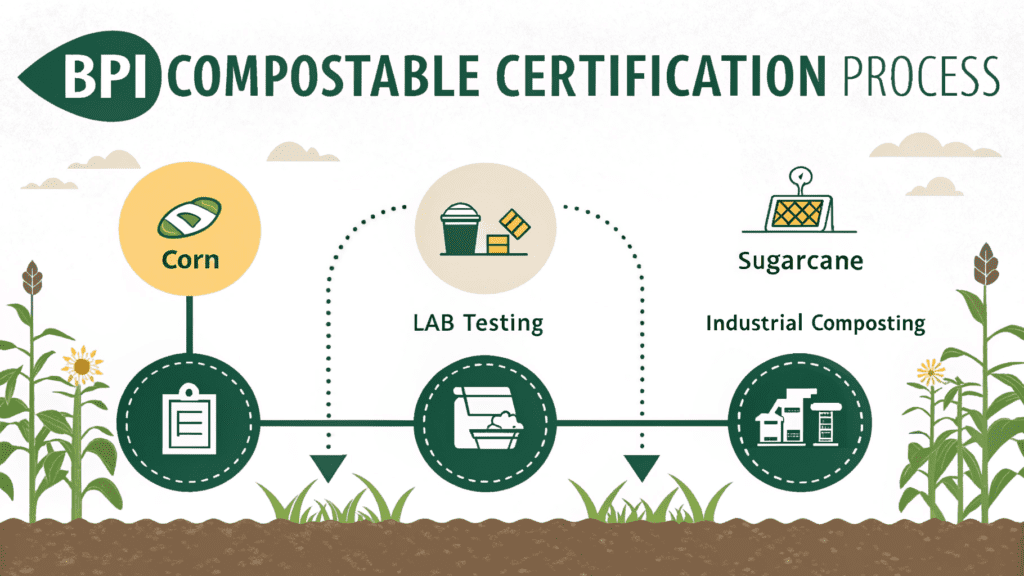
Ilustrație: Procesul riguros de testare și certificare din spatele produselor compostabile BPI.
II. Demistificarea certificării BPI compostabile pentru managerii de achiziții
Pentru profesioniștii în achiziții, identificarea materialelor cu adevărat compostabile este esențială pentru a evita greșelile costisitoare și pentru a asigura îndeplinirea obiectivelor de sustenabilitate pe termen lung. TheInstitutul pentru produse biodegradabile (BPI)oferă o cale clară, susținută științific pentru aceasta.
A. Ce este BPI Compostabil? Standardul de aur nord-american
Înființată în 1999 ca o asociație non-profit, cu mai multe părți interesate, Institutul pentru Produse Biodegradabile (BPI) a devenit principalul certificator terță parte pentru produse și ambalaje compostabile în America de Nord. Misiunea BPI este de a verifica dacă produsele și ambalajele se vor descompune cu succes în instalațiile de compostare comerciale sau industriale gestionate profesional, fără a afecta calitatea compostului finit. Acest proces robust de certificare asigură că articolele certificate compostează complet, în siguranță și în timp util.
Marca de certificare BPI, cu designul său distinctiv în formă de turbion, oferă o verificare de încredere de la terți că un produs a fost testat și verificat în mod independent conform standardelor bazate științific. Această marcă este recunoscută pe scară largă de către municipalități și unitățile de compostare din Statele Unite și Canada, servind drept standard definitiv pentru produsele biodegradabile aprobate în programele de diversiune a substanțelor organice. La aprovizionarea cu produse precum paiele compostabile certificate BPI, de exemplu,afaceri de ospitalitatepot fi siguri că investesc în soluții concepute pentru o adevărată recuperare la sfârșitul vieții.
B. The Rigorous Standards Behind BPI Compostable Products: ASTM D6400 & D6868
Integritatea certificării BPI se bazează pe aderarea sa la standardele tehnice riguroase ale Societății Americane de Testare și Materiale (ASTM). Produsele certificate BPI trebuie să îndeplinească fie ASTM D6400 pentru materiale plastice, fie ASTM D6868 pentru produsele pe bază de fibre care încorporează polimeri ca acoperiri sau aditivi.
Aceste standarde sunt concepute meticulos pentru a asigura o descompunere completă. Mai exact, necesită ca produsele să se dezintegreze în bucăți mici în 90 de zile (sau 12 săptămâni/84 de zile) într-un mediu de compostare industrială. Biodegradarea completă, în care materialul se transformă în dioxid de carbon, apă și biomasă, trebuie să aibă loc în decurs de 90 până la 180 de zile. În mod crucial, această defalcare nu trebuie să lase în urmă reziduuri toxice sau metale grele dăunătoare, asigurându-se că compostul rezultat este sigur pentru creșterea plantelor, un criteriu verificat prin teste de ecotoxicitate.
Un progres semnificativ în programul de certificare BPI este interzicerea substanțelor per- și polifluoroalchil (PFAS). Începând cu 1 ianuarie 2020, BPI a implementat un nou standard care cere tuturor produselor certificate să nu aibă substanțe chimice fluorurate adăugate intenționat și să prezinte un raport de testare cu mai puțin de 100 ppm fluor total. Această măsură proactivă abordează preocupările tot mai mari cu privire la „substanțe chimice pentru totdeauna” și consolidează angajamentul BPI față de materiale cu adevărat sigure și durabile. Mai multe detalii despre aceste standarde pot fi găsite peASTM International website.
BPI certification ensures products meet strict ASTM standards, including PFAS-free requirements for safe composting.
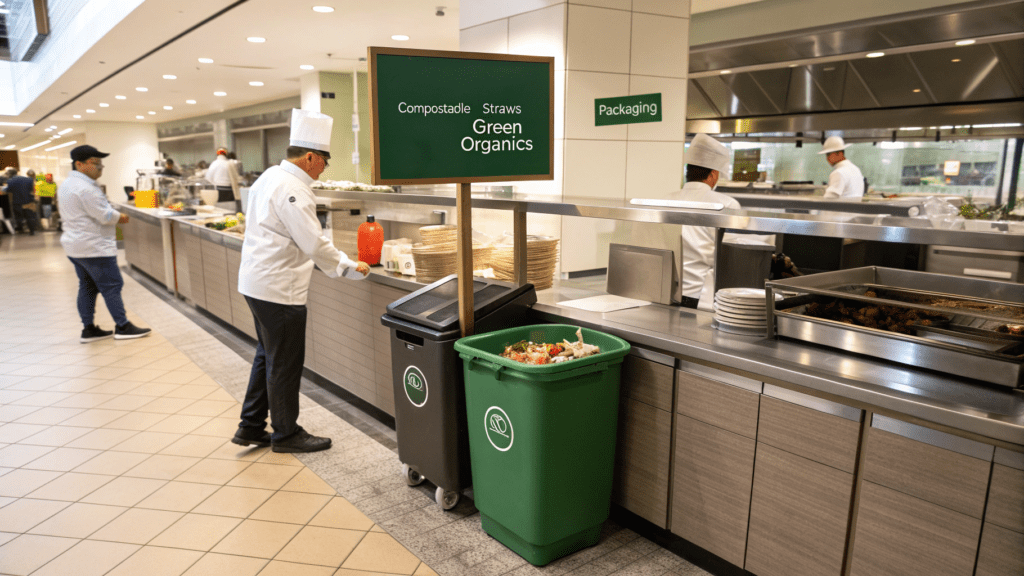
Illustration: Streamlining waste management in hospitality with BPI-certified solutions.
III. Strategic Benefits of Embracing BPI Compostable Solutions for Operations Directors
For operations directors inospitalitate și servicii alimentare, the move to BPI compostable solutions offers more than just environmental goodwill; it provides tangible operational and financial advantages.
A. Elevating Sustainability: Real Waste Diversion with BPI Compostable Materials
Beneficiul principal de mediu al produselor certificate de BPI este capacitatea lor de a facilita deturnarea deșeurilor organice autentice din gropile de gunoi și incineratoare. Asigurând că produsele se descompun complet și în siguranță în instalațiile de compostare industrială, certificarea BPI sprijină în mod direct reducerea contaminării gropilor de gunoi. Aceasta este o problemă critică pentru industria de compostare, deoarece materialele plastice nedegradabile și articolele „biodegradabile” înșelătoare pot costa milioane anual în costuri crescute de procesare și materiale de nevânzare care ajung în continuare la gropile de gunoi.
Embracing BPI-certified materials helps foster a circular economy, transforming discarded organic waste into nutrient-rich compost that can return valuable resources to agriculture. The growth in composting infrastructure underscores this trend: the number of U.S. composting facilities increased by 55% between 2016 and 2021, with an impressive 83% increase in tonnage processed. This growing capacity makes the integration of BPI-certified products increasingly viable and impactful foroperațiuni de servicii alimentare.
B. Ensuring Compliance & Mitigating Greenwashing with BPI Compostable Verification
In a market saturated with vague environmental claims, BPI certification serves as a robust shield against greenwashing. Terms like “biodegradable” or “degradable” are often misleading; while these items may eventually break down, they often fragment into micro-plastics or do not fully decompose in industrial composting systems. BPI offers clear, third-party verified proof of compostability, distinguishing true compostable products from those that merely fragment.
Această claritate este vitală pentru respectarea reglementărilor. Legislația de stat din America de Nord, cum ar fi California AB 1201 și legile statului Washington, solicită din ce în ce mai mult certificarea BPI pentru ca articolele compostabile să fie comercializate ca atare. Bazându-vă pe certificarea BPI, organizația dumneavoastră rămâne în conformitate cu reglementările de mediu în evoluție, atenuând riscurile legale și reputaționale semnificative. Eticheta BPI include adesea în mod explicit „NUMAI COMPOSTABIL COMERCIAL” pentru a clarifica și mai mult eliminarea adecvată și pentru a preveni neînțelegerile consumatorilor.
C. Operational Efficiency & ROI Potential with BPI Compostable Packaging
Beyond compliance and sustainability, BPI-certified products offer clear operational advantages. Unlike conventional plastics, food-soiled BPI compostable products can be disposed of directly into organics recycling streams without the need for cleaning. This significantly streamlines waste sorting and collection processes withinhospitality facilitiesthat have access to organics recycling, improving overall operational efficiency and reducing labor costs associated with waste management.
Moreover, the transition to BPI-certified alternatives can yield direct financial benefits. Some regional programs, such as the MNimize Rebate, offer financial incentives of up to $500 for businesses replacing single-use plastic products with BPI-certified compostable options. Furthermore, investing in verified compostable solutions enhances brand reputation, appealing strongly to sustainability-conscious consumers and partners, and potentially opening new market opportunities and securing long-term contracts with environmentally aligned businesses. You can learn more about how BPI-certified solutions integrate intohospitality sustainability effortsat thisinternal link.
BPI certification offers operational efficiency, compliance, and ROI for hospitality and foodservice waste management.
IV. Comparison Table: Understanding Material End-of-Life Options
Choosing the right materials involves a clear understanding of their end-of-life implications for yourB2B hospitality or foodservice business. This table highlights key distinctions between common material categories.
| Caracteristică | Impact operațional B2B | Notă de conformitate | Potențial de rentabilitate a investiției |
|---|---|---|---|
| BPI compostabil | Integrates seamlessly with organics recycling programs; significantly reduces landfill waste volume and costs foroperațiuni de servicii alimentare. | Meets ASTM D6400/D6868; PFAS-free since Jan 1, 2020; complies with growing state regulations (e.g., CA AB 1201). | Enhanced brand image and customer loyalty; potential waste fee reductions; eligibility for sustainability rebates; reduced contamination costs for composters. |
| Conventional Plastic | Low immediate material cost; however, incurs significant long-term landfill disposal or recycling processing costs, especially if food-soiled inhotel kitchens. | Subject to increasing single-use plastic bans and extended producer responsibility (EPR) laws; often non-recyclable if food-soiled, leading to landfill diversion. | Short-term material cost savings often offset by escalating waste management expenses, potential fines, and negative brand perception. |
| “Biodegradable” Claim | Unclear or misleading disposal path; high risk of contaminating recycling or composting streams; requires manual sorting if accepted incommercial settings. | Often does not meet industrial composting standards; risk of greenwashing backlash and consumer distrust due to vague or unverified claims. | No true environmental benefit; risk of significant reputational damage and legal challenges for deceptive marketing; contributes to waste system inefficiency. |
Understanding material end-of-life options is crucial for informed B2B procurement and sustainability strategies.
Illustration: BPI-certified products seamlessly integrating into a sustainable waste stream.
V. Real-World Impact: BPI Compostable in Action
The adoption of BPI-certified materials extends beyond mere packaging, permeating various stages of the supply chain to ensure comprehensive sustainability forîntreprinderile de ospitalitate și servicii alimentare.
A. Case Study: Zeller+Gmelin’s Commitment to BPI Compostable Inks (May 2025)
A notable example of BPI certification’s impact on the broader supply chain comes from Zeller+Gmelin North America. In May 2025, their 76z50 Series dry offset ink line achieved BPI Compostable certification. This is a significant development, as inks are a crucial component in packaging. By certifying their inks, Zeller+Gmelin enables their customers – packaging manufacturers – to confidently use the BPI mark on their finished compostable packaging products.
This innovation demonstrates a deep commitment to supporting entire supply chains with certified components, ensuring that even the subtle elements like printing inks meet stringent standards for indirect food contact safety and compost performance. Such integrations are vital for creating truly circular systems, where every part of a product contributes to its successful return to the earth as valuable compost, rather than becoming a pollutant, especially forfood packaging in restaurants.
Zeller+Gmelin’s BPI-certified inks exemplify supply chain commitment to comprehensive compostability.
VI. Navigating the Landscape: Implementation and Future Outlook for BPI Compostable
Successfully integrating BPI compostable products requires addressing existing challenges, particularly around consumer behavior and infrastructure development, crucial forlarge-scale hospitality operations.
A. Addressing Consumer Confusion for Better Waste Stream Management
Despite the growing availability of compostable products, consumer understanding remains a hurdle. A joint study by BPI and Closed Loop Partners’ Composting Consortium, released in July 2023, revealed significant public confusion. The digital survey of 2,700 participants found that approximately 49% had difficulty distinguishing between “biodegradable” and “compostable.” Furthermore, nearly one-third of respondents incorrectly placed compostable packaging in recycling bins, and up to 50% mistakenly believed packaging labeled “made from plants” could be composted, regardless of certification.
To counter this, standardized labeling and the prominent display of clear compostability details on packaging are crucial. BPI actively advocates for policy changes to improve waste stream management, including a significant petition filed with the U.S. Department of Agriculture in 2023. This petition seeks to update the 25-year-old definition of compost in the National Organic Program, which currently only allows plant and animal materials, thereby restricting the ability of many processors to handle compostable packaging. Addressing this confusion is vital for maximizing the effectiveness of organics diversion programs, particularly inhigh-volume foodservice environments. For more information on this study and other initiatives, visit theClosed Loop Partners website.
B. The Evolving Landscape of Industrial Composting Infrastructure
While the growth in U.S. composting facilities—a 55% increase between 2016 and 2021, leading to an 83% increase in tonnage processed—is encouraging, more capacity is still needed nationwide to effectively manage the growing volume of organic and compostable waste. The success of BPI-certified products relies heavily on the availability and efficiency of these industrial composting facilities, which is a key consideration forhospitality chains.
To bridge the gap between lab testing and real-world performance, BPI initiated a “Field Validation Program.” This program gathers comprehensive data on how certified products perform in actual composting facility systems. A February 2022 report by BPI and BioCycle, titled “Review of Publicly Available Field Testing Results and Programs,” compiled data from various sources, showing that the majority (85%) of publicly available data indicated BPI products passed field tests within 49-day timeframes. This suggests that the 12-week (84-90 days) disintegration tests required by ASTM standards are sufficiently conservative.
However, the review also highlighted areas for improvement. Challenges were noted for certain paper and fiber items, including molded fiber products without PFAS, which sometimes struggled to pass both 49- and 90-day real-world tests. Bioplastic coatings on paper, such as those found on hot cups, were observed to break down sufficiently, but occasionally left behind a mostly intact paper substrate. BPI’s Executive Director, Rhodes Yepsen, emphasized the ongoing need for further research to identify root causes for items not breaking down, whether due to specific material composition or composting environment conditions. This continuous feedback loop between certification, research, and infrastructure development is essential for the long-term success of the compostable products market. A comprehensive list of BPI certified products and their specific certifications can be found via theinternal linkto the BPI searchable product catalog here.
Addressing consumer confusion and expanding composting infrastructure are vital for BPI product success.
VII. Conclusion: Drive Sustainable Change with BPI Compostable
Embracing BPI compostable solutions is more than an environmental choice; it is a strategic imperative for modernB2B hospitality and foodservice operations. It not only ensures adherence to stringent environmental standards and proactive regulatory compliance but also catalyzes substantial waste diversion, bolsters brand integrity, and enhances operational efficiency. By making a deliberate shift towards BPI-certified products, businesses can quantify cost savings through reduced landfill fees and potential rebates, mitigate compliance and greenwashing risks, and significantly uplift their brand value in the eyes of increasingly conscious consumers and partners. This commitment opens substantial market share opportunities, positioning your organization at the forefront of the circular bioeconomy.
The time for hesitation is over.Acționează acumto evaluate and integrate BPI-certified products into your supply chain, securing a more sustainable, compliant, and profitable future for your organization. Request a comprehensive BPI-certified product assessment today to align your operations with the future of sustainable waste management.
Embrace BPI compostable solutions for strategic sustainability, compliance, and profitability in B2B operations.
Întrebări frecvente (FAQ)
Q: How does BPI certification specifically benefit waste management in a large hotel chain?
A: For large hotel chains, BPI certification streamlines waste sorting by allowing food-soiled compostable items (like cutlery, plates, and cups) to be collected with food waste. This reduces landfill volume, lowers disposal costs, and enhances the hotel’s green image, appealing to eco-conscious guests and corporate clients.
Q: What are the key challenges for foodservice operations when transitioning to BPI compostable packaging?
A: Challenges include ensuring staff training on proper disposal, educating customers to prevent contamination, and verifying local access to industrial composting facilities. Procurement managers must also manage potential cost differences and supply chain adjustments.
Q: Can BPI-certified products withstand the demands of commercial dishwashers in a restaurant setting?
A: BPI certification is for single-use items designed for industrial composting, not for reusability or commercial dishwashers. Restaurants should use BPI-certified products for their disposable needs (e.g., takeout containers) and traditional durable goods for dine-in service.
Q: How does BPI certification differ from “biodegradable” or “degradable” claims?
A: BPI certification is a rigorous third-party verification ensuring products break down completely in industrial composting facilities, leaving no harmful residues. “Biodegradable” or “degradable” are often vague marketing terms that don’t guarantee full decomposition or safety in specific environments, potentially leading to microplastic pollution.
Q: What is the typical ROI for a hospitality business investing in BPI compostable products?
A: ROI comes from reduced landfill fees, potential eligibility for local sustainability rebates, enhanced brand reputation attracting eco-conscious customers, and improved operational efficiency in waste sorting. While initial product costs might be higher, long-term savings and brand value often