

Bulk Compostable Straw Procurement: A Hotel Buyer’s Strategic Guide

Navigating sustainable choices for hospitality supply chains.
The hospitality sector stands at a pivotal juncture, grappling with mounting pressure to address its environmental footprint while simultaneously enhancing guest satisfaction. Single-use plastics, particularly drinking straws, represent a significant challenge. The food and beverage (F&B) sectors in America alone discard an estimated 170 to 390 million plastic straws daily, contributing substantially to ocean and landfill waste. This issue is no longer just an environmental talking point; it’s a high-stakes operational and commercial challenge demanding strategic action from procurement managers and operations directors.
Ignoring this shift carries substantial operational and commercial impacts. Evolving legislation, exemplified by the EU’s Single-Use Plastics Directive enforced since 2021, and the imposition of fines in major U.S. cities like New York City starting November 2022, mandates a decisive move towards sustainable alternatives. Beyond compliance, consumer sentiment is a powerful driver: over 70% of consumers prefer businesses committed to eco-friendly practices, directly influencing brand loyalty and repeat business. Industry leaders such as Marriott, Hilton, and Hyatt proactively phased out plastic straws between 2018 and 2019, setting a new, undeniable standard for sustainable operations and competitive advantage.Hotels must strategically address plastic straw waste to meet regulations and consumer demand, ensuring competitive advantage.
Navigating the Nuances: “Compostable” vs. “Biodegradable” in Bulk Compostable Straw Procurement
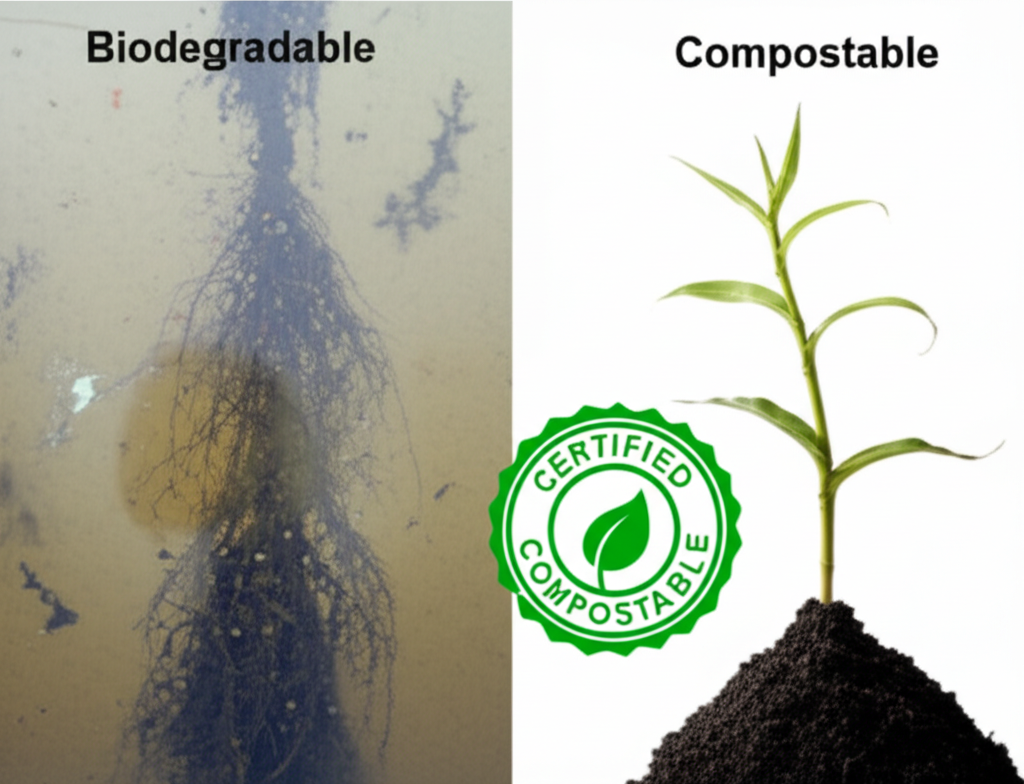
For hotel buyers, understanding the precise terminology in the sustainable straw market is paramount to avoiding “greenwashing” and ensuring genuine environmental impact. The terms “biodegradable” and “compostable” are often used interchangeably, yet their definitions and implications for waste management are critically different.
Beyond “Biodegradable” Claims:
A product labeled “biodegradable” implies it will eventually break down, but often under vague or unachievable conditions. Such materials can take decades or even centuries to decompose and may still leave harmful microplastic residues, effectively persisting as pollutants in the environment. This ambiguity makes “biodegradable” a less reliable indicator of true environmental benefit.
Understanding True “Compostability”:
In contrast, “compostable” carries a rigorous, verifiable standard. A truly compostable product guarantees complete decomposition into nutrient-rich compost, carbon dioxide, and water within a defined timeframe, typically 90 to 180 days, under controlled, high-temperature industrial composting conditions. Crucially, it leaves no toxic residues behind. For a deeper dive into these distinctions, explore our B2B guide on compostable vs. biodegradable straws.
The Critical Role of Certification:
To verify genuine compostability and prevent misleading claims, prioritize products with reputable third-party certifications. Key standards include ASTM D6400 in the United States and EN 13432 in Europe. Certifications from bodies like the Biodegradable Products Institute (BPI) or TÜV Austria’s OK Compost ensure independent verification that products meet these stringent scientific standards. Furthermore, as of January 2020, BPI-certified products are required to be PFAS-free, eliminating harmful “forever chemicals” that pose significant environmental and health risks. Hotels must actively seek suppliers who can provide this level of transparency and certified assurance.Hotels must prioritize certified compostable, PFAS-free straws to avoid greenwashing and ensure genuine environmental impact.

Key Material Options for Bulk Compostable Straw Procurement: A Comparative Guide for Hotels
The market for compostable straws offers diverse material options, each with distinct performance characteristics, suitability for various beverages, and disposal requirements. Hotel buyers must evaluate these options against their specific operational needs, guest experience expectations, and local waste management infrastructure.
- PHA (Polyhydroxyalkanoates) Straws: Derived from plant-based oils, PHA straws offer a feel and durability akin to traditional plastic, resisting sogginess effectively. They maintain integrity in temperatures up to 212°F (100°C), making them suitable for both hot and cold beverages. Critically, PHA straws are certified home compostable (decomposing in approximately 1 year) and marine degradable (breaking down in 4-8 months), without producing microplastics. They are often BPI certified and have been adopted by major F&B companies like First Watch and HMSHost, highlighting their reliability for high-volume operations.
- Sugarcane (Bagasse) Straws: Crafted from the fibrous byproduct of sugarcane juice extraction, bagasse straws are remarkably sturdy and durable. They resist sogginess for up to 24 hours and can endure temperatures up to 220°F (100°C), making them versatile for a wide range of beverages, including hot drinks and thicker smoothies. These straws are certified for both home and industrial composting (e.g., achieving 70% decomposition in 12 weeks) and are frequently EN 13432 certified. Many are also guaranteed PFAS-free, offering a safe and highly functional alternative.
- Wheat & Reed Straws: Naturally derived from the stems of wheat or reed plants, these straws are inherently firm in both hot and cold beverages and are completely gluten-free (as they come from the stem, not the grain). They are 100% compostable and biodegradable in both land and marine environments. Brands like HAY! Straws are BPI certified, with reported decomposition times of just 42 days in composting facilities, and are recognized by the USDA BioPreferred program. Their rustic aesthetic can also enhance a hotel’s eco-conscious branding.
- Paper Straws: While cost-effective, earlier generations of paper straws faced criticism for becoming soggy quickly. However, modern innovations, including multi-ply construction and plant-based coatings, have significantly improved durability, allowing some versions to last 2-4 hours in cold drinks. They decompose rapidly in composting environments (2-6 weeks). A critical concern for hotel buyers, however, is that up to 90% of some paper straw brands have been found to contain PFAS “forever chemicals.” Sourcing certified PFAS-free options is essential for genuine sustainability and guest safety.
- PLA (Polylactic Acid) Straws: Made from fermented plant sugars (e.g., cornstarch), PLA straws closely resemble traditional plastic in look and feel. A key limitation is their requirement for specific high-temperature industrial composting facilities (56-60°C) for effective decomposition. They also deform above 113°F (45°C), restricting their use primarily to cold beverages. While innovative in their time, like the 8mm thick PLA straws implemented by Protea Hotels by Marriott in 2018 (composting in 9-12 weeks), their dependence on specialized infrastructure makes their practical compostability highly location-dependent.
| Feature | B2B Operational Impact | Compliance Note | ROI Potential |
|---|---|---|---|
| Material Type | Varies durability (sogginess, hot/cold); aesthetic. | Certifications (BPI, EN 13432, PFAS-free) dictate true compostability. | Aligning with guest preference (78-80% prefer eco-friendly) increases loyalty. |
| Durability | Influences guest experience, potential for complaints. | Poor performance can lead to greenwashing accusations if not truly functional. | Reduces re-issuing straws; enhances perception of quality and attention to detail. |
| Certifications | Ensures product integrity and environmental claims. | Crucial for regulatory adherence (e.g., NYC fines for non-compliant materials). | Mitigates legal risks and potential fines; boosts market leadership and trust with eco-conscious consumers. |
| Cost | Higher upfront cost than plastic (2-5x more expensive). | Must adhere to local regulations to avoid waste disposal penalties. | Long-term savings from avoiding fines, reduced waste management costs, and increased brand value/guest loyalty. |
| Disposal | Requires dedicated bins, staff/guest education for sorting. | Industrial composting access is limited (only ~15% US facilities accept bioplastics). | Avoids landfill costs; enables circular economy practices; supports broader ESG goals. |
Hotels must select compostable straw materials based on performance, certifications, cost, and disposal infrastructure.
Critical Procurement Considerations for Bulk Compostable Straws
Procuring bulk compostable straws is more complex than simply swapping plastic for an alternative. It requires a strategic evaluation of regulatory landscapes, product performance, cost efficiencies, and supply chain reliability.
Certifications and Regulatory Compliance in Bulk Compostable Straw Procurement
Compliance is non-negotiable for hotels operating in regions with escalating plastic bans.
- Verify Industry Standards: Ensure all products meet recognized compostability standards such as ASTM D6400 (US) and EN 13432 (EU). These standards provide a scientific basis for composting claims.
- Prioritize Third-Party Validation: Look specifically for certifications from independent bodies like the Biodegradable Products Institute (BPI) or TÜV OK Compost. BPI certification, for instance, verifies products have been independently tested and meet ASTM standards for industrial compostability. For more on the significance of BPI certification, consult our guide on BPI compostable vs. biodegradable.
- Mandatory PFAS-Free Sourcing: The presence of Per- and Polyfluoroalkyl Substances (PFAS), or “forever chemicals,” in some plant-based straws is a significant concern. As of January 2020, BPI-certified products are required to be PFAS-free, making this a critical benchmark. Sourcing PFAS-free products safeguards guest health, environmental integrity, and your brand’s reputation.
- Adhere to Local Regulations: Proactive adherence to local regulations is crucial. New York City, for example, began fining businesses in November 2022 for failing to replace plastic straws with certified compostable alternatives, underscoring the immediate financial and legal risks of non-compliance. (Source: New York City Government)
Performance, Durability, and Guest Experience with Sustainable Straws
Guest satisfaction is paramount in hospitality, and soggy or unfunctional straws can undermine an otherwise positive experience.
- Combatting “Soggy Straw” Perceptions: Modern innovations in materials and manufacturing have largely addressed the “soggy straw” issue. Multi-ply paper straws and advanced materials like PHA now offer significantly improved durability, lasting hours in various liquids without compromising integrity.
- Ensuring Neutrality: Select eco-friendly straws that are flavor-neutral and scentless. This ensures the straw does not alter the intended taste or aroma of the beverage, preserving the guest’s sensory experience.
- Optimizing for Diverse Beverages: Consider the breadth of your beverage offerings. Different materials perform better with hot drinks, thick smoothies, or delicate cocktails. Verify that your chosen straw type is robust enough for your entire menu to ensure consistent guest satisfaction.
- Mimicking Traditional Feel: Some compostable straws, such as TORISE products, are specifically designed to feel and function similarly to traditional plastic, enhancing comfort and familiarity for guests and minimizing adoption friction.
Cost-Efficiency and Total Cost of Ownership (TCO) of Eco-Friendly Straws
While compostable straws may have a higher unit price than their plastic counterparts, a comprehensive Total Cost of Ownership (TCO) perspective reveals a more nuanced financial picture.
- Beyond Unit Price: While plastic straws might cost around $0.05 per piece, and some PLA straws around $0.24, evaluating TCO provides a more accurate financial assessment.
- Mitigating Hidden Costs: TCO includes avoiding potential regulatory fines, which can quickly outweigh initial savings on cheaper plastic. It also encompasses reduced waste management expenses due to proper composting and the invaluable, albeit harder-to-quantify, enhancement of guest satisfaction and brand reputation, which directly impacts repeat business and revenue.
- Leveraging Bulk Purchasing: Strategic bulk purchasing offers significant wholesale savings. Partnering with suppliers who offer flexible delivery solutions and predictable long-term contracts can further optimize procurement costs for large hotel groups.
Supply Chain Reliability and Storage for Bulk Compostable Straws
Ensuring a consistent and high-quality supply of compostable straws requires careful supply chain management.
- Vetting Suppliers: Partner with reputable suppliers who offer transparent information on material sourcing, manufacturing processes, certifications, and ethical practices. Conduct due diligence to ensure consistent quality and availability.
- Navigating MOQs and Logistics: Inquire about Minimum Order Quantities (MOQ) and lead times to prevent stockouts and ensure consistent supply for high-volume operations. Some suppliers may offer inventory storage and drop-shipping solutions for large accounts.
- Optimizing Storage Conditions: Proper storage is crucial to maintain the integrity and shelf life of compostable straws. PLA straws, for example, are sensitive to heat and moisture, ideally stored between 59-77°F (15-25°C) with less than 50% relative humidity to prevent warping or premature degradation. Natural materials like rice and wheat straws also require dry conditions to prevent molding or decomposition before use.
Strategic procurement of compostable straws requires evaluating certifications, performance, TCO, and supply chain reliability.

Implementing Bulk Compostable Straw Procurement: Best Practices & Operational Impact
The transition to bulk compostable straws is not just a purchasing decision but an operational shift requiring careful planning and execution within hotel environments.
- Educate Staff and Guests on Disposal: Successful composting relies on proper waste separation. Clearly label disposal bins for compostable items and educate both staff and guests on how to properly separate them from recycling or general waste. This minimizes contamination and ensures the environmental benefits are realized.
- Assess Local Composting Infrastructure: Research commercial composting facilities in your operating area. Many “compostable” straws, particularly PLA, require industrial composting facilities, which are only available in approximately 15% of U.S. facilities. If industrial composting is required but unavailable, these straws may unfortunately end up in landfills, negating their environmental purpose.
- Implement “Straw-on-Demand” Policies: Beyond material choice, reducing overall straw consumption is a powerful sustainability practice. Many hotels have successfully adopted “straw-on-demand” policies, offering straws only upon request. This can significantly reduce overall straw usage, associated costs, and further minimize environmental footprint.
- Mini Case Study: GreenParadise EcoResort (2024): In a compelling real-world application, GreenParadise EcoResort transitioned to compostable wrapped straws across its property in 2024. This initiative, part of a broader sustainability push, resulted in a reported 40% increase in guest satisfaction related to eco-initiatives and a 20% reduction in waste disposal costs within the first year, demonstrating tangible ROI and brand uplift.
- Comprehensive Waste Diversion: The transition to sustainable straws should be integrated into a hotel’s broader waste management strategy. Proper waste separation and diversion protocols for compostable straws can facilitate the composting of other organic waste generated within the hotel, driving a more holistic circular economy approach.
Effective implementation requires staff education, infrastructure assessment, “straw-on-demand” policies, and holistic waste diversion.

Future Outlook: Emerging Trends in Bulk Compostable Straw Procurement (2025-2035)
The trajectory of the compostable straw market over the next 5-10 years indicates rapid evolution, driven by material science breakthroughs, tightening global regulations, and an increasingly eco-conscious consumer base.
- Market Growth Acceleration: The global compostable straws market is projected for substantial expansion, growing from USD 1.9 billion in 2025 to USD 3.8 billion by 2035, exhibiting a Compound Annual Growth Rate (CAGR) of 7.1%. The foodservice sector, including hotels, is expected to account for a dominant 52.8% market share in 2025, solidifying its role as a key driver of this shift.
- Explosive Growth in PHA: PHA (Polyhydroxyalkanoates) straws are anticipated to experience “explosive growth” over the next 5-10 years. Their unique properties, including high marine biodegradability and a feel remarkably similar to traditional plastic, position them as a leading future material.
- Advancements in Material Science: Expect continuous innovation in bioplastics. This includes the development of bacterial cellulose, which promises plastic-like durability at potentially lower costs and may degrade without industrial composting. Furthermore, edible straws made from seaweed, rice, or tapioca will become more mainstream, offering novel, zero-waste solutions. New-generation coating technologies will also enhance water resistance for paper straws without compromising biodegradability.
- Persistent Focus on PFAS-Free Solutions: Increased awareness and regulation surrounding Per- and Polyfluoroalkyl Substances (PFAS) will continue to drive demand for certified PFAS-free compostable straws. This ensures safer products for both consumers and the environment, mitigating health and reputational risks for businesses.
- Enhanced Performance & Cost Reduction: Future iterations of eco-friendly straws will offer even greater durability and heat resistance, directly addressing historical performance concerns. Economies of scale, coupled with advanced manufacturing technologies, are expected to lead to significant cost reductions, making premium compostable options more financially accessible for widespread adoption.
The compostable straw market will see accelerated growth, material innovation, and increased demand for PFAS-free, high-performance solutions.
Conclusion: Optimizing Bulk Compostable Straw Procurement for Sustainable Growth
Embracing bulk compostable straw procurement is no longer merely an option but a strategic imperative for hotels worldwide. By meticulously evaluating material types, prioritizing robust third-party certifications, understanding and adapting to local disposal infrastructure, and focusing on the total cost of ownership rather than just upfront price, hotels can transition effectively and sustainably.
This commitment to responsible procurement and sustainable practices will not only ensure regulatory compliance and significantly reduce environmental impact, but also profoundly enhance brand reputation, attract the growing segment of eco-conscious travelers, and drive long-term profitability. In a competitive market where sustainability is increasingly a differentiator, proactive investment in advanced compostable straw solutions positions hotels for enduring success and market leadership.Proactive compostable straw procurement enhances hotel sustainability, brand reputation, and long-term profitability.
Frequently Asked Questions
What is the difference between ‘biodegradable’ and ‘compostable’ straws for hotels?
Biodegradable means a product will eventually break down, but often under vague conditions and may leave microplastics. Compostable means it breaks down into nutrient-rich compost within 90-180 days under controlled industrial conditions, leaving no toxic residues. Hotels should prioritize certified compostable options for genuine environmental impact.
Why are PFAS-free certifications crucial for hotel straw procurement?
PFAS (Per- and Polyfluoroalkyl Substances) are ‘forever chemicals’ found in some plant-based straws, posing health and environmental risks. PFAS-free certification, like BPI’s requirement since 2020, ensures safer products, protects guest health, and safeguards your brand’s reputation.
How can hotels ensure compostable straws don’t become ‘soggy’ and impact guest experience?
Modern compostable straws, especially multi-ply paper, PHA, or sugarcane, offer significantly improved durability, lasting hours without compromising integrity. Selecting materials optimized for diverse beverages and mimicking traditional plastic feel ensures guest satisfaction.
What is the ‘Total Cost of Ownership’ (TCO) for compostable straws in hotels?
TCO extends beyond unit price to include avoiding regulatory fines, reducing waste management expenses, and enhancing guest satisfaction and brand reputation. Strategic bulk purchasing and long-term supplier contracts can further optimize these costs.
How can hotels effectively implement a ‘straw-on-demand’ policy?
Hotels can implement ‘straw-on-demand’ by training staff to offer straws only when requested by guests. This simple policy significantly reduces overall straw consumption, lowers costs, and minimizes environmental footprint without compromising guest service.