

Importing Compostable Straws: Essential Compliance for Forward-Thinking Distributors
The global economy is at a critical juncture, facing both unprecedented environmental challenges and transformative market opportunities. For B2B distributors, particularly those in the food service and hospitality sectors, the shift away from single-use plastics represents a high-stakes challenge that demands immediate strategic action. With over 70% of consumers now actively favoring sustainable brands (NielsenIQ, 2023), and an increasingly intricate web of regulations governing plastic alternatives, the ability to import and distribute compliant compostable straws is no longer a niche consideration—it’s a fundamental requirement for market access and sustained profitability.
The global straight straw market alone is valued at an estimated $1.2 billion and is projected to grow at a Compound Annual Growth Rate (CAGR) of 6.8% through 2028 (Grand View Research, 2021). This growth is driven almost entirely by the rapid phase-out of conventional plastics. However, navigating the complex regulatory landscape, from the EU’s stringent Single-Use Plastics Directive (SUPD) to a growing patchwork of state-level bans in the US and federal prohibitions in Canada, can be daunting. Failure to proactively master these compliance requirements can lead to costly import detentions, significant fines, brand damage from “greenwashing” accusations, and ultimately, exclusion from key markets. For operations directors, procurement managers, and supply chain executives, understanding these nuances is paramount to securing a competitive advantage and fostering responsible, profitable growth.
Proactive compliance with compostable straw regulations is crucial for hospitality and foodservice distributors to ensure market access and profitability.
The Shifting Landscape of Single-Use Plastics & Importing Compostable Straws
The global movement to curb plastic pollution has dramatically reshaped supply chains. The EU Single-Use Plastics Directive (SUPD), effective July 2021, stands as a landmark regulation, outright banning plastic straws—a prohibition that includes even those labeled as “bio-sourced” or “biodegradable” due to their industrial fermentation process. This directive sets a precedent, classifying many bio-based polymers as plastics, thereby necessitating a deeper understanding of material science beyond surface-level claims.

Across the Atlantic, the United States presents a diverse and evolving regulatory environment. While a single federal ban is absent, a “patchwork” of state and local regulations has emerged. California’s AB-1884, for instance, limits plastic straw distribution, while New York City permits compostable paper or BPI-certified PLA straws upon request. More stringently, the District of Columbia has mandated since January 1, 2019, that businesses must no longer use single-use plastic straws or stirrers, allowing only materials on the Mayor’s List of Compostables, such as paper, hay, or BPI-certified PLA. This fragmented landscape underscores the need for distributors to be acutely aware of regional specifics.
Canada’s approach mirrors the EU’s proactive stance. The Single-Use Plastics Prohibition Regulations (SOR/2022-138), implemented in phases, prohibits the manufacture and import of most single-use plastic straws since December 2022, with a ban on their sale taking effect in December 2023. This comprehensive ban extends to compostable and oxo-degradable single-use plastics, emphasizing a clear shift towards truly sustainable alternatives. Similarly, New Zealand restricted the general sale of single-use plastic straws as of July 2023.
For distributors, this global regulatory convergence represents both a challenge and a massive market opportunity. The burgeoning demand for certified, genuinely sustainable alternatives creates a lucrative segment, but it also places a significant burden on importers to meticulously verify product claims. The risk of “greenwashing”—where products are misleadingly marketed as environmentally friendly—is high, and distributors are increasingly held accountable for the integrity of their supply chain. This requires active engagement, transparent communication with suppliers, and rigorous adherence to globally recognized standards to avoid not only compliance risks but also reputational damage and customer distrust.
Global regulations are rapidly phasing out single-use plastics, creating both challenges and opportunities for compliant compostable straw distribution.
Core Compliance Pillar 1: Understanding Compostability Standards & Certification for Importing Compostable Straws
The term “compostable” is precise and legally defined, unlike the vague and often misleading “biodegradable” or “degradable.” For distributors, this distinction is not semantic; it’s a critical compliance threshold.
Distinguishing “Compostable” vs. “Biodegradable” for Importing Compostable Straws (Greenwashing)
“Compostable” materials are designed to break down completely into non-toxic components (carbon dioxide, water, inorganic compounds, and biomass) within a specific timeframe under specific industrial composting conditions, typically above 56°C. They must not leave behind harmful residues or negatively impact the resulting compost. Products that meet these criteria are intended to contribute positively to soil health and the circular economy.
In contrast, “biodegradable” simply means a material will break down over time due to microbial action, but it lacks defined timeframes, specific environmental conditions, or a guarantee of environmental benefit. A “biodegradable” product could take hundreds of years to break down in a landfill, leaving behind microplastics or harmful residues. Many items marketed as “biodegradable” may require specific, often unavailable, environmental conditions to degrade and, if they end up in landfills or oceans, can behave identically to conventional plastics. This ambiguity is a prime example of “greenwashing” and can result in contamination of composting streams, leading to regulatory action and a loss of consumer trust.
To avoid inadvertently participating in greenwashing, forward-thinking distributors must prioritize products with verifiable third-party certifications. For a deeper dive into these crucial differences, consult our B2B guide on Compostable vs. Biodegradable Straws.
Key Global Compostability Standards
Legal market access for compostable straws hinges on adherence to stringent regional standards:
- United States: The ASTM D6400 is the “gold standard” for compostable plastics in North America, requiring complete breakdown within 180 days in industrial composting facilities, without leaving harmful residues or toxicity. ASTM D6868 applies to multilayer materials, requiring each layer to meet D6400 biodegradation.
- European Union: EN13432 is the essential standard for compostable food packaging and tableware sold in the EU. It dictates that products must achieve 90% disintegration within 12 weeks and 90% biodegradation within 6 months in an industrial composting facility. It also sets strict criteria for chemical composition, including heavy metal limits and eco-toxicity testing.
- Australia: The Australian Standard AS 4736 (industrial composting) and AS 5810 (home composting) apply to compostable plastics, with additional earthworm toxicity tests.
- Canada: While having a federal ban on many single-use plastics, Canada’s SOR/2022-138 mandates third-party compostable certification for allowed alternatives and prohibits PFAS, PVC, or polystyrene in compostable packaging.
- International: ISO 14855:2018-2 details methods for aerobic biodegradability, and ISO 20200:2015 specifies disintegration testing under simulated composting conditions.
Products must demonstrably meet these regional standards to be legally marketed and prevent import detentions.
Essential Third-Party Certifications for Compostable Straws
Third-party certifications are critical for validating compostability claims and providing assurance to customs officials, retailers, and end-users. Unverified claims can be illegal in many US states and EU countries.
- BPI Certified: The Biodegradable Products Institute (BPI) is the leading certification body in North America, verifying compliance with ASTM standards. A BPI certification signifies that a product has been independently tested and verified to break down in a commercial composting facility. Notably, since January 2020, BPI-certified products must contain less than 100 ppm total organic fluorine, effectively ensuring they are PFAS-free. Visit the BPI website for detailed certification criteria.
- TÜV AUSTRIA (Seedling, OK Compost): Validates industrial and home compostability under the European EN 13432 standard. The “Seedling logo,” authorized by European Bioplastics, and “OK compost Industrial” indicate adherence to these rigorous requirements.
- DIN CERTCO (Germany): A recognized independent body for European compostability verification, often seen alongside TÜV AUSTRIA certifications.
- Australian Certified Compostable / ABA Home Composting: These labels confirm compliance with Australian standards.
- US Composting Council (USCC) Compostable Logo: Another recognized certification in the US.
These certifications serve as indispensable proof points, streamlining import processes and building market confidence.
Verifiable third-party certifications like BPI and TÜV AUSTRIA are essential for legally importing and distributing compostable straws.
Core Compliance Pillar 2: Navigating Food Contact Material Regulations & Chemical Restrictions for Importing Compostable Straws
Beyond compostability, straws, as food contact materials (FCMs), must adhere to stringent regulations to ensure they are safe for consumers and do not leach harmful substances into beverages.
FDA and Global Food Safety Standards (Food Contact Materials)
- US FDA: The Federal Food, Drug and Cosmetic Act (FFDCA), administered by the US Food and Drug Administration (FDA), governs FCMs under Title 21 of the Code of Federal Regulations (CFR), particularly Parts 174-179. Distributors must ensure materials are safe for their intended use and do not transfer harmful substances. While the FDA does not require premarket clearance for plastics from post-consumer recycling, recycled plastic FCMs must meet the same strict regulatory requirements as virgin materials. Many compliant compostable straws are explicitly marketed as “US FDA Approved.”
- EU Framework: EC 1935/2004 is the foundational EU framework regulation for FCMs, ensuring that materials do not transfer constituents to food in quantities that could endanger human health, change food composition, or deteriorate its organoleptic characteristics. Specific regulations like EU Commission Regulation (EU) No. 10/2011 apply to plastic FCMs, and Council of Europe Resolution AP (2002)1 covers paper materials in food contact.
Ensuring supplier compliance with these critical food safety standards is non-negotiable for market entry and consumer protection.
The Critical Push for PFAS-Free Compostable Straws
A rapidly growing concern in food packaging is the presence of Per- and Polyfluoroalkyl Substances (PFAS), often referred to as “forever chemicals.” These substances, historically used for water and grease resistance, are increasingly restricted due to their links to serious health concerns and their persistence in the environment.
- PFAS Restriction: Legislative actions against PFAS are accelerating. For example, twelve US states have banned or phased out intentionally-added PFAS in foodservice packaging as of March 2024.
- BPI Standard: As mentioned, the BPI standard for certified compostable products was updated in January 2020 to require less than 100 ppm total organic fluorine, setting a de facto industry benchmark for PFAS-free products.
Distributors must actively seek and verify that suppliers provide proof of PFAS-free manufacturing to ensure long-term compliance and mitigate both regulatory and reputational risks.
Biosecurity and Agricultural Product Compliance (USDA APHIS)
For compostable straws made from plant-based materials like sugarcane or starch, understanding biosecurity regulations is crucial. The USDA Animal and Plant Health Inspection Service (APHIS) regulates imports of plant-based products into the US to prevent the introduction of pests and diseases.
- Permit Requirements: While highly processed plant products for tableware may not always require specific import permits, distributors must verify if phytosanitary certificates or other APHIS requirements apply to the specific raw materials used.
- Cleanliness: Products must be clean and free from contaminants. Additionally, all regulated wood packaging material (WPM) used in shipments must meet specific treatment and certification requirements. Strict adherence prevents import detentions, quarantine, and associated costs, which can significantly disrupt supply chains. Further guidance on import regulations can be found on the USDA APHIS website.
Food contact material regulations, PFAS restrictions, and biosecurity compliance are vital for safely importing compostable straws.
Core Compliance Pillar 3: Labeling, Identification, and Market Restrictions for Importing Compostable Straws
Accurate and transparent labeling is not just good practice; it’s a legal imperative. Mislabeling is a leading cause of import detentions and can result in significant fines.
Accurate & Transparent Labeling for Compostable Straws (Compliance Note)
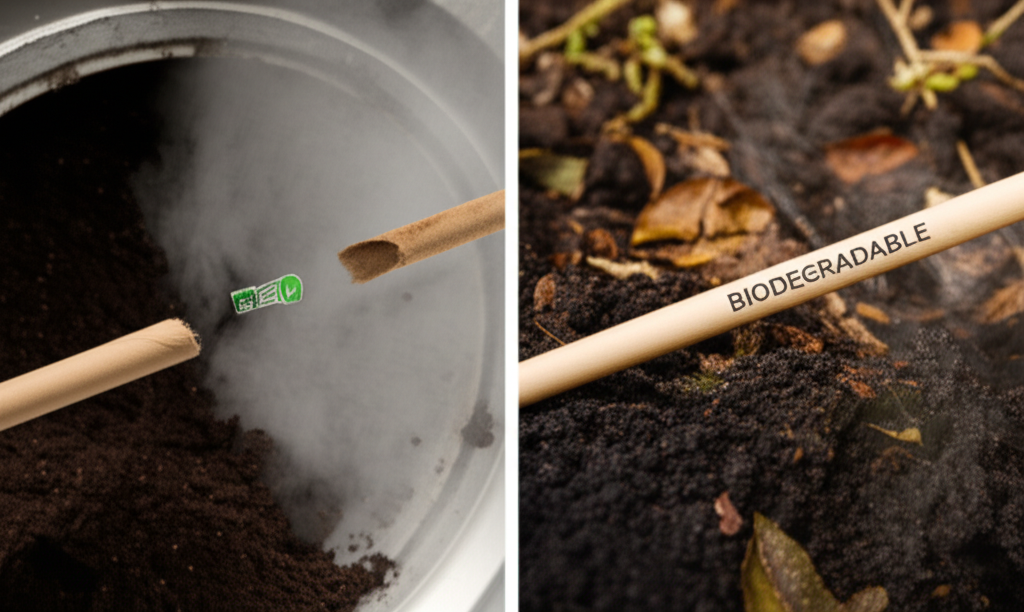
- Certification Logos: Products must prominently display trademarked certification logos such as BPI, Seedling, or OK Compost. These logos provide immediate visual confirmation of compliance to consumers, composters, and regulatory bodies.
- Prohibited Terms: Avoid misleading or unsubstantiated terms like “biodegradable” or “degradable” unless backed by full, specific certification for that claim. Laws are increasingly cracking down on vague “eco-friendly” claims without robust scientific backing.
- Consumer Clarity: Labels must clearly guide proper disposal, indicating whether the product is suitable for industrial or home composting. This clarity is vital, as misidentification often leads to compostable items being screened out and sent to landfills, negating their environmental benefit.
- Regional Specifics: Starting in 2024, Washington and Colorado, for example, will require bioplastic and bioplastic-lined items to meet ASTM standards, display a third-party certification logo, feature the word “Compostable,” and utilize specific coloring (green only in Colorado; green or brown in Washington) or symbols to differentiate them. For a comprehensive guide on proper disposal and identification of BPI-certified products, read our detailed playbook: What Do I Do With BPI Compostable?.
Regional Single-Use Plastic Bans & Their Impact on Compostable Straws
Distributors must track the nuances of regional single-use plastic bans, as some extend to “compostable” versions if local infrastructure is inadequate.
- Canada’s Federal Ban: While generally prohibiting most single-use plastic straws, Canada’s SOR/2022-138 includes exceptions for flexible plastic straws to ensure accessibility for individuals with disabilities or medical needs. These can be imported and sold in packages of 20 or more upon request, but typically not on public display.
- New Zealand Restrictions: As of July 2023, the general sale of single-use plastic drinking straws (including compostable and biodegradable plastic) is restricted.
- US State-Level: California’s AB-1884 limits plastic straw distribution, while New York City allows compostable paper/BPI-certified PLA upon request. The District of Columbia has an outright ban on single-use plastic straws.
Mini Case Study – British Columbia: By July 2024, British Columbia extended its ban to “hard to recycle” compostable plastics if local composting infrastructure is inadequate. This highlights a critical trend: even certified compostable products may face restrictions if the region lacks the necessary processing facilities. This variance emphasizes the need for distributors to conduct granular market research beyond federal regulations. Montreal’s Single-Use Plastics by-law also restricts compostable plastics in certain contexts.
Extended Producer Responsibility (EPR) Schemes for Imported Packaging
Extended Producer Responsibility (EPR) schemes are increasingly common globally, shifting the financial and operational burden of managing end-of-life packaging from municipalities to producers and, critically, importers.
- Producer Responsibility: In the EU and Canada, importers are often deemed “producers” and are therefore liable for the collection, sorting, and recycling or composting of the packaging they introduce to the market.
- Reporting Mandates: EPR requires registration with national schemes (e.g., LUCID in Germany, CITEO in France) and regular reporting on the quantity, type, and composition of packaging materials imported.
- Financial Contributions: Distributors typically must contribute financially to cover the costs of waste management infrastructure and operations.
Non-compliance with EPR schemes can result in significant customs delays, substantial fines, and legal challenges, making proactive registration and reporting essential.
Accurate labeling, understanding regional bans, and complying with EPR schemes are crucial for importing compostable straws.
Strategic Procurement & Supply Chain Due Diligence for Importing Compostable Straws
Achieving compliance is not a one-time check but an ongoing commitment to robust supply chain management. This starts with rigorous vetting of suppliers and a deep understanding of material options.
Vetting Suppliers for Certified Compostable Straws
The quality and compliance of your imported compostable straws are directly tied to the diligence of your supplier.
- Certification Verification: Always demand valid and current certificates for compostability (e.g., BPI, TÜV AUSTRIA, DIN CERTCO), food contact safety (FDA, LFGB), and chemical restrictions (PFAS-Free, BPA-Free, PLA-Free if applicable). Don’t just accept claims; ask for the official documents and verify them with the certifying body.
- Material Scrutiny: Verify the genuine material composition. Ensure that all components, including inks, adhesives, and any coatings, meet the necessary compostability and food safety standards. Some paper straws, for example, might have coatings that impede composting or contain PFAS. Adhesives typically comprise less than 5% of the total dried weight for the straw to be deemed compostable.
- Manufacturing Practices: Inquire about the supplier’s environmental footprint during production, including energy consumption, water usage, and waste management practices. Ethical sourcing of raw materials should also be a key consideration.
- Track Record: Suppliers with a history of cooperation with Fortune 500 companies often demonstrate more robust compliance frameworks and quality control processes, reducing your risk.
Material Options & Performance Considerations (ROI Potential)
The choice of material for compostable straws involves a trade-off between performance, cost, and specific environmental attributes.
| Feature | B2B Operational Impact | Compliance Note | ROI Potential |
|---|---|---|---|
| Paper Straws | Prone to sogginess, potential flavor impact. | Compliance varies; potential PFAS concern. | Lower initial cost, high volume sourcing. |
| PLA Straws | Plastic-like feel, good user experience. | Requires industrial composting (ASTM/EN). | Mid-cost, wide acceptance, improved satisfaction. |
| Sugarcane Bagasse Straws | Repurposes agricultural waste, durable. | Often home compostable (3-6 months); PLA-free options. | Higher cost, enhanced brand reputation & sustainability. |
| PHA Straws | Excellent durability, premium feel. | Considered “gold standard” for B2B sustainability. | Highest cost, market leadership, future-proof. |

- Emerging Materials: Innovation in compostable materials is rapid. New advancements, like lignin and citric acid straws (developed in February 2023), offer enhanced hydrostability and strength, surpassing traditional paper and even plastic straws in some functionalities. Starch-based straws (wheat, rice, corn) can offer improved mechanical strength and water resistance.
- Market Demand Shift: The overall demand for plant-based alternatives to single-use plastics has increased by 40% year-over-year (Eco-Business, 2023), alongside a similar surge in demand for reusable stainless steel and glass straws in commercial sectors. This highlights a clear market signal for sustainable options. For a deeper understanding of how adopting these solutions can provide a strategic advantage for businesses like hotels and airlines, explore our article on strategic advantages with individually wrapped compostable straws.
Ensuring Quality Control and Durability (Consumer Experience)
Consumer experience remains paramount, even for compliant products. A compostable straw that fails during use can undermine brand perception and customer satisfaction.
- Durability Testing: Conduct in-house tests for critical performance indicators such as sogginess, collapse resistance, and taste neutrality. For example, traditional paper straws can absorb up to 30% water in just 10 minutes, leading to user frustration.
- Key Performance Indicators: Prioritize safety, moisture resistance, and flavor neutrality. Research indicates that consumers dislike soggy straws, which directly impacts their perception of the beverage and, by extension, your brand.
- Impact on Business: Quality control directly impacts customer satisfaction, repeat business, and overall product perception. Investing in durable, high-performing compostable straws is an investment in your brand’s reputation.
Rigorous supplier vetting and understanding material performance are crucial for successful, compliant compostable straw procurement.
The Business Case for Compliant Importing Compostable Straws
For procurement managers, operations directors, sustainability officers, and supply chain executives, the decision to import compliant compostable straws transcends mere regulatory adherence. It is a strategic business imperative that offers quantifiable benefits.
- Elevate Brand Reputation: Aligning with the growing consumer preference for sustainable brands (over 70% favor them) enhances market perception, demonstrates corporate social responsibility, and builds customer loyalty. This translates into increased brand value and a stronger competitive position.
- Future-Proof Operations: Proactive compliance is the ultimate risk mitigation strategy. By staying ahead of evolving regulations, distributors can avoid costly fines, prevent customs delays that disrupt supply chains, and circumvent potential market access restrictions. This foresight ensures operational continuity and reduces unforeseen expenses.
- Enhance Customer Experience: Providing superior, compliant products that meet both performance expectations (e.g., durability, flavor neutrality) and environmental goals directly contributes to customer satisfaction. Happy customers mean repeat business and positive word-of-mouth, fostering organic growth.
- Drive Sustainability & Capture Market Share: Contributing to the circular economy by sourcing truly compostable products significantly reduces waste and lowers the carbon footprint across your supply chain. This commitment resonates with eco-conscious businesses and end-consumers, creating a compelling differentiator in a crowded market. As the global straight straw market continues its rapid shift, being a reliable provider of compliant, high-quality compostable options positions your business to capture a larger share of this expanding, values-driven market.
Importing compliant compostable straws elevates brand reputation, future-proofs operations, enhances customer experience, and drives market share.
Conclusion: Master Importing Compostable Straws for Sustainable Success
Navigating the intricate and rapidly evolving regulations for importing compostable straws is no longer optional; it’s a strategic imperative for any forward-thinking B2B distributor. The era of vague “eco-friendly” claims is over, replaced by a demand for rigorous, verifiable compliance. By deeply understanding global standards like ASTM D6400 and EN 13432, securing essential third-party certifications such as BPI and TÜV AUSTRIA, meticulously adhering to food contact material and PFAS restrictions, and performing rigorous supply chain due diligence, distributors can transform regulatory challenges into significant market advantages.
This meticulous approach not only safeguards your business from compliance risks, financial penalties, and supply chain disruptions but also positions you as a trusted leader in sustainable procurement. By consistently delivering high-quality, genuinely compostable products that meet both regulatory demands and consumer expectations, you will elevate your brand, future-proof your operations, and secure your market position in an increasingly eco-conscious global economy.
Elevate your supply chain and secure your market leadership: Request a compliant-ready compostable straw sample pack today to ensure your products meet global standards and capture the growing demand for certified sustainable solutions.
Mastering compostable straw import compliance is a strategic imperative for sustainable business success and market leadership.
Frequently Asked Questions (FAQ)
Compostable straws break down completely into non-toxic components under specific industrial conditions, leaving no harmful residues.
Biodegradable straws simply break down over an undefined time, often leaving microplastics, making ‘compostable’ the only truly sustainable choice for hospitality.
Ensure suppliers provide documentation proving compliance with FDA Title 21 CFR Parts 174-179, confirming materials are safe and do not leach harmful substances.
Many compliant straws are explicitly marketed as ‘US FDA Approved.’
PFAS are ‘forever chemicals’ used for water/grease resistance, linked to health concerns.
Many states and certifications (like BPI) now restrict them.
Prioritizing PFAS-free straws mitigates regulatory and reputational risks for your hospitality clients.
Always demand valid third-party certifications like BPI (ASTM D6400) for North America or TÜV AUSTRIA/DIN CERTCO (EN13432) for Europe.
Verify these certificates directly with the certifying body to ensure authenticity.
Some regional bans (e.g., Canada, New Zealand, specific US states) restrict even compostable straws if local infrastructure is inadequate or for specific accessibility reasons.
Hotels and airlines must research local regulations beyond federal laws.