Cât durează materialul compostabil BPI pentru a se descompune? Un ghid strategic pentru liderii B2B
De către un strateg senior de conținut pentru sustenabilitate B2B
Impulsul global pentru sustenabilitate a transformat peisajul operațional pentru întreprinderile B2B. Cu o conștientizare sporită a mediului și o rețea din ce în ce mai complexă de reglementări, companiile sunt supuse unei presiuni imense pentru a adopta practici mai ecologice. În fruntea acestei schimbări se află cererea tot mai mare de materiale compostabile, în special cele certificate de cătreInstitutul pentru produse biodegradabile (BPI). BPI certification serves as a vital assurance for environmental claims, but for procurement managers, operations directors, sustainability officers, and supply chain executives in the hospitality and foodservice industries, understanding the precise breakdown timelines and conditions for BPI-certified materials is paramount. Ignoring this crucial detail can lead to compliance risks, operational inefficiencies, and missed opportunities in a rapidly evolving market.
Consider the commercial implications: the global compostable packaging market, valued at USD 55.53 billion in 2024, is projected to reach USD 89.85 billion by 2032, demonstrating a robust Compound Annual Growth Rate (CAGR) of 6.20% from 2025 to 2032 (Source:Grand View Research, 2024). Această creștere reflectă nu doar o tendință, ci și o recalibrare fundamentală a lanțurilor de aprovizionare către circularitate. Afacerile care înțeleg în mod clar mecanismele compostabilității BPI sunt mai bine poziționate pentru a satisface această cerere, pentru a reduce costurile de eliminare a deșeurilor și pentru a-și spori reputația mărcii. Acest ghid oferă informații esențiale, bazate pe date, pentru factorii de decizie B2B cu privire la performanța de compostare a materialelor certificate BPI, ajutându-vă să navigați cu încredere în acest imperativ strategic.
Înțelegerea defalcării materialelor compostabile BPI este crucială pentru întreprinderile din sectorul ospitalității și al serviciilor alimentare pentru a asigura conformitatea și a profita de oportunitățile de pe piață.
Decodificarea timpilor de defalcare a materialelor compostabile BPI pentru operațiuni B2B
BPI-certified compostable materials are not merely “biodegradable” in a vague sense; they are meticulously engineered to break down under specific, controlled conditions found in industrial composting facilities. This distinction is critical for B2B operations, as it directly impacts waste management strategies and environmental claims. The certification process mandates adherence to rigorous American Society for Testing and Materials (ASTM) standards, primarily ASTM D6400 and ASTM D6868.
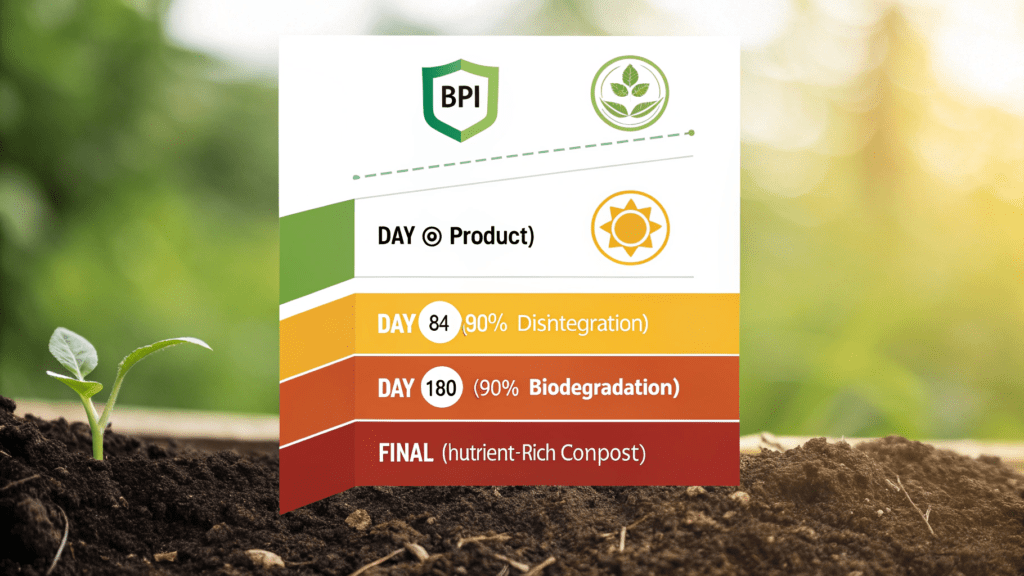
These standards stipulate clear performance benchmarks. For physical disintegration, BPI-certified products are required to break down into small fragments (less than 2mm) within84 days (12 weeks)when subjected to industrial composting conditions. This ensures that the material becomes indistinguishable from compost. Beyond physical disintegration, full biodegradation—the conversion of organic carbon into carbon dioxide, water, inorganic compounds, and biomass—must occur to at least 90% within180 days (6 months). Crucially, this process must leave no toxic residues or heavy metals, ensuring the resulting compost is safe and beneficial for soil.
Adhering to ASTM Standards: D6400 and D6868 Requirements
The ASTM D6400 standard specifically addresses compostable plastics, while ASTM D6868 applies to composite materials, such as those combining bioplastics with paper or fiber. Both standards are foundational to BPI certification, dictating how products must perform in an industrial composting environment. They mandate a minimum of 90% biodegradation of organic carbon into CO2 within the 180-day timeframe, demonstrating that the material is truly consumed by microorganisms. Furthermore, the 90% physical disintegration requirement by 84 days ensures the material does not remain as problematic fragments in the finished compost. A key aspect of these standards is the prohibition of toxic residues or heavy metals remaining post-composting, guaranteeing the integrity and safety of the final compost product. This rigorous testing and certification process helps businesses avoid misleading “greenwashing” claims and ensures genuine environmental impact.
Rolul critic al instalațiilor industriale de compostare
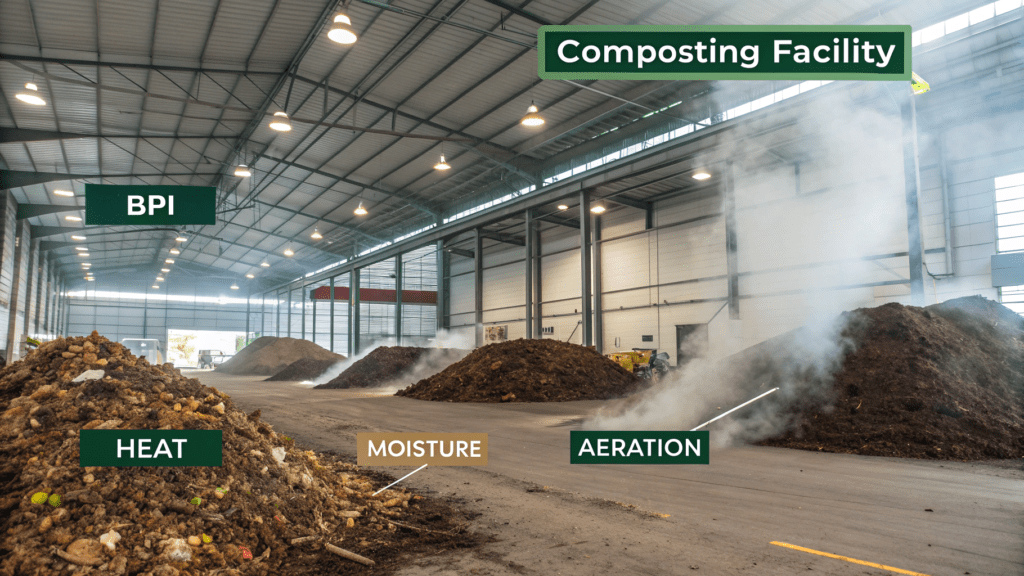
Este vital ca părțile interesate B2B să înțeleagă că produsele certificate BPI sunt concepute în mod explicit pentru instalațiile de compostare industrială, nu grămezi de compost din curte sau gropi de gunoi generale. Instalațiile industriale oferă condiții optime - căldură ridicată (de obicei 150-160 ° F), niveluri de umiditate controlate și aerare constantă - care sunt esențiale pentru accelerarea activității microbiene și pentru descompunerea eficientă. Aceste medii controlate asigură că materialele certificate BPI se descompun în conformitate cu termenele prevăzute.
Fără acces la astfel de facilități, chiar și produsele certificate BPI s-ar putea să nu se descompună așa cum s-au prevăzut, potențial ajungând în gropile de gunoi unde se pot descompune în mod anaerob și pot produce metan, un gaz cu efect de seră puternic. Timpul efectiv necesar pentru ca produsele să se defecteze poate varia, de asemenea, în practică, variind de la 30 la 190 de zile, în funcție de factori specifici instalației, cum ar fi practicile de management și compoziția și grosimea materialului specific. Această variabilitate subliniază importanța unei infrastructuri robuste de compostare, o provocare semnificativă în multe regiuni din America de Nord și Europa.
Materialele certificate BPI se descompun în termen de 84-180 de zile în condiții de compostare industrială, cruciale pentru gestionarea eficientă a deșeurilor B2B.
Imperativul strategic: Materiale compostabile certificate BPI și conformitate
Adoptarea materialelor certificate BPI este mai mult decât un gest de mediu; este un imperativ strategic de afaceri care asigură alinierea cu mandatele emergente de sustenabilitate și protejează reputația mărcii. Marca de certificare BPI validează afirmațiile de mediu, oferind verificarea de la terți că produsele îndeplinesc standarde științifice stricte. Acest lucru este deosebit de crucial, deoarece organismele de reglementare și consumatorii examinează din ce în ce mai mult inițiativele corporative de sustenabilitate, în special în sectoarele ospitalității și serviciilor alimentare, unde articolele de unică folosință sunt predominante.
Dincolo de performanța de defecțiune, certificarea BPI include și măsuri de protecție critice împotriva substanțelor chimice dăunătoare. De la 1 ianuarie 2020, BPI a cerut ca toate articolele certificate să fie sub 100 de părți per milion (ppm) fluor total, asigurând efectiv că nu sunt prezente PFAS (substanțe per- și polifluoroalchile) adăugate intenționat. Această măsură proactivă atenuează riscurile legale și reputaționale asociate cu substanțele chimice persistente. De asemenea, este important să reiterăm că „compostabil” (cu timpul și condițiile definite de defalcare) diferă semnificativ de termenul general și adesea nedefinit „biodegradabil”, oferind un standard mult mai înalt de responsabilitate pentru mediu. Pentru a aprofunda aceste distincții, explorați ghidul nostruBPI compostabil vs. biodegradabil: Ghid de durabilitate.
Navigarea peisajelor de reglementare și certificare
Peisajul de reglementare în jurul materialelor compostabile evoluează rapid, punând atât provocări, cât și oportunități pentru afaceri. În SUA, Programul Național Organic (NOP) al Departamentului Agriculturii (USDA) dezbate în prezent dacă să includă bioplasticele în compostul organic certificat, o decizie care va avea un impact profund asupra industriei de compostare. În mod similar, legile privind responsabilitatea extinsă a producătorului (EPR) câștigă teren în America de Nord, mai multe provincii canadiene și patru state din SUA au adoptat o astfel de legislație. BPI pledează în mod activ pentru ca aceste fonduri EPR să sprijine în mod specific extinderea infrastructurii de compostare și a educației publice, mai degrabă decât să fie redirecționate către alte fluxuri de gestionare a deșeurilor.
În plus, confuzia consumatorilor cu privire la eliminarea adecvată rămâne un obstacol semnificativ. Studiile arată că aproape o treime dintre consumatorii chestionați plasează în mod eronat ambalajele compostabile în coșurile de reciclare (Sursa:Reciclarea resurselor, 2023). Pentru a combate acest lucru, BPI, în colaborare cu Consiliul de Compost din SUA (USCC), lucrează pentru a dezvolta principii pentru o etichetare clară și standardizată, inclusiv afișarea proeminentă a mărcii BPI. Etichetarea clară este esențială pentru minimizarea contaminării și pentru a asigura că articolele compostabile ajung la căile de sfârșit de viață prevăzute, în special în medii cu volum mare, cum ar fi hotelurile și cantinele.
Certificarea BPI asigură conformitatea și atenuează riscurile, esențiale pentru ospitalitatea și serviciile alimentare care navighează în evoluția reglementărilor de durabilitate.
Quantifying Value: Operational Impact of BPI Compostable Solutions
Integrating BPI-certified compostable materials into your supply chain offers tangible operational benefits that extend beyond environmental compliance. A primary advantage is the reduction in landfill waste, which directly translates into lower disposal costs for businesses. As landfill tipping fees continue to rise and regulatory pressures mount, diverting waste from landfills becomes an increasingly attractive economic proposition for hotels, restaurants, and catering services.
However, the path is not without challenges. Contamination from non-compostable materials remains a significant hurdle for composting facilities, costing some up to 17% of their total operating expenses in contaminant removal (Source:US Composting Council, 2023). This issue highlights the critical need for effective collection systems and consumer education within hospitality and foodservice settings. Moreover, the insufficient industrial composting infrastructure in many regions presents logistical hurdles, requiring businesses to carefully assess local capabilities when implementing compostable solutions. Despite these challenges, adopting BPI-certified solutions significantly enhances a company’s corporate social responsibility (CSR) profile, strengthens brand image, and improves market positioning in an increasingly eco-conscious economy.
| Caracteristică | Impact operațional B2B | Notă de conformitate | Potențial de rentabilitate a investiției |
|---|---|---|---|
| Certificare BPI | Ensures proper end-of-life disposal in industrial settings; simplifies waste stream management for hospitality. | Meets ASTM D6400/D6868; avoids harmful residues, supporting organic compost standards. | Improved brand image; supports sustainability goals, attracting eco-conscious customers. |
| Material Choice (e.g., PLA) | Versatile for various packaging and foodservice applications (e.g., rigid containers, films). | Must achieve 90% disintegration (84 days) and 90% biodegradation (180 days). | Accesses growing market segments (Food & Beverage: 48.7% of global market by 2025); broad applicability. |
| Compostaj industrial | Requires specific collection and processing logistics; optimizes decomposition process. | BPI-certified products depend on these controlled conditions for effective breakdown. | Diversion from landfill saves disposal costs; reduces methane emissions, contributing to carbon reduction targets. |
| PFAS-Free Commitment | Ensures product safety and purity; avoids potential regulatory scrutiny and liability. | BPI requires less than 100ppm total fluorine since January 2020. | Mitigates legal and reputational risks; builds consumer trust and differentiates offerings. |
Real-World Performance: Insights from the Composting Consortium Study
The effectiveness of BPI-certified materials in real-world industrial composting environments has been rigorously validated. A groundbreaking large-scale field study, conducted in April 2024 by the Composting Consortium (an initiative of Closed Loop Partners) in North America, provides compelling evidence. This study rigorously tested over 23,000 units of certified food-contact compostable packaging across 10 diverse U.S. composting facilities, representing various operational parameters.
The findings were highly encouraging: compostable plastic packaging achieved an impressive 98% disintegration on average, significantly exceeding the industry threshold of 90%. Similarly, compostable fiber packaging demonstrated 83% disintegration on average, meeting established industry benchmarks. This study confirms that when BPI-certified packaging is processed in facilities meeting reasonable operational parameters, it breaks down successfully, underscoring the reliability of the BPI standard in practical applications. This real-world validation should instill confidence in B2B decision-makers in hospitality and foodservice considering a transition to compostable solutions. To understand more about managing this transition effectively, consider reviewing ourB2B Playbook for Sustainable Waste Management.
BPI-certified solutions offer tangible operational benefits, including reduced landfill costs and enhanced CSR profile.
Propelling Forward: The Market Outlook for BPI Compostable Materials
The trajectory for BPI compostable materials is one of significant expansion, fueled by increasing consumer demand, regulatory drivers, and continuous innovation. The global compostable packaging market is projected to reach USD 89.85 billion by 2032, exhibiting a robust 6.20% Compound Annual Growth Rate (CAGR) from 2025-2032. This growth is a clear indicator that businesses prioritizing compostable solutions are aligning with a dominant market trend.
Polylactic Acid (PLA), derived from renewable agricultural sources like corn starch and sugarcane, is poised to remain a leading material, forecast to hold a substantial 36.4% market share by 2025 in the compostable plastic packaging segment. Its versatility in applications, from rigid containers to flexible films, positions it as a go-to material for various industries, especially the food and beverage sector, which is expected to lead end-use demand with a 48.7% share by 2025. Key industry leaders like Amcor, Mondi Group, NatureWorks, and Eco-Products are actively investing in and expanding their compostable offerings, signaling a broader industry commitment.
Driving Adoption: Innovation and Infrastructure Investment
The escalating consumer demand for sustainable products is actively fueling the shift towards a circular bioeconomy model, where materials are designed to be reused, recycled, or composted. Material science advances are continuously yielding more robust and versatile compostable solutions. Beyond established materials like PLA, innovative new options are emerging, including Polyhydroxyalkanoates (PHA) – polymers produced by microbial fermentation – and even mycelium-based packaging derived from mushroom root structures, offering eco-friendly alternatives to traditional plastic foams. These innovations are expanding the functional capabilities of compostable materials, matching those of conventional plastics in many applications relevant to hospitality and foodservice.
Technological integration, such as the application of Artificial Intelligence (AI) and Machine Learning (ML) in certification processes, is set to enhance transparency and efficiency in verifying biodegradability. Crucially, meeting the growing demand and policy goals hinges on significant investment in composting infrastructure. Initiatives like the US Composting Infrastructure Coalition (USCIC) are working to establish widespread composting capabilities, promoting legislation and grants to fund the necessary expansion. This commitment to infrastructure development is paramount for B2B enterprises to fully realize the environmental and economic benefits of BPI-certified materials. For hospitality businesses looking to leverage BPI certification for their sustainability goals, our guide onBPI Compostable Certification & Hospitality Sustainabilityoferă perspective valoroase.
The compostable materials market is expanding, driven by innovation and crucial infrastructure investments for B2B adoption.
Competitive Advantage & Business Case
For B2B decision-makers in hospitality and foodservice, embracing BPI-certified compostable materials translates into a compelling competitive advantage and a robust business case. Beyond the direct environmental benefits, there are quantifiable gains. By reducing landfill waste, companies can achieve significant cost savings on disposal fees, which can amount to a substantial portion of operational expenses. Furthermore, compliance with evolving regulations, such as the EU Single-Use Plastics Directive and emerging US EPR laws, mitigates the risk of fines and legal challenges, preserving brand equity.
The market share opportunity is substantial: with the global compostable packaging market poised for significant growth, early adopters gain a first-mover advantage. Companies that demonstrably commit to BPI-certified solutions can attract the growing segment of eco-conscious consumers and B2B partners, enhancing brand value and fostering deeper customer loyalty. This strategic pivot can also lead to improved supplier relationships with innovative material providers and the potential for new revenue streams through sustainable product lines. The shift to compostable packaging is not just about reducing environmental footprint; it’s about positioning your business for future market leadership and resilience in a sustainability-driven economy.
Adopting BPI-certified materials offers a competitive edge, reducing costs, ensuring compliance, and enhancing brand value.
Concluzie
BPI-certified compostable materials offer a vital, scientifically backed pathway to achieving sustainable operations. Understanding their precise breakdown timelines—physical disintegration within 84 days and full biodegradation within 180 days under industrial composting conditions—is foundational for effective B2B waste management and sustainability strategies. Businesses that prioritize BPI certification gain not only compliance assurance and mitigated environmental risks but also a clear competitive advantage in a rapidly expanding eco-conscious market.
Transform your supply chain for a sustainable future. Partner with certified BPI compostable material suppliers to achieve your environmental goals and enhance operational efficiency today.
Embrace BPI-certified compostable materials to achieve sustainability goals and gain a competitive edge in the B2B market.
Contactați-ne pentru soluții durabile
Întrebări frecvente (FAQ)
Q: How do BPI-certified materials benefit my hotel’s waste management costs?
A: By diverting BPI-certified compostable items from landfills to industrial composting facilities, hotels can significantly reduce landfill tipping fees. This also helps avoid potential fines associated with increasing waste disposal regulations, leading to direct cost savings and improved operational efficiency.
Q: What are the key differences between “compostable” and “biodegradable” for foodservice packaging?
A: “Compostable” (especially BPI-certified) means a product will break down into natural elements in a specific timeframe (84-180 days) under industrial composting conditions, leaving no toxic residue. “Biodegradable” is a broader, less regulated term that doesn’t guarantee breakdown within a specific timeframe or environment, often leading to confusion and potential greenwashing.
Q: How can a large-scale catering operation ensure proper disposal of BPI-certified materials?
A: Catering operations should implement clear, color-coded waste bins for compostables, provide staff training on proper sorting, and partner with local industrial composting facilities. Clear labeling on packaging (e.g., the BPI logo) also helps minimize contamination from guests.
Q: Are BPI-certified products safe for food contact in restaurants?
A: Yes, BPI certification includes strict requirements for product safety. Since January 2020, BPI has mandated that all certified items contain less than 100 ppm total fluorine, effectively ensuring no intentionally added PFAS chemicals are present, making them safe for food contact.
Q: What is the role of industrial composting facilities in the breakdown of BPI materials?
A: Industrial composting facilities provide the high heat, controlled moisture, and aeration necessary for BPI-certified materials to break down efficiently within the specified 84-180 day timeframe. Without these controlled conditions, the materials may not decompose as intended.